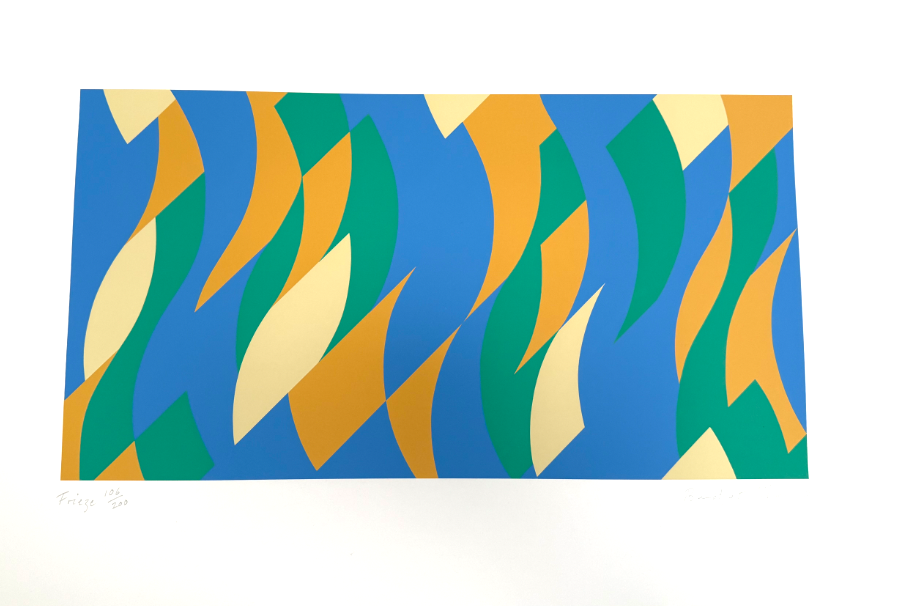
Frieze, 2000
Silkscreen on paper
47.6 cm X 72.4 cm
Signed
£ 0
VAT may be added as applicable to this price
All-inclusive price
Up to 1 year insurance included on all artworks.
Due diligence checked
We check condition, authenticity and provenance.
Buyer protection
Multiple secure payment options, 14-day money back guarantee & 24hr cancellation policy.
Artist
Bridget Riley
Title
Frieze
Dimensions
47.6 cm X 72.4 cm
Year
2000
Material
Silkscreen on paper
Description
Frieze (2000) belongs to Bridget Riley’s sustained investigation into optical perception and the dynamics of visual rhythm. Working within the medium of silkscreen, Riley translates her painterly concerns into a graphic format that emphasises clarity, precision, and repeatability, while maintaining the perceptual complexity central to her practice.…
Frieze (2000) belongs to Bridget Riley’s sustained investigation into optical perception and the dynamics of visual rhythm. Working within the medium of silkscreen, Riley translates her painterly concerns into a graphic format that emphasises clarity, precision, and repeatability, while maintaining the perceptual complexity central to her practice.
The composition is structured through a sequence of vertical bands that generate a continuous lateral movement across the surface. Through calibrated shifts in colour and proportion, the image produces a sense of vibration and spatial instability, where figure and ground remain in flux. The eye is guided along the frieze-like arrangement, yet never settles, as the visual field resists fixed interpretation. The horizontal extension implied by the frieze format suggests a continuation beyond the edges of the paper, reinforcing the idea of the composition as a fragment of a larger, ongoing sequence.
Riley’s use of repetition operates not as redundancy but as a means of activating perception. The work foregrounds the act of seeing as a temporal process, unfolding through duration rather than instant recognition. In this way, Frieze (2000) engages with broader questions of how visual information is organised and experienced, positioning perception itself as the primary subject of the work.
The composition is structured through a sequence of vertical bands that generate a continuous lateral movement across the surface. Through calibrated shifts in colour and proportion, the image produces a sense of vibration and spatial instability, where figure and ground remain in flux. The eye is guided along the frieze-like arrangement, yet never settles, as the visual field resists fixed interpretation. The horizontal extension implied by the frieze format suggests a continuation beyond the edges of the paper, reinforcing the idea of the composition as a fragment of a larger, ongoing sequence.
Riley’s use of repetition operates not as redundancy but as a means of activating perception. The work foregrounds the act of seeing as a temporal process, unfolding through duration rather than instant recognition. In this way, Frieze (2000) engages with broader questions of how visual information is organised and experienced, positioning perception itself as the primary subject of the work.