
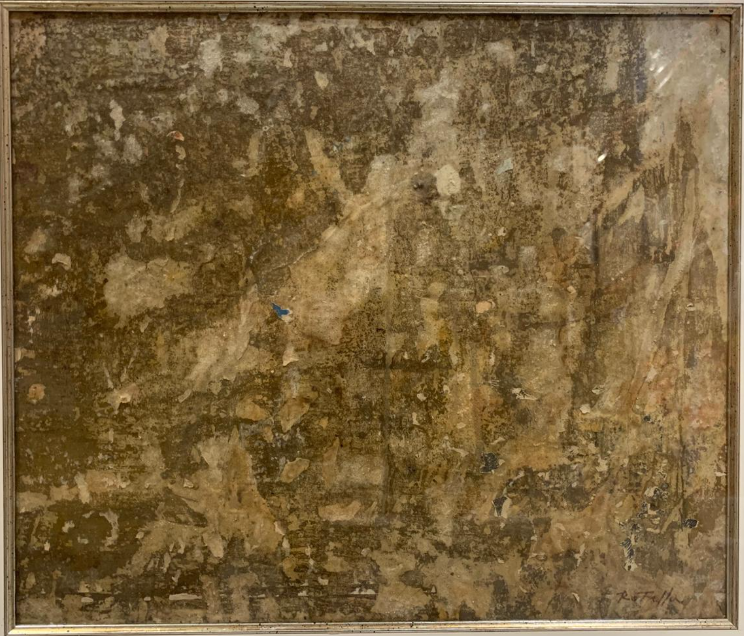
Rosso Romano, 1956
Retro d’affiches on cardboard
33.5 cm X 40 cm
Signed
£ 0
VAT may be added as applicable to this price
All-inclusive price
Up to 1 year insurance included on all artworks.
Due diligence checked
We check condition, authenticity and provenance.
Buyer protection
Multiple secure payment options, 14-day money back guarantee & 24hr cancellation policy.
Artist
Mimmo Rotella
Title
Rosso Romano
Dimensions
33.5 cm X 40 cm
Year
1956
Material
Retro d’affiches on cardboard
Description
Rosso Romano (1956) forms part of Mimmo Rotella’s early décollage practice, a body of work that
emerged from his engagement with the visual language of post-war urban environments. Rathe…
Rosso Romano (1956) forms part of Mimmo Rotella’s early décollage practice, a body of work that
emerged from his engagement with the visual language of post-war urban environments. Rather
than constructing images through additive means, Rotella works subtractively, tearing and
reassembling layers of found posters to create compositions that sit between abstraction and
figuration. In these early works, fragments of typography, colour, and image are partially revealed
and obscured, allowing the surface to operate as both material and image simultaneously.
The composition is built through successive layers of paper, distressed and weathered through both
process and time. Rotella’s gestures—ripping, peeling, and exposing—introduce a physicality that
disrupts any singular reading of the image, replacing clarity with texture and fragmentation. The
resulting surface is dense and tactile, where colour emerges unevenly and visual information is
dispersed across the work rather than centrally organised.
emerged from his engagement with the visual language of post-war urban environments. Rather
than constructing images through additive means, Rotella works subtractively, tearing and
reassembling layers of found posters to create compositions that sit between abstraction and
figuration. In these early works, fragments of typography, colour, and image are partially revealed
and obscured, allowing the surface to operate as both material and image simultaneously.
The composition is built through successive layers of paper, distressed and weathered through both
process and time. Rotella’s gestures—ripping, peeling, and exposing—introduce a physicality that
disrupts any singular reading of the image, replacing clarity with texture and fragmentation. The
resulting surface is dense and tactile, where colour emerges unevenly and visual information is
dispersed across the work rather than centrally organised.
