

Amoako Boafo market analysis. Is now a good moment to sell? (March 2026)
Last updated: 16 March 2026.
If you own an Amoako Boafo, the dilemma is no longer validation. Belvedere’s Proper Love, Gagosian’s London exhibition, a Venice museum show in 2026, and Tate’s acquisition of Blank Stare have already supplied the major programmes.[2][5][8][9] What matters now is harder: does your work belong to the Yellow Blanket end of the market, the serious paper tier, or the standard portrait barometer that buyers now price with much more discipline? That difference determines whether you should sell publicly, sell privately, or wait. This is a placement market.
Data note. The figures below reflect public auction results for unique Boafo works offered between 13 February 2020 and 7 March 2026, from The Lemon Bathing Suit through Abena, and are expressed in US dollars for comparability. They describe the public tape, not the whole market. Private sale activity, condition, provenance, exhibition history, and paperwork can materially shift where a specific work sits.
→ Start with a valuation. Click here and get a price range in about 60 seconds.
In this article
- The sale that set the ceiling
- How the Boafo market actually works
- Why private sale is not a fallback here
- Sell now or wait
- How to start with Artscapy
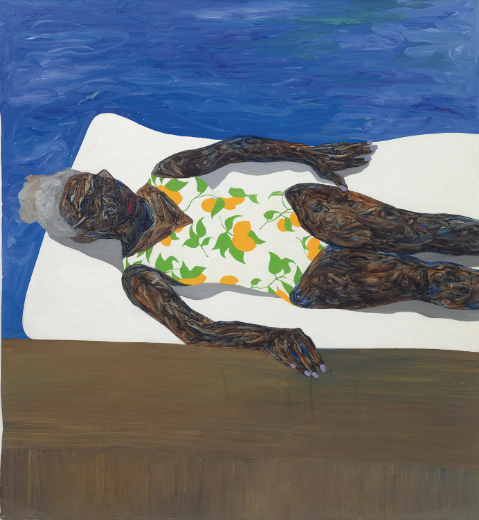
Amoako Boafo, The Lemon Bathing Suit, 2019. Image: © Sothebys
The sale that set the ceiling
Yellow Blanket made about US$1.55 million in Shanghai in March 2022. That was not just a record. It told buyers in Shanghai, London, and New York that a large Boafo portrait with scale and colour authority could behave like a trophy object, not merely a breakout lot. The signal was reinforced quickly: Orange Shirt sold the same day for about US$1.20 million, and Yellow Dress reached about US$819,000 in New York two months later. After that, the market stopped asking whether Boafo had a ceiling and started asking how many works could live near it.
The answer, with hindsight, was: not many. In September 2023, Blue Girl and Bricks was tested in Shanghai at a US$1.5–2.5 million estimate and failed to sell. That is the hinge in this market. Boafo’s validation held; indiscriminate trophy pricing did not.
How the Boafo market actually works
From The Lemon Bathing Suit in February 2020 to Abena in London in March 2026, Boafo’s public market has been liquid when the right works are offered at believable levels. Across 84 unique lots, about 94% sold once withdrawals are excluded. Buyers still engage; they are simply far more selective than the 2021 headlines suggest.
What changed is supply. The difference between the 2020 London/New York breakout and the current London/Vienna tape is that sold volume fell from 27 works in 2020 to 6 in 2025. That matters because high sell-through here does not mean the market is broad; it means houses are bringing fewer Boafo works to auction, and owners are already exercising more routing discipline.
The central benchmark is now much lower than the peak imagination around the artist. Across unique works, the median sale is about US$225,000. Since the start of 2024, the public ceiling has been only about US$293,000, mostly through London and New York day-sale territory rather than through the Shanghai-style trophy theatre that produced Yellow Blanket. This market still clears; it just clears at a different altitude.
Within canvas painting, scale is the first hierarchy. Boafo canvases above roughly 2 square metres have a median around US$479,000, while smaller canvases sit nearer US$135,000. If you own a large early portrait with physical presence—closer in ambition to Purple on Red or Tonica and Adia than to a routine standard bust—you are not in the same pricing lane as the lower public barometer.
Support matters almost as much as scale, and Boafo is unusually clear on this point. Joined-sheet paper compositions carry a median around US$291,000, while single-sheet paper works sit nearer US$163,000. Yellow Dress and The Shadow of Imana helped establish that ambitious paper works can behave like major compositions, whereas smaller single-sheet papers are a distinct and lower tier. That distinction is useful when deciding whether to sell a paper work privately or publicly.
The cleanest public barometer is the standard-format Untitled oil-on-canvas portrait that cycled repeatedly through Christie’s, Phillips, and Sotheby’s. Twelve examples appear in the tape. This is the cluster bidders can compare quickly when assessing whether Boafo sentiment is warming or cooling.
That barometer has repriced sharply. The cluster reached about US$655,000 at the top in June 2021, but a comparable example sold for about US$65,000 in New York in May 2024. The implication is clear: a generic Boafo premium has gone. Buyers now pay for image strength, date, scale, support, and routing, not simply for authorship.
The deeper theme underneath this market is recognition. Boafo’s best works stage self-possession through fingertip-built flesh, frontal presence, and the deliberate centring of Black subjectivity; that reading is reinforced by institutional and gallery programmes.[1][2][5][6][7] The works that hold attention best are those in which that charge is immediately legible, not those relying on residual momentum from 2021.
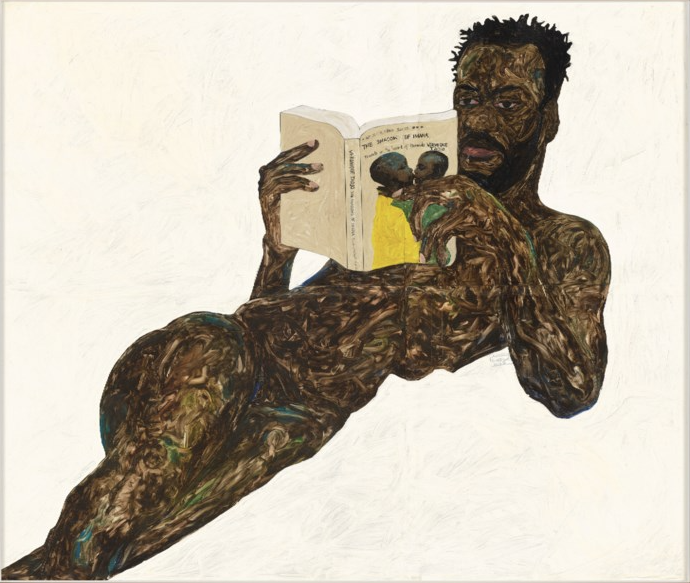
Amoako Boafo, The Shadow of Imana, 2018. Image: © Christie’s
Why private sale is not a fallback here
Private sale makes structural sense in Boafo’s market because the public tape now contains two very different stories at once: historical trophy benchmarks such as Yellow Blanket, and a recent ceiling below US$293,000. If your work sits nearer the first than the second, a public auction can anchor it to the wrong part of the market before the right buyers have focused. Private placement allows control over audience, pricing discipline, and timing.
That logic is stronger because Boafo’s ecosystem is now broader than the saleroom. Gagosian has built the recent exhibition programme, while Mariane Ibrahim and Gallery 1957 continue to represent the artist; Belvedere staged Europe’s first museum exhibition, Wooyang held the first Asian institutional solo, Venice follows in 2026, and Tate has already acquired an oil on paper.[2][3][4][5][7][8][9] If you own a strong paper work or a major early canvas, that network matters. It implies the right buyer may be thinking institutionally, not just opportunistically.
This broader pattern is particularly relevant given the structure of the market. Private sales through auction houses rose in 2024 even as public auction sales fell.[10] Christie’s reported that private sales accounted for 24% of its 2025 global sales.[12] In the 2025 collecting survey, a substantial share of transaction value among high-net-worth buyers moved through dealers.[11] Serious collectors are already comfortable operating outside the public auction tape.
In Boafo, this matters because paper works are not automatically secondary, and standard-format portraits are not automatically scarce. Tate’s acquisition of Blank Stare, an oil on paper, reinforces that serious works on paper can carry institutional weight.[9] Private sale is therefore especially rational where a work needs to be understood through programme, provenance, and image quality rather than reduced to a narrow auction comparable.
Paperwork is part of that control. A clear invoice trail from Gagosian, Mariane Ibrahim, Gallery 1957, or another primary placement, together with exhibition history, loan records, and any original certificate of authenticity, helps position a work within the correct comparable set rather than the generic Boafo barometer.[2][3][4]
Sell now or wait
Sell now if your work already sits in the recognised top lane
Sell now if you own a work that already reads as a premium Boafo object: a large canvas with real scale, a joined-sheet paper composition, or a paper work with particularly strong image quality and provenance. These tiers are not interchangeable with the standard portrait barometer. Large canvases above 2 square metres carry a median around US$479,000, and joined-sheet paper compositions around US$291,000. At the same time, the institutional calendar continues to expand.[5][7][8][9] That creates a rational basis to act—but to do so with control.
If your work sits closer to Yellow Blanket, White on White, or Red Dress than to the standard Untitled barometer, begin with private placement before accepting auction as the default. The recent public ceiling remains around US$293,000, and a controlled sale can prevent misalignment with the wrong segment of the market.
Wait if your work still needs its story improved
Wait if your work is likely to be read through the barometer rather than the ceiling. The signal is straightforward: the standard-format Untitled cluster reached about US$655,000 in 2021, but a comparable example sold for about US$65,000 in 2024. This is not a market in which weak provenance, ordinary image quality, or uncertain paperwork should be exposed to auction.
Waiting only makes sense if it changes how the work is read. An exhibition loan, a condition report, strengthened provenance, or a clean invoice trail back to Gagosian, Mariane Ibrahim, or Gallery 1957 can materially affect routing.[2][3][4] If none of that is likely, waiting becomes speculative. The more grounded approach is to establish a realistic price range and choose the appropriate channel deliberately.
The conclusion is straightforward. Boafo is fully validated, but his secondary market now distinguishes clearly between trophy works, serious papers, and barometer portraits. Sell now if your work already sits in the segment buyers actively compete for; wait only if time will materially improve how the work is positioned and understood.
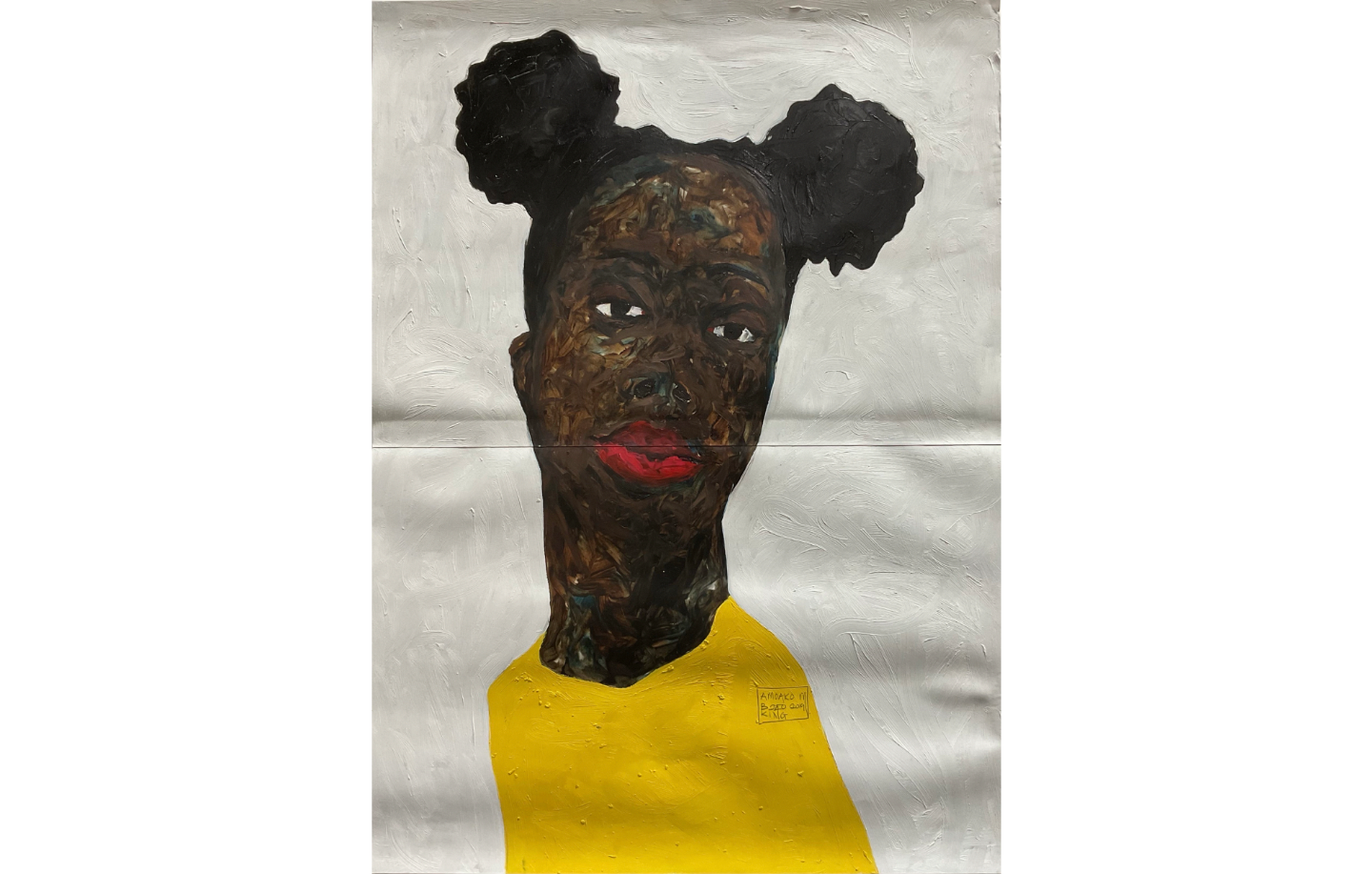
Amoako Boafo, Girl in yellow, 2019. Image: © Amoako Boafo
How to start with Artscapy
- Start with a 60-second estimate. It is instant and grounded in auction data refreshed every 24 hours. Your work is benchmarked against relevant Boafo results, then assessed within the correct market tier.
- Pick your path.
- Choose Fast Sale if speed matters, or Maximise Returns if strategy is the priority. Where appropriate, request purchase offers within 48 hours with 0% seller fee.
- Move only when the route fits the work.
- Fast Sale: receive a non-binding offer in 1–3 working days, where eligible.
- Maximise Returns: choose private placement, targeted auction, or a hybrid route based on the work’s characteristics.
- Close cleanly.
- The process remains straightforward: 0% seller commission, transparent costs, and escrow-protected transactions. Payout is made within 7 days of collection, with Fast Sale payouts initiated the same day once the work is received.
Sources and references
[1] “Amoako Boafo.” Gagosian, artist page, accessed 16 March 2026.
[2] “Amoako Boafo: I Do Not Come to You by Chance.” Gagosian, 24 March 2025, accessed 16 March 2026.
[3] “Amoako Boafo.” Mariane Ibrahim, artist page, accessed 16 March 2026.
[4] “Amoako Boafo.” Gallery 1957, artist page, accessed 16 March 2026.
[5] “Amoako Boafo: Proper Love.” Belvedere Museum, 25 October 2024–12 January 2025, accessed 16 March 2026.
[6] “Amoako Boafo: Soul of Black Folks To Open at Denver Art Museum This Fall, the First Solo Museum Tour for Celebrated Ghanaian Artist.” Denver Art Museum, 2 May 2023, accessed 16 March 2026.
[7] “Amoako Boafo: I Have Been Here Before.” Gagosian / Wooyang Art Museum, 20 July 2025, accessed 16 March 2026.
[8] “Amoako Boafo.” Museo di Palazzo Grimani, Venice, presented in collaboration with Gagosian, 16 March 2026, accessed 16 March 2026.
[9] “Amoako Boafo’s ‘Blank Stare’ Acquired by Tate at 1-54 Marrakech 2025.” Gallery 1957, 30 January 2025, accessed 16 March 2026.
[10] “The Art Basel & UBS Art Market Report 2025: Auctions.” Art Basel & UBS / Arts Economics, 2025, accessed 16 March 2026.
[11] “The Art Basel & UBS Survey of Global Collecting 2025: Sales Channels.” Art Basel & UBS, 2025, accessed 16 March 2026.
[12] “$6.2B Projected Global Sales in 2025.” Christie’s, 17 December 2025, accessed 16 March 2026.
