

Banksy market analysis. Is now a good moment to sell? (March 2026)
Last updated: 16 March 2026.
Banksy puts you in a particular kind of seller’s dilemma: public auction can validate a Girl with Balloon or Laugh Now, but the market is now selective enough that exposure also creates risk. Strong originals such as Love is in the Bin sit in one lane; ordinary editioned material sits in another. The question is no longer whether Banksy has buyers. It is whether your work belongs in the premium lane or the crowded one. Selectivity rules.
Data note. Figures in this analysis reflect Banksy public auction results from 25 January 2018 to 7 March 2026. Prices are discussed on a hammer-price basis and converted to US dollars for comparability across London, New York, Hong Kong and other venues. Public auction results do not capture private sales, and the picture can shift as new sales are recorded.
→ Start with a valuation. Click here and get a price range in about 60 seconds.
In this article
- The sale that reset expectations
- How the Banksy market actually works
- Why private sale is often the stronger route
- Sell now or wait?
- How to move with Artscapy
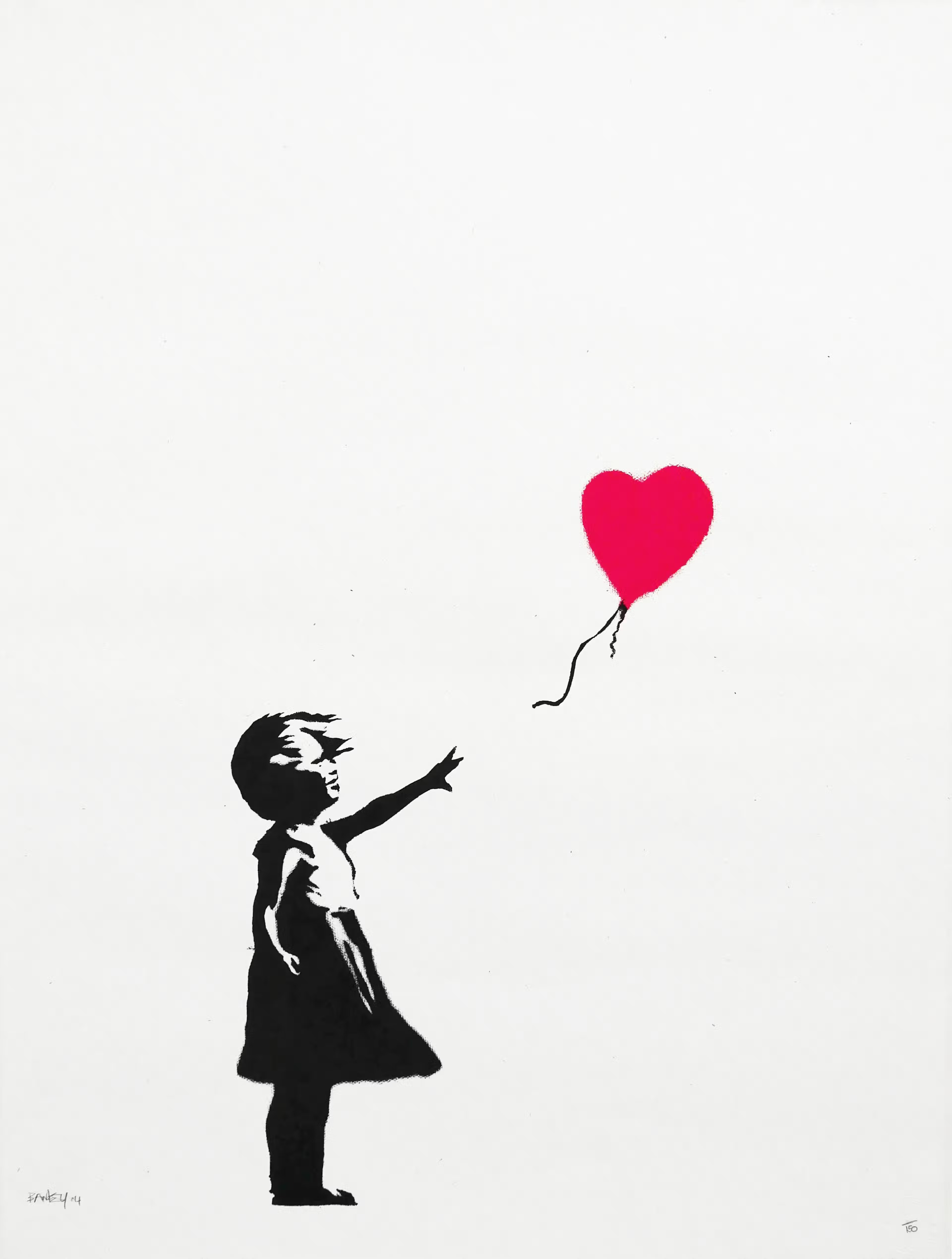
Banksy, Girl with Balloon, 2004. Image: © Banksy / Pest Control Office
The sale that reset expectations
The standout case is Love is in the Bin. On the public tape, it hammered at about $23.25 million in 2021. Sotheby’s described the artist-built shredding mechanism as integral to the work, which is the point: the market was not just buying a picture, it was buying a Banksy-authored event.[6] Game Changer made the same lesson visible from another angle, because its hospital provenance and public-health charge gave the work moral and cultural weight as well as image recognition.[7] For Banksy, the ceiling is created where authorship, story and public meaning converge.
That matters because it stops you drawing the wrong conclusion from the records. The lesson is not that every Banksy is an auction headline. It is that the very best Banksys are read as cultural signals first and objects second. If your work does not carry that kind of narrative authority, it needs to be priced and routed with more discipline.
How the Banksy market actually works
Authorised versions of familiar images
Banksy’s market rewards authorised versions of already famous images. Pest Control states that it is the sole point of contact for the artist, the only source of Banksy certificates of authenticity, and the only point of sale for new work; it also directs buyers to its “check before you buy” service when a work lacks a COA.[1][2] That makes certificate, provenance and basic file quality part of price formation, not an administrative extra.
On the public tape, sell-through sits around 81% and the median hammer is about $35,000. That is liquid enough to sell, but selective enough that weak routing or thin paperwork is penalised. Banksy is a wide market, not a uniformly deep one.
Recent official programming has reinforced the canon rather than flattening it. Cut & Run, Banksy’s first official exhibition in 14 years, put the stencils and artefacts behind works such as Girl with Balloon, Kissing Coppers and Mobile Lovers back at the centre of attention, and the Glasgow run broke the venue’s box-office record.[4][5] When Banksy himself reactivates the core image bank, buyers tend to return to the most recognisable motifs on the secondary market.
The barometer: Girl with Balloon
If you want one clean read on Banksy sentiment, use Girl with Balloon. It trades often enough to show market mood, and it sits high enough in the print hierarchy to matter. On the public tape, 54 of 59 Girl with Balloon print lots sold. Buyers continue to show up for that image.
The cluster’s median hammer is about $143,000, and over the past two years it has held around $95,000. The premium has cooled from the peak years, but it has not disappeared. A canonical Banksy image still commands conviction, even as the broader print field requires sharper pricing.
If your work sits close to this barometer in image strength, signature, edition profile or provenance, you can be firmer on value and more selective on route. If it does not, avoid borrowing Girl with Balloon comparables simply because the format appears similar.
The correction that changed the rules
Banksy’s speculative phase broke in the second half of 2022. Print sell-through fell from roughly 85% in the first half of that year to about 65% in the second. The shift materially changed buyer behaviour.
Median print hammer moved accordingly, dropping from around $42,000 to about $19,000. The easy-money phase ended there. Since then, a clean Girl with Balloon, Love Is in the Air or Laugh Now can still attract bids; the broader print field no longer receives a free pass.
This is where sellers misread the market when relying only on brand recognition. “It’s a Banksy” is no longer a pricing argument on its own. The market now asks which Banksy, which image, which paper trail, and why this one.
Paperwork is price in Banksy
In October 2025, Pest Control warned that high-level fake Banksy prints from around 2003 were circulating.[3] That is why certificate and provenance are not cosmetic details in this market; they are part of the buyer’s risk calculation before engagement even begins.
A clean file reduces friction. An incomplete one narrows the buyer pool, weakens comparables, and increases auction risk. In Banksy, the paperwork premium is real.
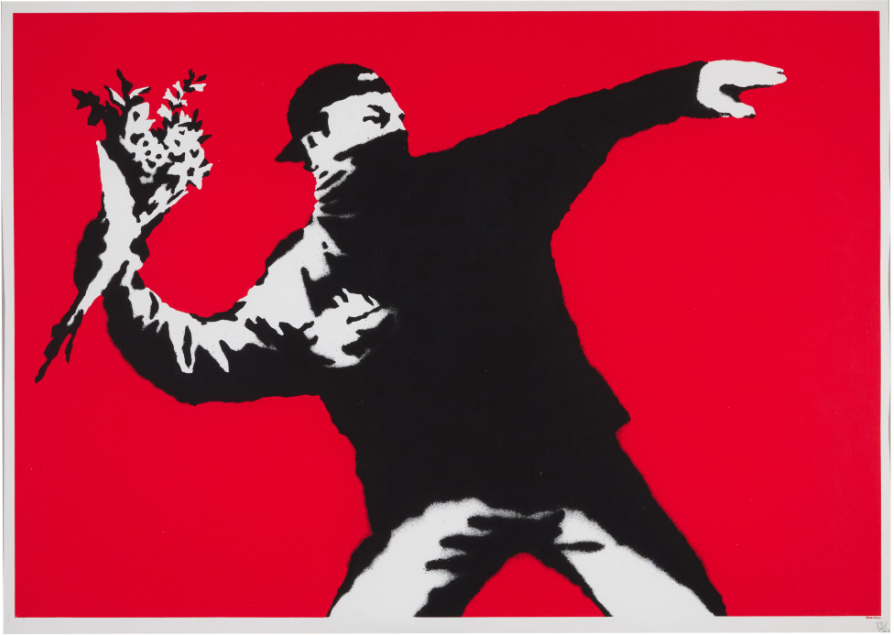
Banksy, Love Is In The Air, 2003. Image: © Banksy / Pest Control Office
Why private sale is often the stronger route
Private sale is not a consolation prize in Banksy; it aligns with how this market functions. Banksy is not distributed through a conventional gallery system, and reporting in March 2026 described invitation-only private sales managed through Pest Control, with tight control over access and resale.[1][10] Controlled placement is therefore part of the structure of serious Banksy supply.
Auction works best when the object is easily benchmarked: a clean Girl with Balloon, a recognisable Love Is in the Air, a standard Laugh Now. It is less effective for unusual colourways, rare proofs, stronger originals, or works whose provenance exceeds what public comparables can demonstrate. In those cases, private placement preserves nuance rather than compressing it.
Broader market data supports this. Auction-house private sales grew in 2024.[8] In parallel, a significant share of high-net-worth collectors’ transactions moved through galleries and dealers.[9] Discreet buyer matching is standard behaviour, not a fallback.
For sellers, the advantage is control. Private sale allows full presentation of the Pest Control certificate, Pictures on Walls invoice, verso, framing, condition report and provenance chain before pricing becomes public. In a selective market, that is often the more rational route.
Sell now or wait?
Sell now if your work is already in the premium lane
Sell now if your Banksy reads clearly as a premium work: a canonical image, a clean Pest Control certificate, coherent provenance, and either genuine rarity or meaningful scale. Girl with Balloon remains a premium print barometer, and the March 2025 London offering of Crude Oil (Vettriano) shows that important originals still receive serious evening-sale positioning when both object and file are strong.[11] The market continues to reward strength.
In this segment, waiting does not automatically improve outcomes. The current market rewards precise placement more than passive timing. If your work is already legible to serious buyers, a private placement or tightly targeted auction can convert that clarity into a sale without relying on another speculative upswing.
Wait if your Banksy sits in the broad middle
Wait if your work is solid but not clearly premium: a more common print, a higher-edition impression, condition issues, or incomplete paperwork. The post-2022 market rewards discipline, not optimism. If the image sits below Girl with Balloon, Love Is in the Air or Laugh Now in strength, public auction can create a visible benchmark that is difficult to reset.
Waiting only makes sense if it improves how the work is read. Strengthen the condition file, tighten provenance, confirm the certificate trail, and reassess whether private sale, hybrid routing or a later auction window offers more control than immediate exposure.
For most Banksy owners, the decision is more straightforward than it appears: sell now when the market already understands the work; wait when it still needs to be properly positioned.
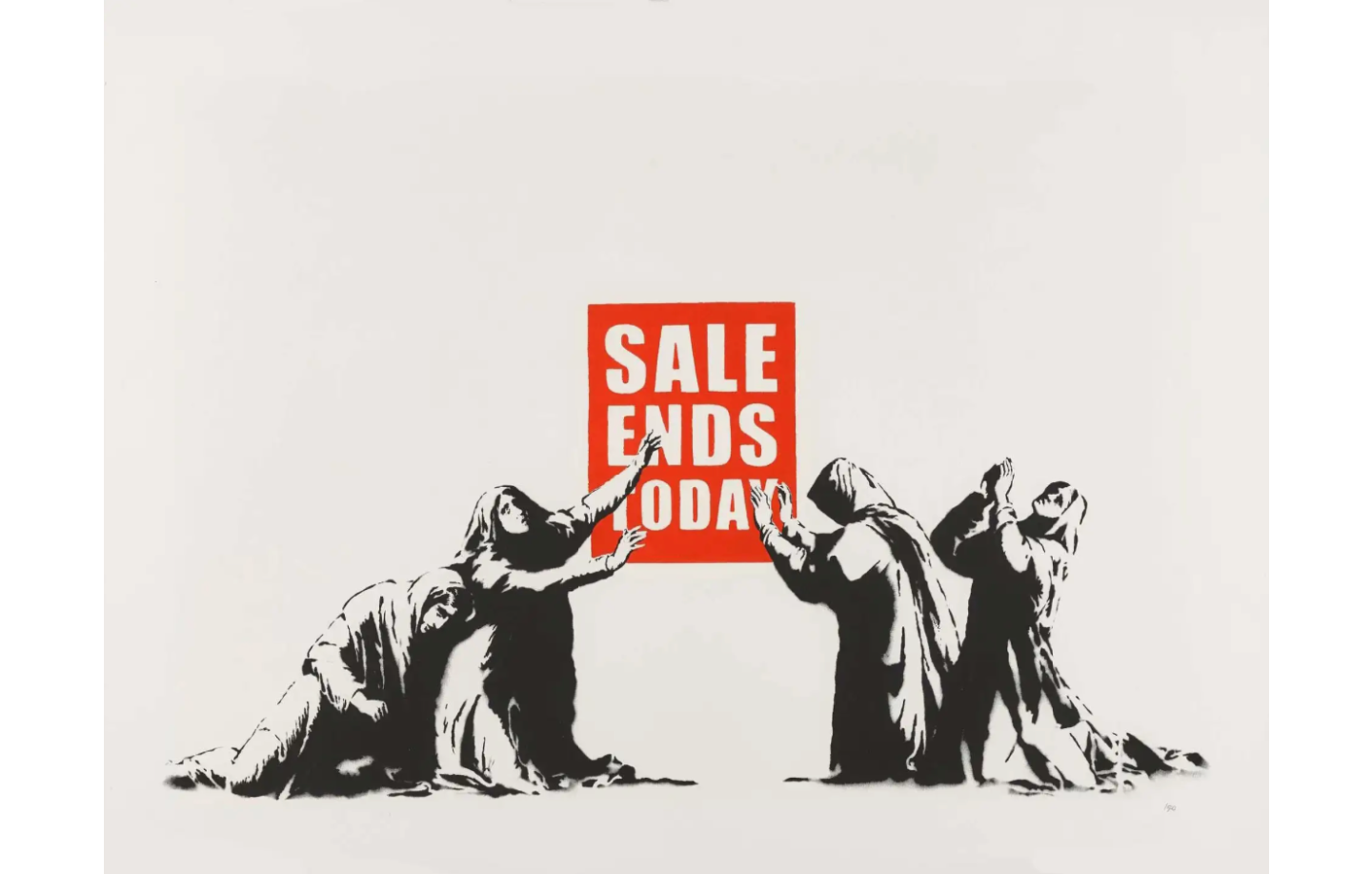
Banksy, Sale Ends, 2007. Image: © Banksy / Pest Control Office
How to move with Artscapy
If you want to understand where your Banksy sits within that hierarchy, begin with clarity.
- Start with a 60-second estimate: an instant price range grounded in auction data refreshed every 24 hours.
- Pick your path: Fast Sale (speed) or Maximise Returns (advisor-led strategy).
- Fast Sale: receive a non-binding offer in 1–3 working days, where eligible.
- Maximise Returns: choose private placement, targeted auction, or a hybrid strategy based on the work itself.
- Close cleanly: 0% seller commission, transparent costs, and escrow-protected transactions. Payout is made within 7 days of collection, with Fast Sale payouts initiated the same day once the work is received.
Sources and references
[1] Pest Control Office FAQ. Pest Control Office. No date. Accessed 16 March 2026.
[2] Check or Register Artwork. Pest Control Office. No date. Accessed 16 March 2026.
[3] Pest Control Office homepage notice. Pest Control Office. 22 October 2025. Accessed 16 March 2026.
[4] José da Silva, “First official Banksy show in over a decade will be open all night at weekends—unless you ‘show up appearing to be very intoxicated’”. The Art Newspaper. 15 June 2023. Accessed 16 March 2026.
[5] “Banksy closes Glasgow show at GoMA and asks ‘Where next?’” Glasgow Life. 28 August 2023. Accessed 16 March 2026.
[6] Love is in the Bin. Sotheby’s, Contemporary Art Evening Auction lot page. 14 October 2021. Accessed 16 March 2026.
[7] “CHRISTIE’S RESULTS | Banksy’s Game Changer sells for £16,758,000 / $23,176,314 / €19,422,522”. Christie’s Press Centre. 23 March 2021. Accessed 16 March 2026.
[8] The Art Basel and UBS Global Art Market Report 2025. Art Basel. 2025. Accessed 16 March 2026.
[9] Sales Channels — The Art Basel & UBS Survey of Global Collecting 2025. Art Basel / Arts Economics. 2025. Accessed 16 March 2026.
[10] James Pearson et al., “For Banksy, a network of companies, secret auctions, and $250 million in secondary-market sales”. Reuters Investigates. 13 March 2026. Accessed 16 March 2026.
[11] Crude Oil (Vettriano). Sotheby’s, Modern & Contemporary Evening Auction lot page. 4 March 2025. Accessed 16 March 2026.
