
Bridget Riley market analysis. Is now a good moment to sell? (March 2026)
Last updated: 16 March 2026.
If you own a Bridget Riley, the dilemma is rarely recognition. The market knows her, whether the work is closer to an Arrest-period canvas, a Bassacs study, or a Fragment print. The real question is whether you want public validation or private control in a market that can be highly selective at the top and quietly liquid further down. Route matters.
Data note. The figures below reflect public auction results from 25 January 2018 to 7 March 2026. To keep cross-border comparables consistent, the benchmarks use hammer prices converted into US dollars; where a recent UK sale record also reports the premium-inclusive total, that is noted separately. That keeps Four Colours with Orange, Study for Arrest Series, and Fold inside one comparable framework without pretending they belong to the same tier.
→ Start with a valuation. Click here and get a price range in about 60 seconds.
In this article
- The recent Riley moment that matters most
- How the market actually works
- Why private sale is structurally rational in Riley
- Sell now or wait?
- How to sell with Artscapy
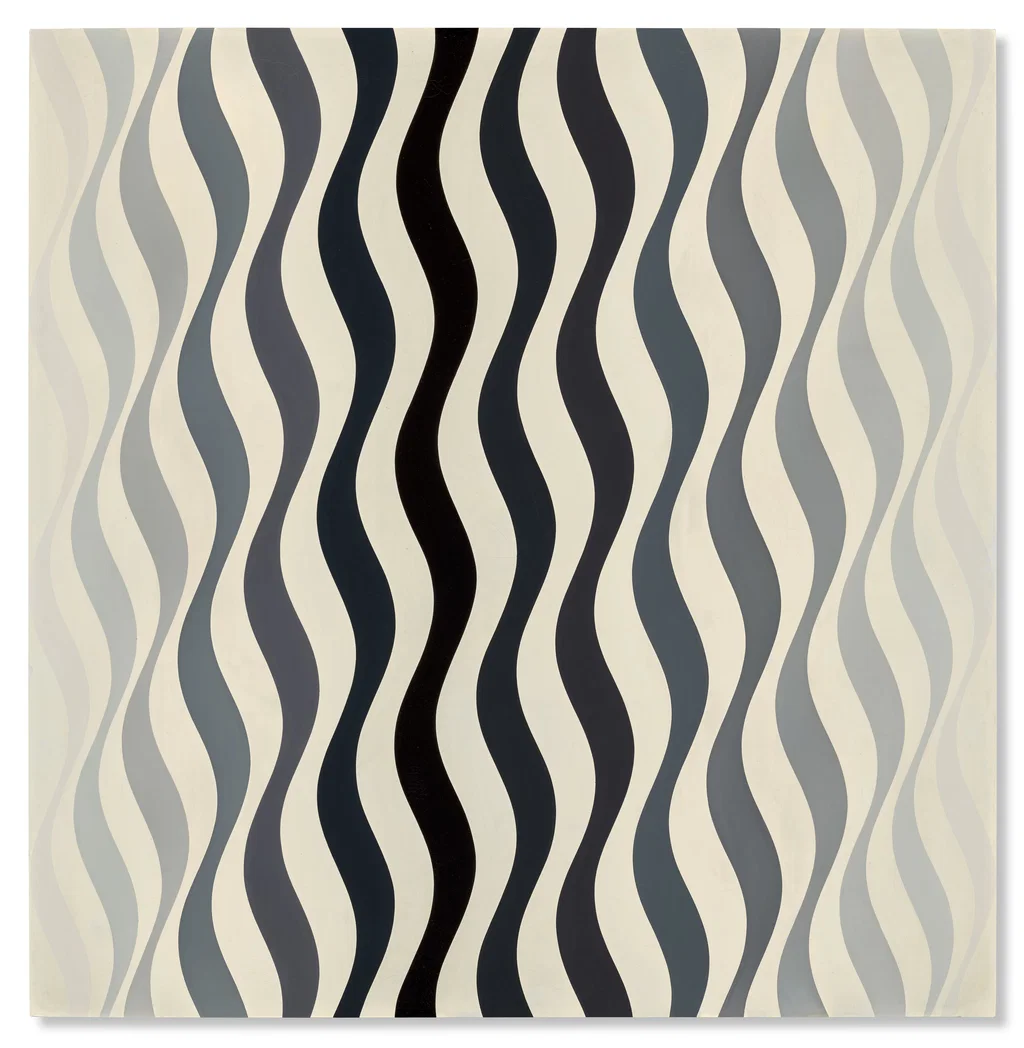
Bridget Riley, Arrest 4, 1965. Image © HENI Gallery
The recent Riley moment that matters most
The most revealing Riley moment in the current tape arrived in the first week of March 2026. Christie’s withdrew Arrest 4, a 1965 canvas, from its London evening sale at a £3.5 million–£5.5 million estimate, while Sotheby’s sold Four Colours with Orange, a 2002 painting, in London days earlier for £650,000 hammer, or £832,000 with premium. Same city. Same week. Very different outcome.
That is the Riley market in one frame. Buyers are active, but they are judging period, image language, scale, estimate, and routing with real discipline. For a seller, that is not bad news. It is usable news.
Riley is also entering 2026 with unusually visible institutional reinforcement. Turner Contemporary’s Learning to See runs through May 2026, Tate Britain’s Bridget Riley display through June 2026, Dia Beacon has announced a 2026 presentation of the early black-and-white paintings, Centre Pompidou records Ascent (Wall Painting) from 2023 as a 2026 acquisition, and Musée d’Orsay’s recent Point de départ reframed the Seurat connection that underpins her mature language.[1][2][3][4][5]
That matters because Riley is still priced through recognisable chapters: the early optical breakthroughs, the mature 1970s and 1980s canvases, and the studies or wall works that explain how the paintings are made. The market is not asking, “Is this Bridget Riley?” It is asking, “Which Bridget Riley is this?”
How the market actually works
At aggregate level, the public market is deep: 322 of 343 lots sold, a sell-through rate of about 94%. But that top-line figure hides the mechanism. Riley is not one market. She is three.
Fragment prints and Arrest-scale canvases do not share the same buyer logic. Nor do Bassacs studies and later retail editions. Inference: Riley’s market behaves a little like Riley’s art. It is about perception. The closer a work sits to the moments where Zing 2, Fragment, or Bassacs make her language unmistakable, the more decisive buyer behaviour becomes.
Paintings: where the ceiling lives
The ceiling lives in paintings, and supply there is thin. Just 37 paintings sold publicly in this run, with a median around $1.33 million. That scarcity is why a single visible pass or withdrawal can matter more than it would for a more frequently traded artist.
The top of the tape is not being set by any Riley canvas that happens to be large. It is being set by recognised breakthroughs: Zing 2 remains the record at about $4.08 million, and the highest results cluster around major paintings such as Halcyon 2, Orphean Elegy 7, Tinct, and Gaillard. Buyers are rewarding canonical Riley, not generic Riley.
After a quieter 2023, the painting lane reopened in 2024 and 2025. The median across those two years was about $1.35 million, helped by results for Gaillard 2, Break, Daphne, and Myrrh. The opportunity is real. The selectivity is real too.
That selectivity is being reinforced rather than weakened by institutions. Tate’s current display includes Concerto I, 2024, as a gift to the national collection, while Centre Pompidou records Ascent (Wall Painting), 2023, as a 2026 acquisition.[2][5]
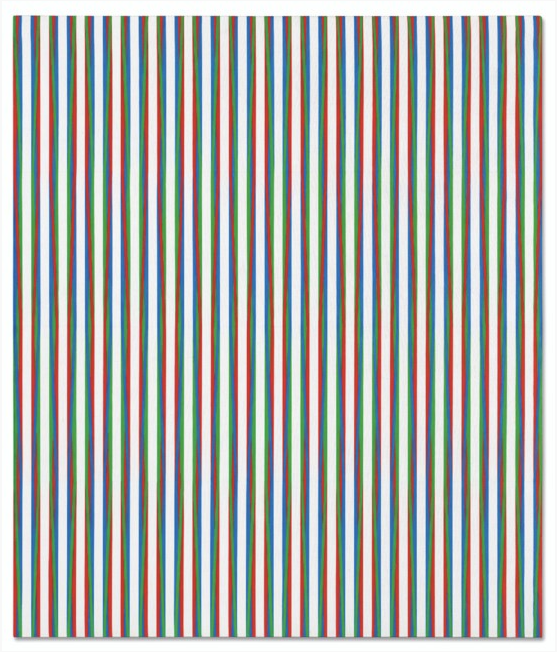
Bridget Riley, Zing 2, 1971. Image © Christie’s
Works on paper: where scholarship changes price
Works on paper form a serious middle tier, not a decorative appendix. Thirty-eight sold publicly, and the median sits around $122,500. In Riley, that is the lane where description, linkage, and paperwork do real commercial work.
The stronger paper results are not anonymous sheets. They are studies with a destination or a sequence: Study no. 1 for Studio International Cover, Study after Cartoon. September 5 ’90., Study for Persian Painting, and the recent Study for Arrest Series. In March 2026, that last work made £140,000 hammer, or £177,800 with premium, in London. When the paper tells you where it sits in Riley’s thinking, buyers respond.
That fits the external record. Turner Contemporary notes that preparatory works on paper show how drawing underpinned Riley’s working life, and the Bridget Riley Archive indicates that further research on works on paper and colour studies is planned. For paintings, that archive infrastructure is already deeper: the Foundation states it completed research on works made on canvas, board, and the wall for Bridget Riley: The Complete Paintings.[1][6][8]
Inference: in Riley’s paper market, scholarship is part of liquidity. A study tied to Arrest, Bassacs, Persian Painting, or another named sequence is easier to place, easier to defend, and often safer to sell well.
Data needed. A current written policy from the Bridget Riley Archive or studio confirming whether it issues certificates, letters of authenticity, or research opinions for paintings, works on paper, or prints would confirm the exact paperwork standard for your work.
The barometer: early optical prints versus retail editions
Prints provide the liquidity floor. There were 247 public print sales in this period, and the median price sits around $9,500. A Riley print can usually sell. It does not follow that every Riley print sits in the same buyer conversation.
The clearest barometer is the split between canonical early optical titles and later retail editions. Over the last 24 months, titles such as Fragment, Movement in Squares, Circular Movement, Blaze, and Nineteen Greys sat around $29,000 at the median, while titles such as Fold, Sideways, About Lilac, and One Small Step sat around $6,600. That is a real hierarchy, not just a few outliers.
That hierarchy also fits Riley’s documented practice. The Bridget Riley Art Foundation’s print catalogue raisonné describes printmaking as an intermittent but integral extension of the paintings, and Dia Beacon’s forthcoming exhibition centres the early black-and-white breakthrough works.[4][7]
Inference: buyers pay more when a print feels close to Riley’s breakthrough perceptual argument, not simply close to her name.
Data needed. A catalogue raisonné reference, edition details, and a current condition report would confirm whether your print belongs with the premium optical comparables or the retail-edition lane.
Why private sale is structurally rational in Riley
Private sale is not a consolation prize in Riley. It is often the channel that best matches the object. The public market is broad at the Fragment/Fold print level, but the meaningful tiers — Arrest-scale canvases and Bassacs or Persian Painting studies — are thin. Thin markets punish public mistakes.
That is why the wider trade has leaned on controlled channels. Art Basel and UBS reported that auction-house private sales rose 14% in 2024 even as dealer and public auction values fell, and the 2026 report describes a market in which sustained growth depends on bringing exceptional works to market and deepening client relationships rather than relying on indiscriminate demand.[9][10]
For Riley, private placement becomes most rational when the work is strong but buyer depth is narrow. That includes a serious canvas that belongs in the shadow of Arrest, Halcyon 2, Zing 2, or Gaillard; a study whose value depends on explaining its relation to a named painting or sequence; or a later painting that has institutional support but fewer public comparables than the 1970s and 1980s high points. In these cases, public auction can validate, but it can also force the work to clear on one date, in one room.
London remains the main public theatre for serious Riley material, and that is useful only if the work is already legible to London buyers. The tape provides clear warning signs. Reverse passed in Shanghai. Ka V passed in London. Study 2 for Praise passed in 2025. In Riley, a visible non-sale can reposition a work faster than a discreet approach ever would. Private sale lets you protect price, target the right buyers, and control the narrative.
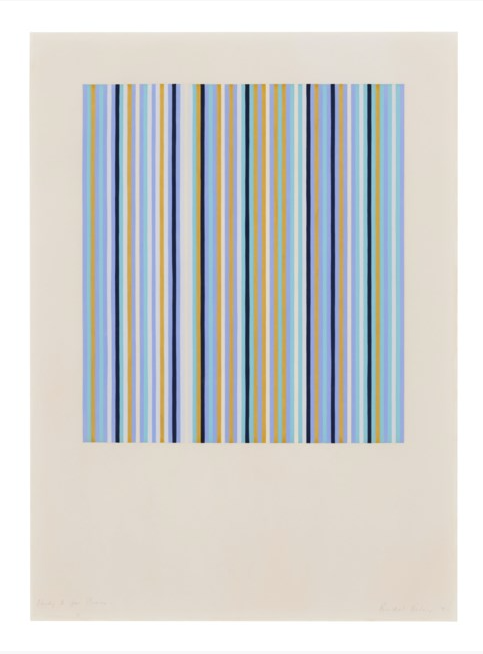
Bridget Riley, Study 2 for Praise, 1981. Image © Christie’s
Sell now or wait?
Sell now if your work already belongs to the premium lane
Sell now if your Riley is already legible to the market. That means a strong painting from the recognised high-value periods, a clearly linked study, or a print that sits in the early optical barometer rather than the retail-edition lane. In those cases, the current environment is supportive: the public tape since 2024 shows serious painting demand, and the institutional frame around Riley is unusually active across Tate, Turner, Musée d’Orsay, Dia, and Centre Pompidou.[1][2][3][4][5]
Inference: when market attention and institutional attention align, you do not need euphoria. You need a work that already comes into focus for buyers.
Wait if your work needs proof more than exposure
Wait if the work is good but not yet fully legible. That includes later prints in the Fold, Sideways, or About Lilac lane, studies with incomplete provenance, or paintings whose condition, exhibition history, or series placement still need clarification. The public Riley market is not punitive, but it is unforgiving once a work has been seen and declined.
The barometer is clear. Premium early optical prints sit well above the retail-edition lane, and the works-on-paper tier is more selective than the print market. If your object currently reads as generic rather than specific, rushing to auction risks fixing the lower comparable.
Data needed. A current condition report, provenance trail, exhibition history, and any archive or catalogue raisonné documentation would confirm whether your work is genuinely auction-ready or better developed first through private placement.
The calm conclusion holds. Riley’s market is functioning, but it is functioning by hierarchy, not by blanket enthusiasm. The right question is not whether now is universally good. It is whether your Riley is already in focus.
Sell with Artscapy
1. Start with a 60-second estimate
Get a price range in about 60 seconds. The estimate is instant, backed by auction data refreshed every 24 hours, and built to distinguish a Gaillard 2-type painting from a Fragment or Fold print.
2. Pick your path
Choose Fast Sale if speed matters, or Maximise Returns if the work deserves an adviser-led strategy. The right route depends on whether your Riley behaves more like Gaillard 2, Study for Arrest Series, or Fold.
3. Choose the route that fits the work
Fast Sale means a non-binding offer in 1–3 working days, where eligible. Maximise Returns means choosing between private placement, targeted auction, and a hybrid strategy built around whether the work is an Arrest-period canvas, a named study, or a retail edition.
4. Close cleanly
We sell with 0% seller commission, transparent costs, and escrow protection. Payout arrives within 7 days of collection, and Fast Sale payout is initiated the same day once the work is in our care.
If it looks right, request purchase offers within 48 hours, where eligible, with 0% seller fee.
Sources and references
[1] Bridget Riley: Learning to See. Turner Contemporary. Exhibition page for 22 November 2025–4 May 2026. Accessed 16 March 2026.
[2] Bridget Riley display opens at Tate Britain, including a major new gift to the national collection. Tate. 21 July 2025. Accessed 16 March 2026.
[3] Bridget Riley: Point de départ. Musée d’Orsay. Exhibition page for 21 October 2025–25 January 2026. Accessed 16 March 2026.
[4] Bridget Riley. Dia. Exhibition page for Dia Beacon, opening 17 July 2026. Accessed 16 March 2026.
[5] Ascent (Wall Painting). Centre Pompidou. Collection entry; acquisition recorded 2026. Accessed 16 March 2026.
[6] Research and Archive. The Bridget Riley Art Foundation. Accessed 16 March 2026.
[7] Bridget Riley: The Complete Prints 1962–2020. The Bridget Riley Art Foundation. 10 September 2020. Accessed 16 March 2026.
[8] Bridget Riley: The Complete Paintings. The Bridget Riley Art Foundation. 2018. Accessed 16 March 2026.
[9] The Global Market — The Art Basel & UBS Art Market Report 2025. Art Basel / UBS / Arts Economics. 2025. Accessed 16 March 2026.
[10] The Art Basel and UBS Global Art Market Report 2026. Art Basel / UBS / Arts Economics. March 2026. Accessed 16 March 2026.