
Damien Hirst market analysis. Is now a good moment to sell? (March 2026)
Last updated: 16 March 2026.
If you are thinking about selling a Damien Hirst, the problem is not whether a market exists. It does. The problem is that Hirst’s market is split between broad, highly visible edition traffic and a much narrower top tier for major unique works such as Spot and Colour Space paintings, butterfly canvases, cabinets, formaldehyde works, Blossoms and Veils. One route gives you public validation. Another gives you control. The wrong route can make a strong work look ordinary. Control matters.
Data note. The figures below reflect public auction results recorded between 25 January 2018 and 8 March 2026. For comparability, prices are discussed using the auction results’ USD-equivalent realised prices. Public auction data does not show private placements, dealer sales or works that never reached the block, so benchmarks can move as new results appear.
→ Start with a valuation. Click here and get a price range in about 60 seconds.
In this article
- The blossom sale that reset the ceiling
- How the Damien Hirst market actually works
- What buyers actually pay for, and how routing changes the result
- Why private sale is often the rational channel for Hirst
- Sell now or wait
- How to start with Artscapy
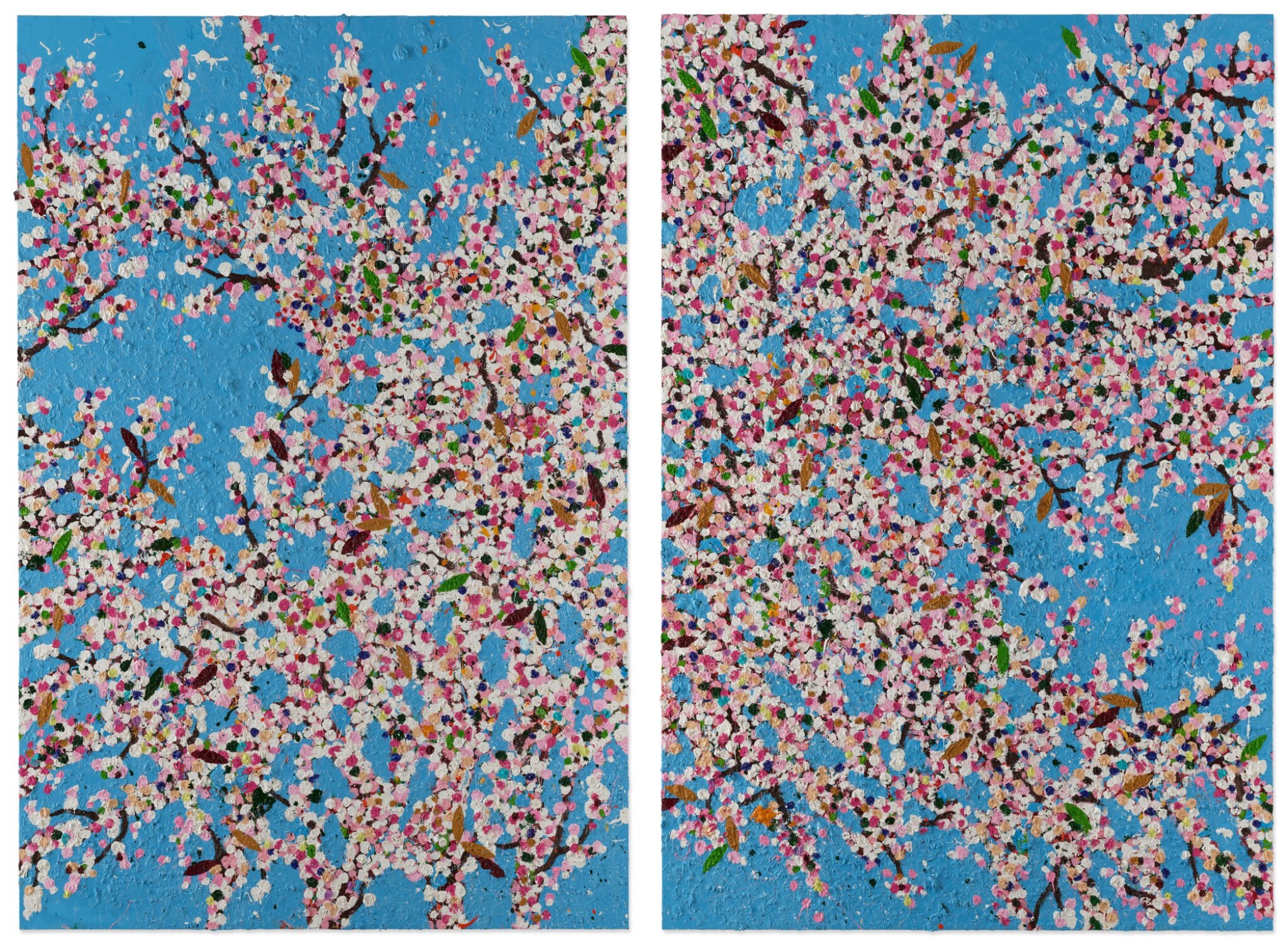
Damien Hirst, Happy Life Blossom, 2018. Image: © Sothebys
The blossom sale that reset the ceiling
The clearest signal in this public tape is Happy Life Blossom, which made about $5.61m at Sotheby’s New York in May 2022. It still stands as the strongest public result in this dataset, and what mattered was not only the price. It shifted attention toward Hirst’s painterly Blossom and Veil bodies, not just the older shorthand of spots, butterflies, cabinets and formaldehyde. Fondation Cartier framed Cherry Blossoms as a serious painting project, and Gagosian had already given the Veil Paintings their own large-scale commercial context. Inference: once buyers accepted that part of the practice as a credible upper tier, later results such as Momentary Love Blossom at about $3.04m and Veil of Life Everlasting at about $2.23m started to read less as isolated results and more as evidence of a functioning ceiling.[5][6]
How the Damien Hirst market actually works
This is a deep market, but it is not a flat one. Across 2,917 public auction appearances in the period, sell-through excluding withdrawals sits at 80.9%, while the overall median realised price is only about $9.6k. That gap is the first thing a seller needs to understand. Media headlines describe the top of the Hirst market; they do not describe the ordinary Hirst market.
The mechanism is straightforward. Liquidity sits in editions and works on paper. The ceiling sits in recognisable unique works. Inference: buyers stretch when a work lands cleanly inside one of the artist’s durable belief systems rather than at the edge of the catalogue—the clinical logic of Spot and Colour Space paintings, the butterfly’s life-and-death symbolism, the pharmaceutical theatre of Pill and Medicine Cabinets, or the beauty-and-decay charge of Blossoms and Veils. White Cube continues to place Colour Space works in current fair programming, Gagosian continues to stage Hirst exhibitions, and the main series remain legible through institutional and publisher programmes rather than surviving only as historical footnotes.[1][2][3][4][5][6][7][9][13]
The clearest barometer: aluminium editions
If you want a public barometer for broad Hirst sentiment, it is the aluminium-panel edition tier: The Virtues, The Empresses and related HENI releases. This cluster reached 257 lots in 2023, when the median fell to about $4.7k. By 2025, volume had eased to 138 lots and the median recovered to about $7.6k. That is not exuberance; it is improved absorption once supply stopped flooding the market.
That matters even if your work is not an edition. When this tier is congested, buyers become more selective across the lower and middle parts of the Hirst market. When it clears more cleanly, confidence tends to improve.
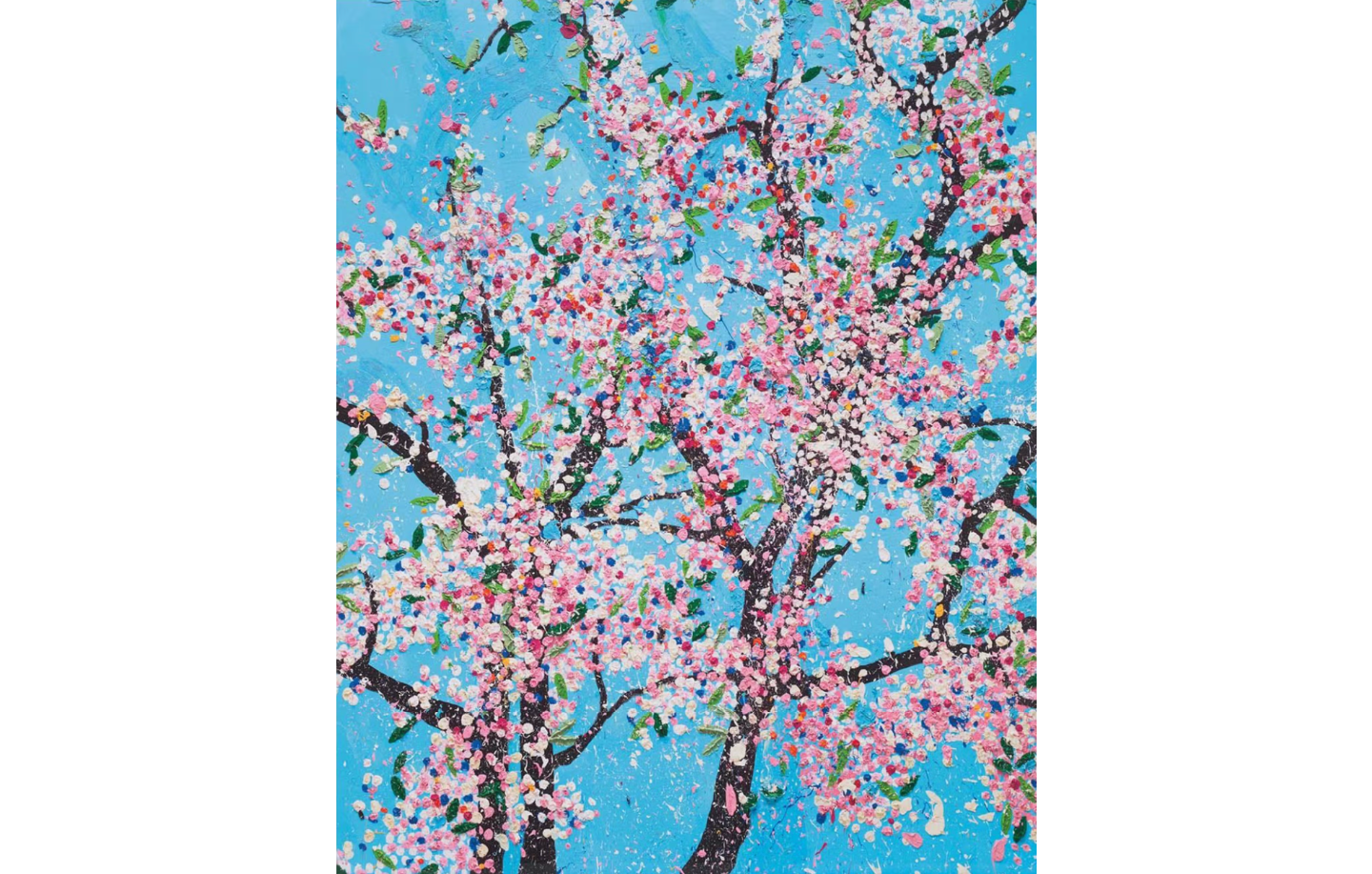
Damien Hirst, Politeness (H9-4), 2021. Image: © Damien Hirst
What buyers actually pay for, and how routing changes the result
Where the ceiling lives: Blossom and Veil canvases
The strongest public prices in this dataset sit in recent large oil-on-canvas works. This is a small but serious tier: there are 7 public results here, all sold, and the median is about $2.0m. That is a different market from ordinary Hirst auction traffic. If you own a Blossom or Veil canvas, it should not be benchmarked against the edition tape or lower-voltage decorative material. The relevant comparison set is other large, painterly Hirst canvases with clean provenance, strong scale and credible placement.[5][6]
The dependable upper-middle: Spot and Colour Space paintings
Below that ceiling sits the most dependable original-painting tier: Spot and Colour Space works. The public median here is about $257k, and roughly 88% of sold examples cleared in London or New York. Buyers understand this language immediately. That is the advantage. The constraint is that they also expect disciplined routing. For this category, the city forms part of the price. A strong spot painting offered in the wrong venue can read as plentiful; the same work in the right London or New York context reads as canonical.[2][4]
Still potent, but more selective: butterfly paintings, paper spins and editions
Butterfly paintings continue to command meaningful prices, with a median of about $212k, because the butterfly remains one of Hirst’s clearest motifs of beauty, belief and mortality. That does not make every butterfly work interchangeable. Recent public results show buyers still compete for the right canvas, particularly when the work sits convincingly within that memento mori tradition rather than drifting into purely decorative territory.[9]
Paper spins behave differently. They are liquid, but they are not the ceiling. The public tape shows 321 sold examples at a median of about $4.8k, and only about 18% of those sales occurred in London or New York. A large share cleared through regional routes such as Rago in Lambertville. That is a useful correction for sellers. If your Hirst is a paper spin, prestige routing is not automatically the value lever. Matching the work to the correct buyer pool matters more.
Data needed. To judge whether a full H9 or H10 set deserves a premium in your case, we would need the exact edition numbers, condition report, labels, and whether the original HENI packaging survives.
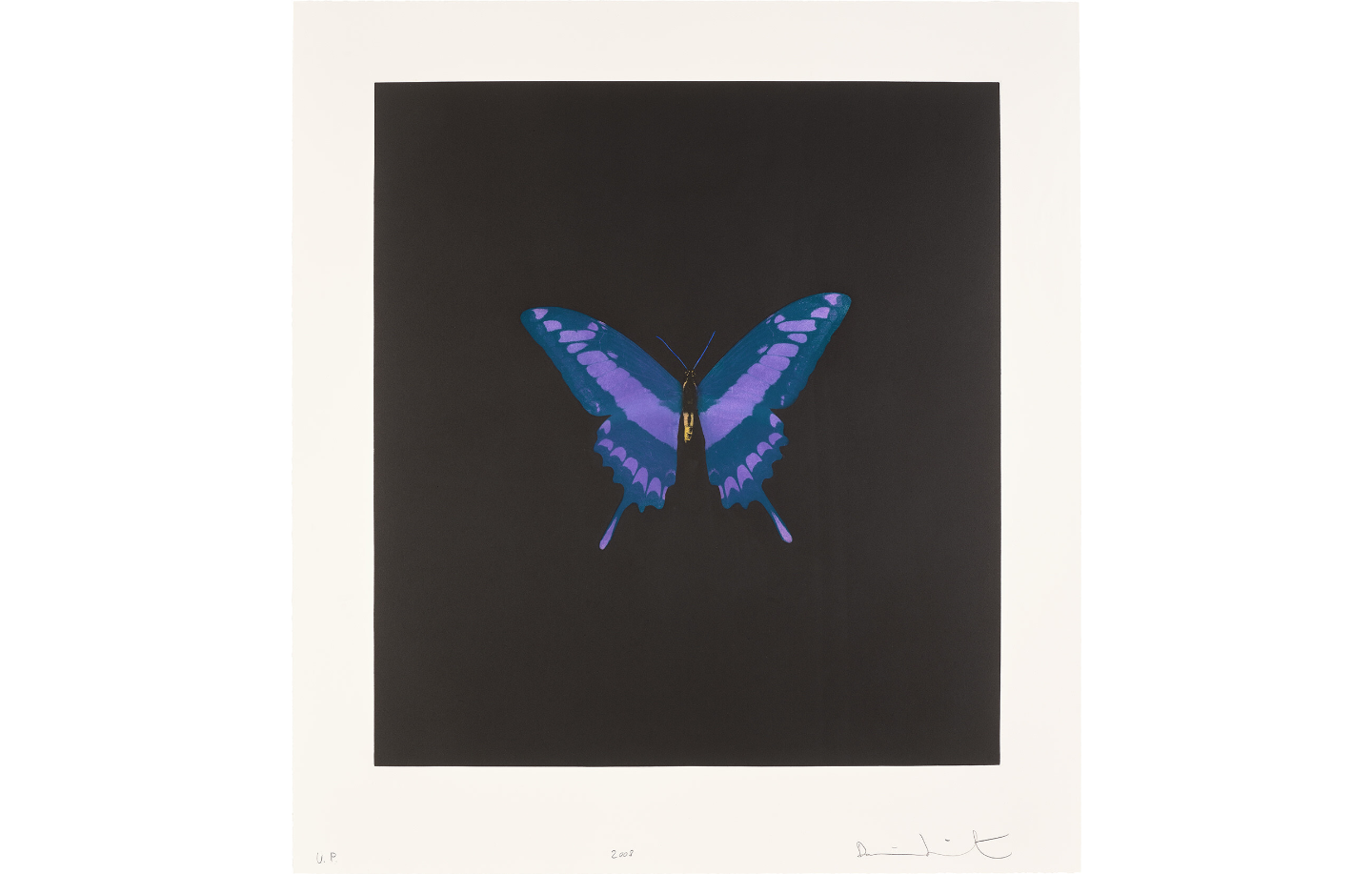
The Souls on Jacob's Ladder Take Their Flight, 2008
Why private sale is often the rational channel for Hirst
Private sale is not a consolation in this market. It is a control tool. In the wider market, private sales by auction houses rose 14% in 2024 even as public auction value fell, and UBS reports that the channel still accounted for just under $4.2bn in 2025. That is sufficient to make one point clearly: serious sellers and intermediaries already use private channels when discretion, pacing and comparison control matter.[11][12]
That logic is particularly strong for Damien Hirst because his public auction record is both highly visible and uneven. A strong Spot or Colour Space painting, butterfly canvas, Medicine Cabinet or formaldehyde work does not require more visibility; it requires the right comparison set. A private placement allows the work to be positioned within the correct Hirst narrative, reduces the risk of a public misfire, and targets collectors who already respond to that specific body of work. For cabinets and formaldehyde works in particular, gallery and institutional framing still influence how buyers assess the object.[4][7][13]
For recent editions, private sale can also make sense, but only when the paperwork is complete and expectations are realistic. That is the point. Private sale adds value here not by concealing weaker material, but by preventing the wrong public benchmark from defining the work.
Sell now vs wait
Sell now if your work already sits in a recognised Hirst tier
If you hold a major Blossom or Veil canvas, a strong Spot or Colour Space painting, or a serious butterfly work, the evidence is sufficient to act. The painterly canvas tier is fully sold in this dataset, Spot works continue to sit in the mid-six figures, and the HENI aluminium barometer has recovered from its 2023 low. Inference: this is a market that will currently pay for conviction, but only when the work is clearly placed within a recognised Hirst category, supported by clean provenance and disciplined routing. For that type of work, selling now is rational.
Wait if your work depends on a general edition rebound
If your work sits in the edition-heavy middle, waiting can also be rational, but only under specific conditions. The supply shock in 2022 was material: annual auction volume rose from 183 lots to 728 while the market median fell from about $15.4k to about $8.8k. That is what oversupply looks like. It does not indicate structural weakness in Damien Hirst; it reflects an excess of substitutable material.
That reframes the decision. If your work is a recent aluminium-panel edition, a paper edition without strong differentiation, or a paper spin with ordinary condition and documentation, time alone is not a strategy. Waiting only makes sense if you can improve the work’s position: stronger documentation, better condition, complete set integrity, or more appropriate routing. The calendar is not the catalyst. The work is.
The conclusion is straightforward. It is a good moment to sell the right Damien Hirst, not every Damien Hirst. If your work sits high in the hierarchy, you can sell into a market that still rewards recognisability, scale and disciplined placement. If it sits lower, the rational move is to control the channel and protect the work until the comparison set improves. Either way, the next step is the same: price it properly before exposing it.
What happens next with Artscapy
- Once we know whether your Hirst is a Blossom canvas, a Colour Space painting, a butterfly work or an edition, the route becomes much clearer.
- Start with a 60-second estimate. Instant price range, backed by auction data refreshed every 24h.
- Pick your path. Fast Sale (speed) vs Maximise Returns (advisor-led strategy).
- Choose execution. Fast Sale: receive a non-binding offer in 1–3 working days (where eligible). Maximise Returns: choose private placement, targeted auction or a hybrid approach based on what your work actually is.
- Close cleanly. 0% seller commission, transparent costs, escrow-protected. Payout within 7 days of collection (Fast Sale payout initiated the same day once in our care).
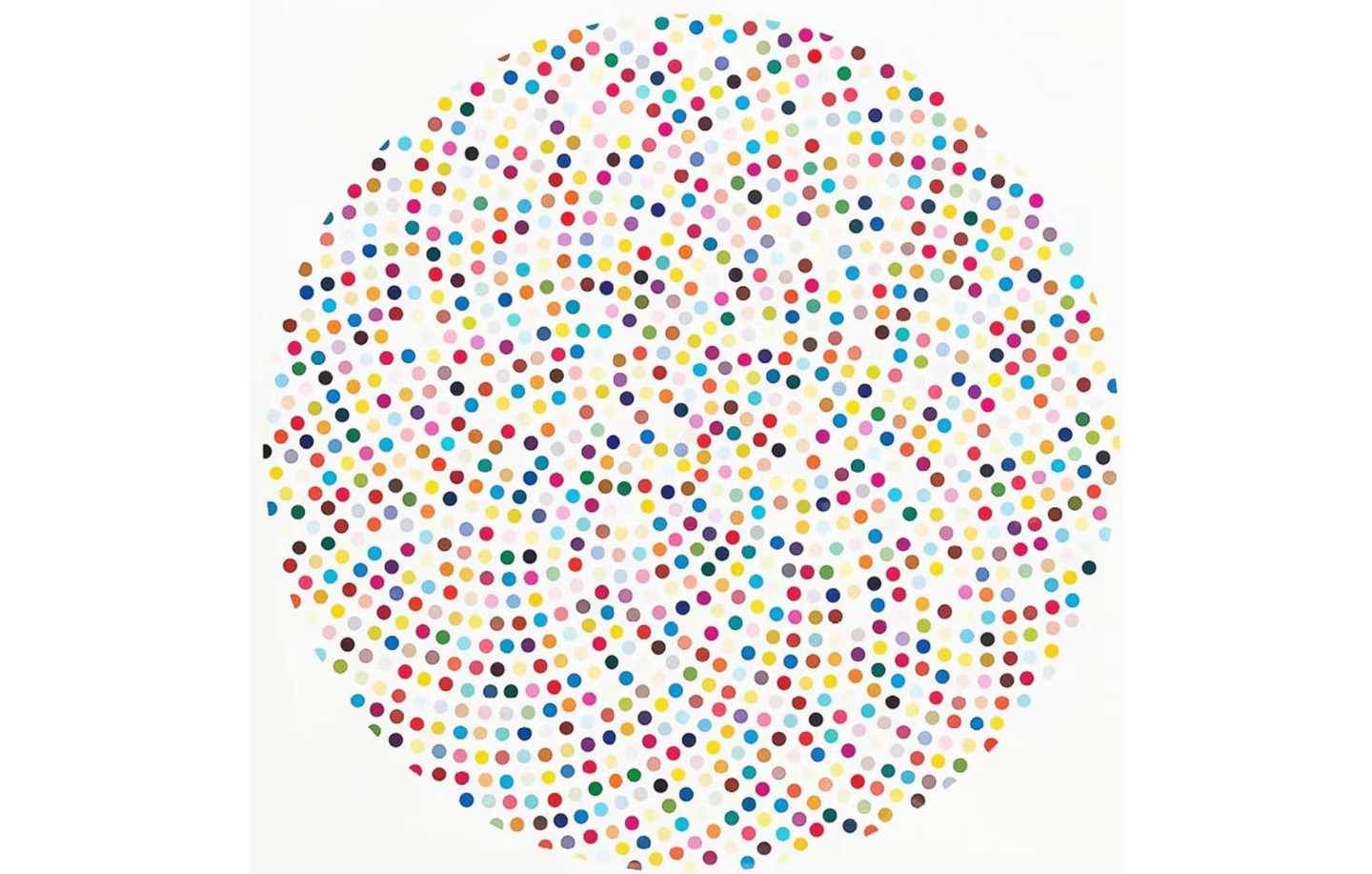
Damien Hirst, Valium, 2000. Image: © Damien Hirst
Sources and references
[1] “Damien Hirst,” White Cube, artist page, accessed 16 March 2026.
[2] “White Cube at West Bund Art & Design 2025,” White Cube, 5 November 2025, accessed 16 March 2026.
[3] “Duane Hanson | Damien Hirst,” Gagosian, exhibition page, 29 February–3 April 2024, accessed 16 March 2026.
[4] “Damien Hirst: Colour Space Paintings,” Gagosian, exhibition page, 4 May–10 August 2018, accessed 16 March 2026.
[5] “Damien Hirst: The Veil Paintings,” Gagosian, exhibition page, 1 March–14 April 2018, accessed 16 March 2026.
[6] “Damien Hirst — Cherry Blossoms,” Fondation Cartier pour l’art contemporain, exhibition page, 2021, accessed 16 March 2026.
[7] “Damien Hirst: Cathedrals Built on Sand,” Gagosian, exhibition page, 8 June–22 September 2021, accessed 16 March 2026.
[8] “The Virtues (H9),” HENI Editions, series page, accessed 16 March 2026.
[9] “The Empresses (H-10),” HENI Editions, series page, accessed 16 March 2026.
[10] “General Release Info,” HENI FAQ, accessed 16 March 2026.
[11] “The Global Market — The Art Basel & UBS Art Market Report 2025,” Art Basel / Arts Economics, 2025, accessed 16 March 2026.
[12] “The Art Basel and UBS Global Art Market Report 2026,” UBS / Arts Economics, March 2026, accessed 16 March 2026.
[13] “Damien Hirst: Natural History,” Gagosian, exhibition page, 9 March 2022–7 January 2023, accessed 16 March 2026.