
David Hockney market analysis. Is now a good moment to sell? (March 2026)
Last updated: 16 March 2026.
Selling a Hockney can feel deceptively simple. The name is famous, the market is deep, and there is always public evidence somewhere. But the real question is not whether David Hockney sells. It is whether your Hockney sits in the part of the market buyers are actively competing for right now: a California painting, a serious pool work on paper, an Arrival of Spring print, or something more routine and more replaceable. Control matters here. Verdict: yes, for the right work and the right route.
David Hockney’s figures here reflect public auction results from 25 January 2018 to 7 March 2026.[1] For consistency, benchmarks are expressed in US dollars. Where older public records do not publish buyer’s-premium totals consistently, long-range comparisons rely on the reported auction result or hammer field in the public record. New Hockney sales can move short-term medians quickly, particularly when a dedicated series sale appears.
→ Start with a valuation. Click here and get a price range in about 60 seconds.
In this article
- The Hockney sale that mattered most recently
- How this market actually works
- Why private sale is often the smart route for Hockney
- Sell now or wait?
- How to start with Artscapy
David Hockney, Christopher Isherwood and Don Bachardy, 1968. Image: © The MET
The Hockney sale that mattered most recently
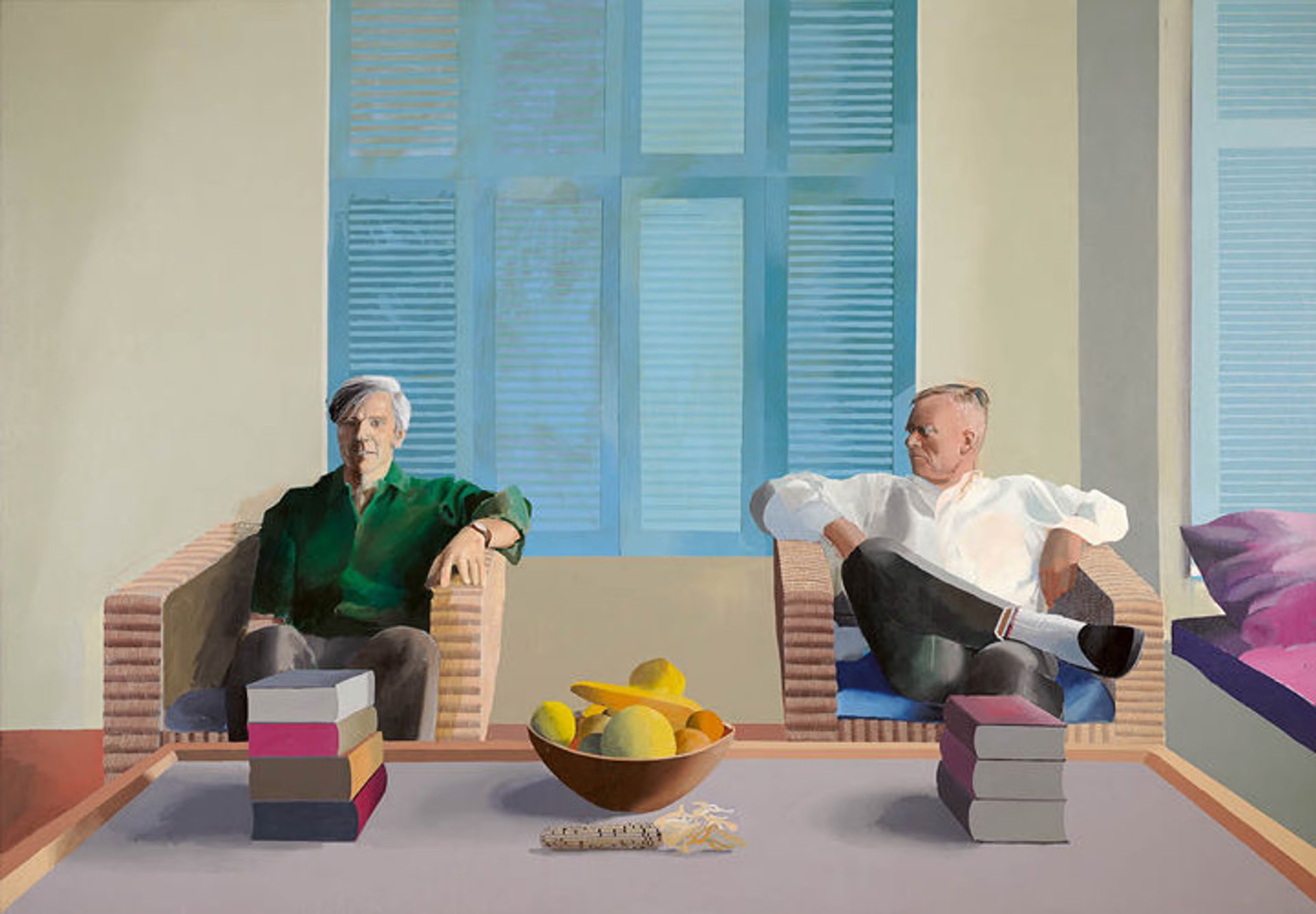
Christie’s November 2025 sale of Christopher Isherwood and Don Bachardy at around $44.3 million was the clearest recent reminder that Hockney’s ceiling still sits with scarce, culturally legible paintings.[1] Christie’s positioned the work as the first of Hockney’s celebrated double portraits, and it had just appeared in David Hockney 25 at Foundation Louis Vuitton, the artist’s largest Paris exhibition to date, where the institution foregrounded both the double portraits and the pool pictures as emblematic Hockney territory.[4][6][7]
That result clarified the market’s hierarchy. The highest benchmark in the tape still sits with the pool image at roughly $90.3 million in 2018, but the 2025 double-portrait result showed that the top end is not simply “big Hockneys” versus “small Hockneys”.[1] It is a contest for canonical pictures: works that distil Hockney’s California light, social world and psychological clarity into images collectors immediately recognise. That is where validation converts into price.
How this market actually works
Inference: Hockney’s market is ultimately a market of recognition. Buyers compete most strongly when a work makes one of his signature ways of seeing unmistakable: the pool, the double portrait, the Yorkshire or Normandy season, the intimate portrait, the technically distinct digital series. Fondation Louis Vuitton framed those motifs as central in 2025; Hockney’s own public-collections record reinforces how consistently pool pictures, double portraits, landscapes and portraits recur in institutional holdings.[4][12]
The public market is deep, but not especially broad. Across 2,681 lots in the tape, 89.7% sold, which sounds reassuring. Yet 2,252 of those lots were prints and multiples, while only 107 were paintings.[1] So the Hockney market offers liquidity at the lower levels, but very limited true substitutability at the top. A major Los Angeles canvas and an editioned Olympic print do not operate in the same market simply because they share the same name.
That split becomes clearer in the recent data. Over the last 12 months, the median painting sale was around $2.2 million, compared with about $47,000 for works on paper and about $16,000 for prints.[1] These are not gentle gradations; they are distinct Hockney lanes, each requiring different expectations, comparables and routing.
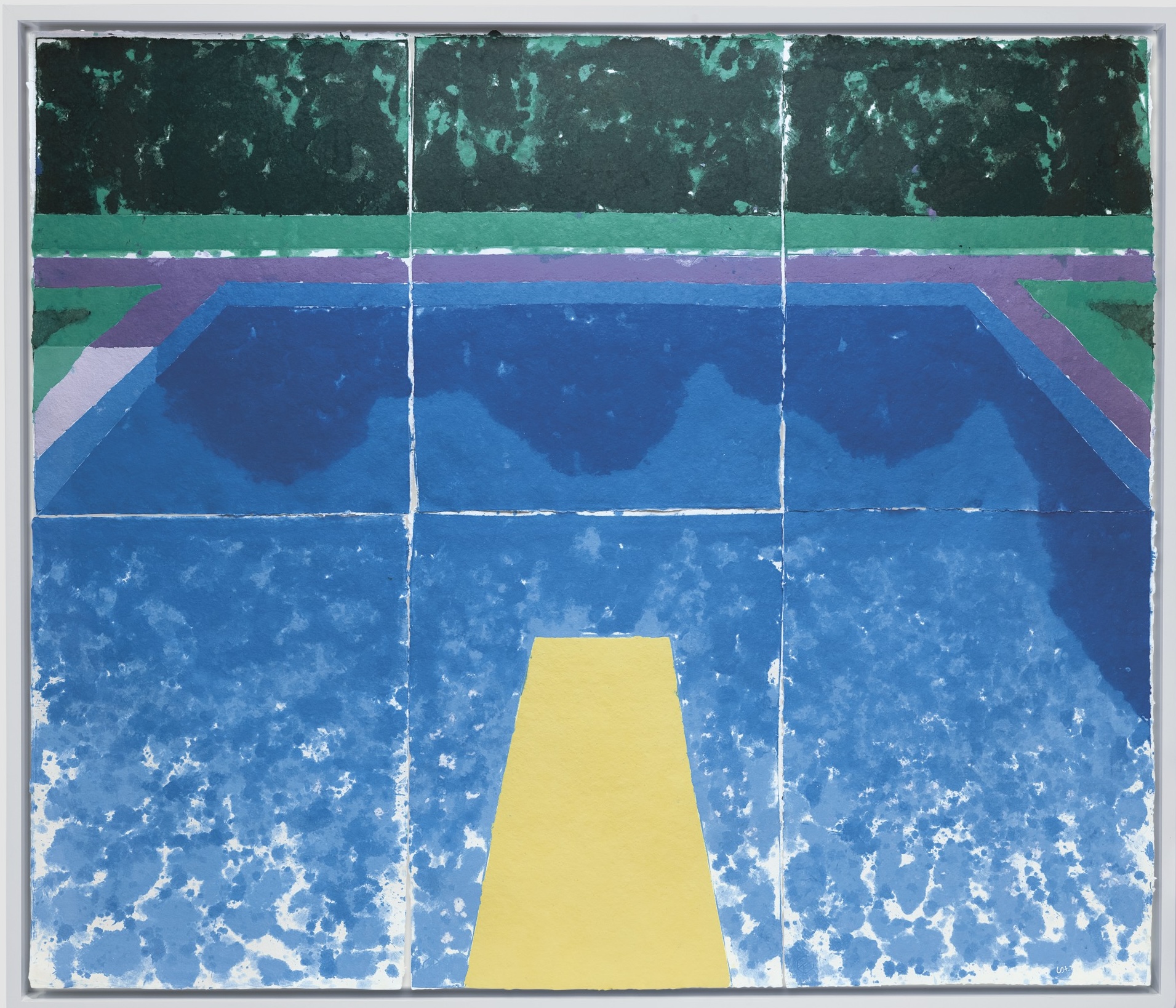
The middle tier is stronger than many owners assume. Hockney works on paper are not merely a waiting room below the paintings: the recent median is around $47,000, but museum-grade paper works can move substantially higher, as Day Pool with Three Blues (Paper Pool 7) did at about $10.5 million in 2019 and Terrace Hollywood Hills House with Banana Tree did at about $2.49 million in 2025.[1] If you own a serious gouache, crayon study or paper-pulp work, the relevant comparison is not a casual signed print. It is the relatively small collector group that buys serious Hockney on paper.
The broader market also looks healthier when supply is disciplined. Volume peaked at 656 lots in 2023, when the median slipped to about $8,900; by 2025, volume had fallen to 453 and the median had recovered to about $17,000.[1] That is the key signal in the tape. The market has not become indiscriminately stronger; it has become more selective. That favours stronger material and is less forgiving for routine books, posters and minor edition stock.
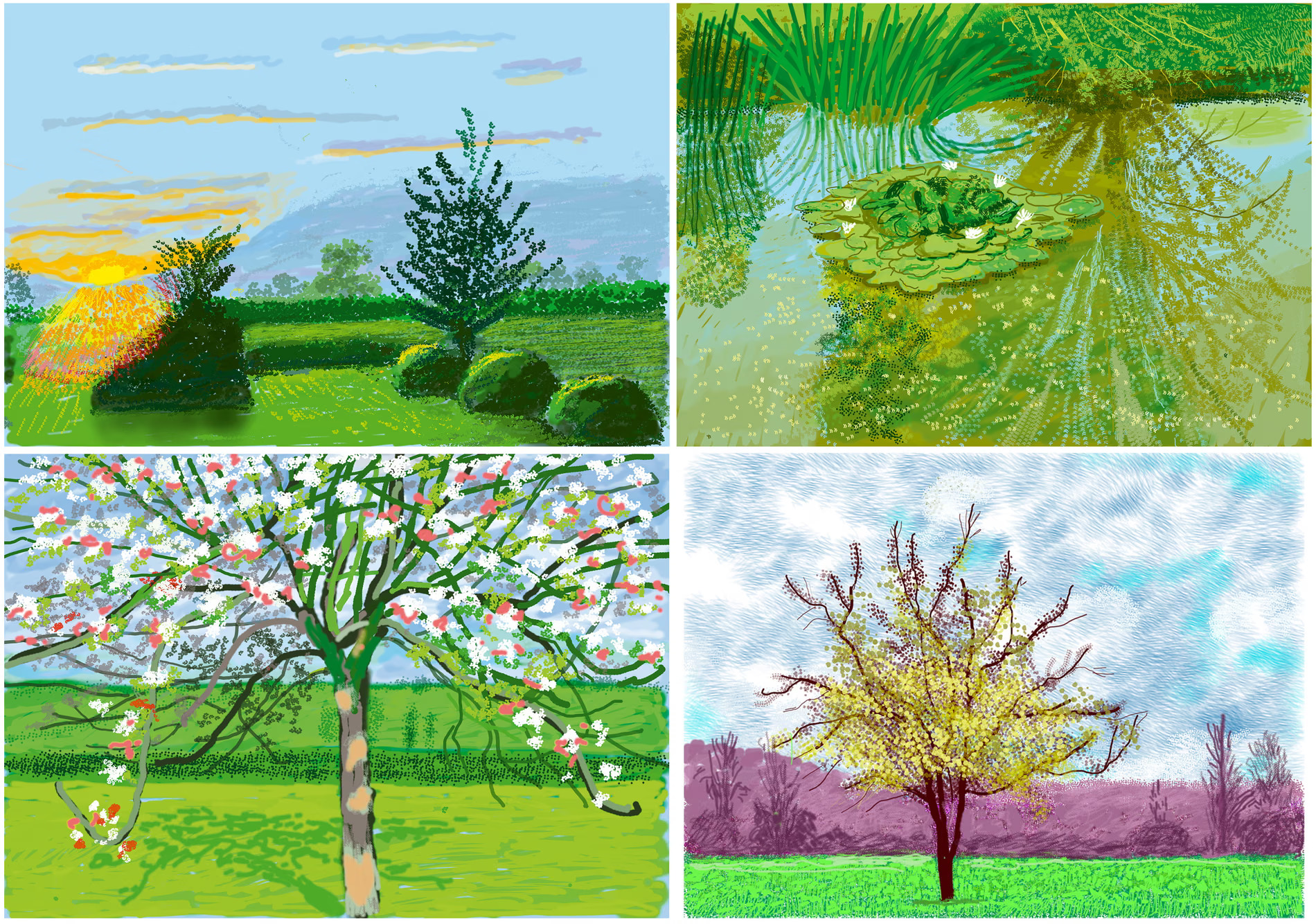
The clearest barometer is Arrival of Spring in Woldgate. Hockney’s own site treats it as a distinct body of work; L.A. Louver documented the series as a focused exhibition following the Royal Academy’s A Bigger Picture and noted the split between the larger Dibond-mounted format and the more common edition of 25; Sotheby’s described the March 2026 group as the final release from a private collection, with subjects not previously seen at auction.[8][9][10]
In the last 12 months, 56 Arrival of Spring works sold without a single pass, and the median hammer was around $287,000.[1] This is not simply a strong Hockney print market. It is a premium sub-market within the wider Hockney print category. Buyers use it to access a fully recognisable late Hockney body of work without entering painting territory.
Now compare that with the lower print lanes. Across the full tape, pool prints sit around a $44,000 median, Six Fairy Tales around $3,500, and Olympic prints around $1,100.[1] The conclusion is straightforward. Buyers pay for named images, named suites and established hierarchies. They do not pay equally for every signed Hockney. Hockney’s own FAQ reinforces that distinction by stating that reproduction prints and posters are not considered works of art by the artist.[3]
There is one important caveat. Inference: the very strong early-2026 data should not be read as a universal new floor for every Hockney edition. Almost half of the sold lots this year so far come from Arrival of Spring alone.[1] If your work is not in that lane, it should not be priced as though the entire Hockney print market has moved with it.
 David Hockney, No 227, 27 April 2020; No 340, 12 June 2020; No 88, 3 March 2020; and No 209, 20 April 2020. Image: © David Hockney
Why private sale is often the smart route for Hockney
Private sale often makes sense in Hockney because the market is steeply tiered and highly image-specific. The public record of works in collections clusters around paintings such as American Collectors (Fred & Marcia Weisman), paper-pulp pool works, and portraits tied to the core figurative years; the artist’s own website also routes interest through a relatively tight group of gallery representatives across major cities.[2][12]
This matters because Hockney is not a “send it anywhere” market. If your work is a strong painting, a serious paper work, a photographic drawing, or an Arrival of Spring impression with clean provenance, the real question is who should see it first. In many cases, the answer is not “everyone at once”, but “the right buyers, in the right context, with the right framing”.
Paperwork is also unusually important here. Hockney’s official FAQ states that the artist’s organisation does not authenticate works and does not provide certificates of authenticity.[3] Sotheby’s lot pages for Arrival of Spring and earlier prints instead rely heavily on signature, numbering, publisher, provenance, sheet size and condition details such as full margins.[10][11]
So private sale is not a secondary option. It is often the most controlled way to assemble the selling case before a work becomes a public comp. If your Hockney is scarce but thinly comparable, or attractive but condition-sensitive, a discreet placement can protect price while clarifying exactly where the work sits.
To confirm that position properly, we would need the front and verso, signature and numbering details, publisher or gallery paperwork, prior invoices or auction references, full-sheet dimensions, and a current condition report.
The broader market backdrop supports this approach. Art Basel and UBS describe auction-house private sales as a meaningful part of the trade through both the softer 2024 market and the 2025 rebound, even as public auctions recovered and the high end became more active again.[14][15] In Hockney terms, that makes private placement a rational route for a California-era canvas, a substantial pool paper work, or a strong late digital work. It is a route for control, not a fallback.
Public auction remains the right tool when a work is already a known bidding product. Arrival of Spring demonstrates that a named, editioned, institutionally visible series can generate competition in public. But for a unique Hockney with limited direct comparables, discretion is often the more effective form of exposure.
David Hockney, Day Pool with Three Blues (Paper Pool 7), 1978. Image: © Christie’s
Sell now or wait?
Sell now if your work sits in an active Hockney lane
Sell now if your work belongs to the part of the Hockney hierarchy buyers already understand: a major painting, a strong work on paper, a recognised Arrival of Spring print, a good pool image, or a clean, desirable edition with proper documentation.[1][8][10][11] The barometer is active, stronger material is being rewarded, and Hockney’s institutional visibility remains high: David Hockney 25 filled Fondation Louis Vuitton in 2025, Serpentine opened A Year in Normandie and Some Other Thoughts about Painting on 12 March 2026, and Annely Juda has recently shown new paintings in London.[4][5][16]
That combination matters. The tape points to selectivity, not weakness. If your work already sits within a recognised Hockney lane and your paperwork is in order, the current market provides a rational case to act.
Wait if the market does not yet know exactly what your work is
Wait if the work is poster-adjacent, missing publisher or provenance information, condition-compromised, or only loosely comparable to the active parts of the Hockney tape. Hockney’s own organisation states that reproduction prints and posters are not treated as works of art by the artist, and it does not issue COAs.[3] Meanwhile, the public market draws a clear distinction between iconic edition series and routine graphic material.[1]
Inference: waiting is justified when a period spent clarifying provenance, edition status, margins, condition or exhibition history will move your work from “generic Hockney” to a clearly defined example buyers can place with confidence. In this market, better documentation can be more valuable than faster execution.
The conclusion is straightforward. Sell because your Hockney has a defined place in the hierarchy, not because the name alone feels safe. If that place is clear, act. If it is not, document first and route second.
Start with Artscapy
The sensible next step is not to choose auction versus private sale in the abstract. It is to identify which Hockney lane your work actually occupies.
- Start with a 60-second estimate. Instant price range, backed by auction data refreshed every 24h. Get a price range in about 60 seconds.
- Pick your path. Choose Fast Sale if speed matters, or Maximise Returns if your Hockney needs advisor-led strategy and tighter routing.
- Match the route to the work. Fast Sale gets you a non-binding offer in 1–3 working days, where eligible. Maximise Returns lets you choose private placement, targeted auction or a hybrid strategy based on what your work actually is: an Arrival of Spring print, a serious pool work on paper, or a major painting.
- Close cleanly. 0% seller commission, transparent costs, escrow-protected. Payout within 7 days of collection, with Fast Sale payout initiated the same day once your work is in our care.
If it looks right, request purchase offers within 48 hours with 0% seller fee, where eligible.
Sources and references
[1] Public auction results for David Hockney, various auction houses, 25 January 2018–7 March 2026. Accessed 16 March 2026.
[2] Galleries, David Hockney official website, 2026. Accessed 16 March 2026.
[3] FAQs: Contacts, David Hockney official website, 2026. Accessed 16 March 2026.
[4] David Hockney 25, Fondation Louis Vuitton, exhibition page, 2025. Accessed 16 March 2026.
[5] David Hockney: A Year in Normandie and Some Other Thoughts about Painting, Serpentine Galleries, exhibition page, 2026. Accessed 16 March 2026.
[6] Hockney’s first double portrait comes to auction, Christie’s, 23 October 2025. Accessed 16 March 2026.
[7] Christie’s presents David Hockney’s Christopher Isherwood and Don Bachardy, Christie’s Press Release, 18 September 2025. Accessed 16 March 2026.
[8] David Hockney: The Arrival of Spring, L.A. Louver, exhibition page, 2014. Accessed 16 March 2026.
[9] The David Hockney Sale: The Arrival of Spring, Sotheby’s digital catalogue, 2026. Accessed 16 March 2026.
[10] The Arrival of Spring in Woldgate, East Yorkshire in 2011 (twenty eleven) – 2 January, Sotheby’s lot page, 5 March 2026. Accessed 16 March 2026.
[11] The Arrival of Spring in Woldgate, East Yorkshire in 2011 (twenty eleven) – 12 May, Sotheby’s lot page, 19 November 2025. Accessed 16 March 2026.
[12] Selected Works in Public Collections, David Hockney official website, 2026. Accessed 16 March 2026.
[13] The Foundation, The David Hockney Foundation, 2026. Accessed 16 March 2026.
[14] The Art Basel and UBS Global Art Market Report 2026, Art Basel & UBS, 2026. Accessed 16 March 2026.
[15] The Global Market — The Art Basel & UBS Art Market Report 2025, Art Basel & UBS / Arts Economics, 2025. Accessed 16 March 2026.
[16] David Hockney: Some Very, Very, Very New Paintings Not Yet Shown in Paris, Annely Juda Fine Art, 7 November 2025–28 February 2026. Accessed 16 March 2026.