

Derrick Adams market analysis. Is now a good moment to sell? (March 2026)
Last updated: 16 March 2026.
If you own a Derrick Adams work, the dilemma is not whether there is demand. There is. The real question is whether your work sits in the part of the market buyers instantly recognise — Figure in the Urban Landscape, a full-scale Floater, or a singular works-on-paper benchmark — or whether it sits in the much wider edition layer, where liquidity is real but ceilings are lower. Add Gagosian’s representation, the London and Seoul solo programmes, and the forthcoming ICA Boston survey, and the selling decision becomes a question of control as much as timing [3][4][5][6]. Sellable, but selective.
Data note. Figures in this analysis reflect public auction results recorded between 26 September 2018 and 26 February 2026. Public auction results are a useful barometer, not the whole market: private sale outcomes, condition, provenance, exhibition history, and paperwork can move value materially, and the picture will shift as new sales occur.
In this article
- The benchmark sale that reset expectations
- How the Derrick Adams market actually works
- What buyers really pay for: series, scale, and provenance
- Why private sale is structurally logical here
- Sell now or wait
- Sell your Derrick Adams work with Artscapy
The benchmark sale that reset expectations
The most revealing Derrick Adams result in the tape is not the record but the Phillips sale of Style Variation 4 in March 2023. It realised $215,900 against a $50,000–$70,000 estimate. That mattered because the market was not rewarding paper as paper. It was rewarding a singular, large, visually complete Adams image system — the same Beauty World logic that Tandem Press describes as a major series, and that Gagosian extended in The Strip through beauty-supply windows, mannequin heads, brick reliefs, and pop-cultural titling [5][11]. The seller lesson is sharp. A recognisable Adams world can outrun medium labels, but title family alone is not enough: later editioned Style Variation prints traded around $5,000, which shows how decisively buyers separate unique works from reproducible ones.
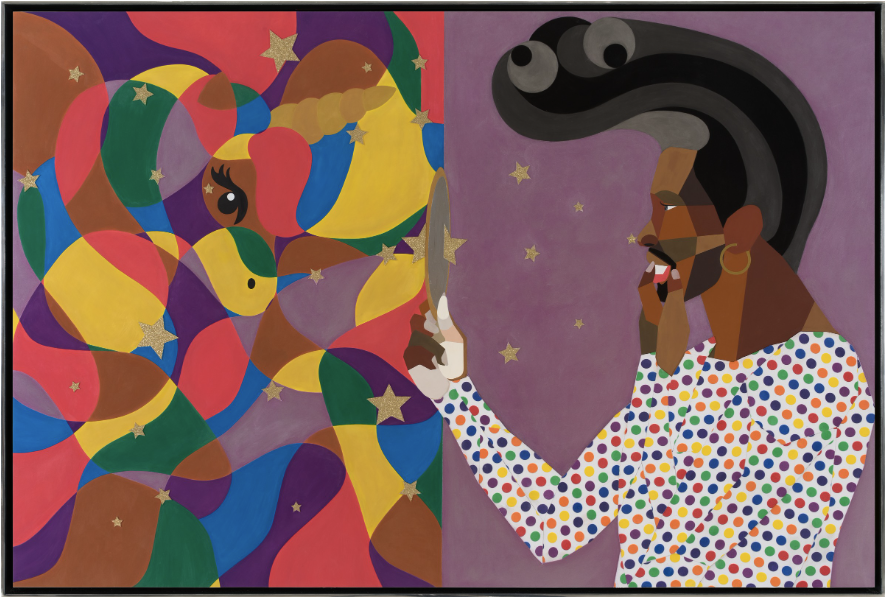
Derrick Adams, Abracapocus, 2025. Image: © Derrick Adams Studio
How the Derrick Adams market actually works
On the secondary market, Derrick Adams is not one pool. Across 88 public lots, sell-through sits at about 82%, but the overall median is only $12,600. That headline number is true and misleading at the same time, because Adams has an active edition market beneath a much more selective unique-work market. If you are trying to read Derrick Adams auction results as a price range, you start with the series and the format, not the artist-wide average. That is especially true for a practice now framed by Gagosian, museum programmes such as Situation Comedy and View Master, and the longer institutional arc around Floaters and Beauty World [4][6][9][11].
The ceiling: Figure in the Urban Landscape
This is where the ceiling lives. Figure in the Urban Landscape holds the auction record for Adams at $250,000, and the large square examples cluster around $238,400, while the smaller 63.5 cm versions sit nearer $69,850. Buyers are paying for a very specific Adams proposition here: urban grid, grip tape, model cars, fabric collage, and a panel support that reads as finished, architectural, and flagship. That is why these works behave differently from Under the Soft Light, Holding Court, or even a strong editioned Beauty World group. If you own a city-grid panel, you are not selling into the generic Derrick Adams market. You are selling into his benchmark tier.
The barometer: full-scale Floaters
The clearest sentiment barometer is the full-scale Floater. Museum-scale Floaters carry a median around $62,980, while petite Floater works sit closer to $10,000. That gap is the market telling you that the leisure motif by itself is not enough; buyers want the canonical series at the scale that made it culturally legible through exhibitions such as Buoyant and through holdings in serious collections [9][11]. Inference: when the full-size Floaters hold, confidence in Adams’s core language is intact. When the smaller or more derivative float works are doing the transacting, buyers are asking for a discount.
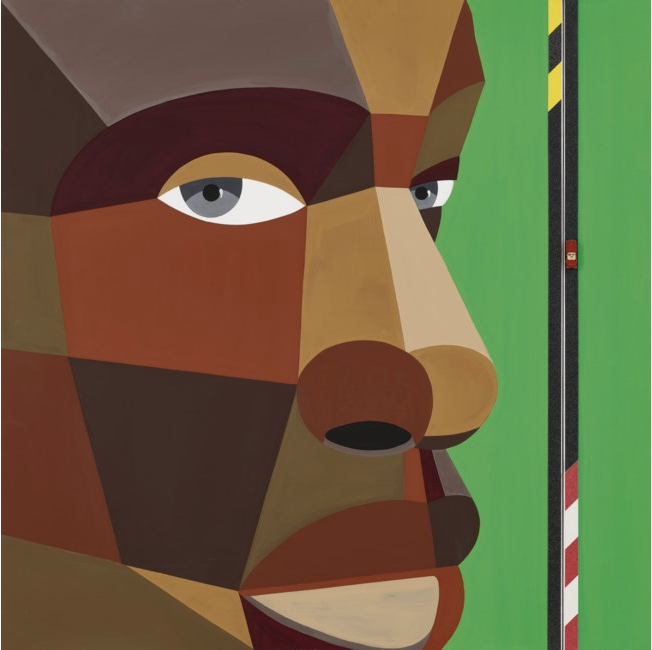
Derrick Adams, Figure in the Urban Landscape 26, 2018. Image: © Derrick Adams Studio
The liquidity layer: editions and portfolios
Below the flagship tiers sits a very real edition market. Its median is about $5,500, but the best portfolios and technically ambitious editions can move materially higher, with How I Spent My Summer reaching $40,640. That makes editions useful for liquidity, but not reliable as ceiling-setting comparables. It also explains why the public tape can look softer than the best unique works really are: Self Portrait on Float, Under the Soft Light, Holding Court, Parlay, and Beauty World: four prints keep turnover visible, while museum and publisher activity around Eye Candy and Tandem Press keeps the edition branch of the oeuvre active [8][10][11]. Liquidity matters. It is just not the same thing as benchmark demand.
The recent shift is toward selectivity, not disappearance of demand. Over the last 12 months, sell-through fell to about 63%, and only half of the unique or sculptural works offered found buyers. The passes are also telling. Right At Home (Man), Lady with Red Rose, We Came to Party and Plan 23, and a higher-estimate Mirroring Idealism print all failed publicly. The market is still validating Derrick Adams, but it is no longer validating every Derrick Adams equally. That changes routing.
What buyers really pay for: series, scale, and provenance
The Adams market rewards series recognition before it rewards medium labels. That is why Style Variation 4 could leap into top-tier territory, and why a strong work on paper such as You’ve Been Served can sit in a very different bracket from a standard print. It is also why an edition with a familiar Adams title can still trade like an edition. For a seller, the practical implication is simple: you should describe your work first by series, image family, and support — Figure in the Urban Landscape panel, full-scale Floater, Beauty World-related unique work, editioned Self Portrait on Float — and only then by the broad category of painting, work on paper, or print.
Programme matters as well. Since Gagosian announced global representation in 2023, Adams has been framed through Situation Comedy in London, The Strip in Seoul, the Parrish Art Museum’s FRESH PAINT, the McNay’s Eye Candy, and ICA Boston’s forthcoming View Master survey [3][4][5][6][7][8]. Tandem Press also positions Beauty World as an active body of work and notes institutional holdings that include the Brooklyn Museum, the Met, the Studio Museum in Harlem, the Whitney, and the Virginia Museum of Fine Arts [11]. None of that guarantees a higher price. It does mean buyers have a current programme against which they will read your work. The closer your object feels to that living conversation, the easier it is to justify ambition without overreaching.
Paperwork is where many Adams sales are quietly won or lost. Tandem Press states that Style Variation 5 (Fringe) is signed and numbered and comes with a documentation sheet, in effect a certificate of authenticity [10]. That kind of publisher-backed paperwork reduces friction for a buyer deciding between two comparable Adams editions. Data needed. A current written confirmation from Derrick Adams Studio, Gagosian, Tandem Press, or the original publisher would establish whether your specific work can be re-certified, or whether the original invoice, label, or certificate is mandatory for resale.
Why private sale is structurally logical here
Private sale is not a consolation channel in a Derrick Adams market. It is often the rational one. The wider art market behaved this way in 2024, when Art Basel and UBS reported that private sales by auction houses rose even as public auction values fell [1]. The 2026 UBS market research then showed the opposite mix in 2025 — public auctions recovered while reported private auction sales eased [2]. The point is not that private sale always wins. The point is that in selective conditions, sellers use it for control. That is the exact condition Adams owners are now facing.
For Derrick Adams, private placement makes the most sense in the upper-middle tiers and in work that needs context. A Figure in the Urban Landscape panel or a full-scale Floater may deserve a narrow, informed buyer universe rather than a public estimate that hardens into a ceiling. A work such as Lady with Red Rose or Right At Home (Man) can also benefit from discretion if the issue is not quality but fit: the public room may hesitate, while a targeted buyer who follows Situation Comedy, The Strip, or View Master may read the same object very differently. In private sale, you can centre the actual selling points — series, scale, provenance, exhibition relevance, condition — instead of allowing one unsold appearance to define the work.
This matters even more because Adams has a broad edition layer beneath the unique-work market. Public auction is good at clearing Under the Soft Light, Holding Court, or standard print material. It is less good at explaining why one singular work belongs near the flagship conversation and another does not. Private sale lets that argument happen properly. In a market with real liquidity but uneven public appetite, that is not a fallback. It is discipline.
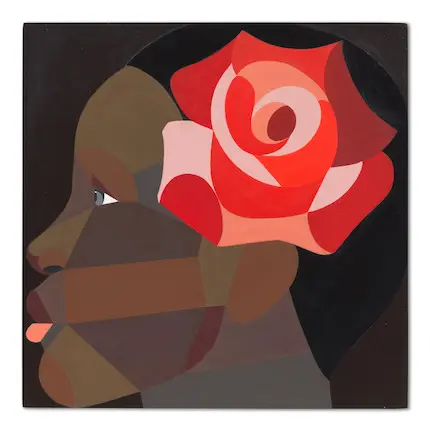
Derrick Adams, Lady with Red Rose, 2023. Image: © Derrick Adams Studio
Sell now or wait
Sell now if your work already sits inside the market’s core language
Now is a good moment to sell if your Adams already looks like what the market recognises at first glance: a Figure in the Urban Landscape panel, a full-scale Floater, or a major unique work on paper with unmistakable series identity. The barometers are there. The city-grid works own the ceiling. The full-size Floaters still sit far above the edition layer. And the external programme — Gagosian in London and Seoul, ICA Boston in 2026 — keeps the artist visible to exactly the kind of buyer who wants a resolved, recognisable Adams object [4][5][6]. The practical move is to get a valuation now, then choose the route that protects the comparison set you actually want buyers to use.
Wait if the work needs more context than the room currently gives it
Waiting can be rational if your work sits outside the clearest barometers and the paperwork is not yet strong enough. That includes smaller Floater variants, mid-tier editions, wall-relief material such as Mirroring Idealism, or works that need gallery, publisher, or exhibition context to be read correctly. The recent tape is harsher on that material than on the flagship series. More time can help if it allows you to recover provenance, confirm a certificate, secure publisher documentation, or sell closer to a museum or gallery programme that sharpens the story around the work [7][10][11]. But waiting only makes sense when something becomes clearer. Waiting without better placement, better paperwork, or a stronger narrative is only delay.
The calm conclusion is this: now is a good moment to sell a Derrick Adams work only if you route it like a specialist. The public market still validates the right object. It is simply less forgiving of the wrong comp, the wrong estimate, or the wrong channel. If your work sits inside Adams’s recognised image systems, there is a rational case for action. If it sits outside them, preparation may be more valuable than haste.
Sell your Derrick Adams work with Artscapy
- Get a price range in about 60 seconds. If it looks right, request purchase offers within 48 hours with 0% seller fee.
- Start with a 60-second estimate. Instant price range, backed by auction data refreshed every 24h.
- Pick your path. Fast Sale for speed, or Maximise Returns for an advisor-led strategy.
- Fast Sale. Get a non-binding offer in 1–3 working days, where eligible. Maximise Returns. Choose private placement, targeted auction, or a hybrid route based on what your work actually is — benchmark Figure in the Urban Landscape, sentiment-barometer Floater, or edition-layer material.
- Close cleanly. 0% seller commission, transparent costs, escrow-protected. Payout within 7 days of collection. Fast Sale payout initiated the same day once the work is in our care.
Sources and references
[1] The Global Market — The Art Basel & UBS Art Market Report 2025. Art Basel & UBS / Arts Economics, 2025. Accessed 16 March 2026.
[2] Art Market Research. UBS Global, March 2026. Accessed 16 March 2026.
[3] Derrick Adams. Gagosian, announcement of global representation, 2 March 2023. Accessed 16 March 2026.
[4] Derrick Adams: Situation Comedy, Davies Street, London, February 13–March 29, 2025. Gagosian, 2025. Accessed 16 March 2026.
[5] Derrick Adams: The Strip, APMA Cabinet, Seoul, September 3–October 12, 2024. Gagosian, 2024. Accessed 16 March 2026.
[6] Derrick Adams: View Master. Institute of Contemporary Art/Boston, 2026. Accessed 16 March 2026.
[7] FRESH PAINT: Derrick Adams. Parrish Art Museum, 2024. Accessed 16 March 2026.
[8] Derrick Adams: Eye Candy. McNay Art Museum, 2024. Accessed 16 March 2026.
[9] Derrick Adams. Hudson River Museum, 2020. Accessed 16 March 2026.
[10] Derrick Adams, Style Variation 5 (Fringe), 2023. Tandem Press, 2023. Accessed 16 March 2026.
[11] 2024 New Editions: Derrick Adams, Where My Girls At? Tandem Press, 24 September 2024. Accessed 16 March 2026.
