

Francis Picabia market analysis. Is now a good moment to sell? (March 2026)
Last updated: 16 March 2026.
If you own a Francis Picabia, the temptation is obvious: a public auction result can validate the work in one stroke. The risk is just as obvious. Picabia’s market is not one smooth ladder but several separate lanes, from rare late-1920s paintings that can reset the ceiling to recurring small papers that trade far more often and far more cautiously. The question is not simply whether demand exists. It is whether your Picabia belongs in the lane that benefits from public theatre, or in the lane where control matters more. Selective, but open.
Data note. The figures below reflect public auction results recorded between 27 February 2018 and 6 March 2026. Public auction data is only one part of the Picabia market, and results can move as new sales, private placements and fresh scholarship emerge.
→ Start with a valuation. Click here and get a price range in about 60 seconds.
In this article
- The short answer
- The Picabia sale that reset expectations
- How this market actually works
- Why private sale often makes more sense
- Sell now or wait?
- Sell your Picabia with more control
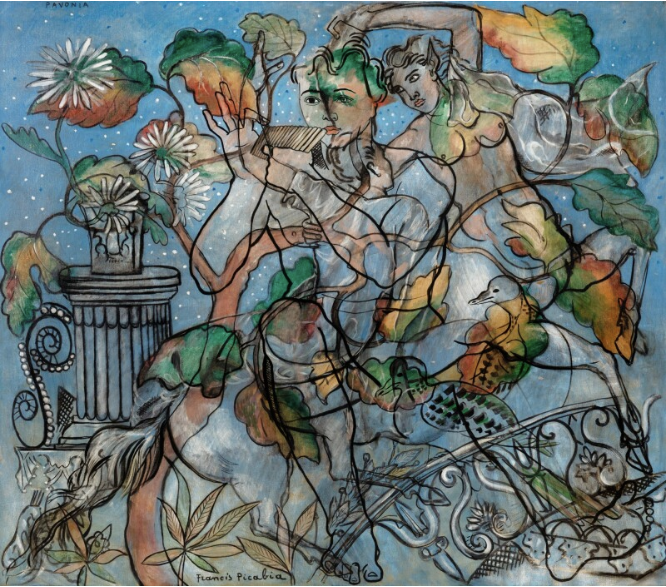 Francis Picabia, Pavonia, 1929. Image: © Sothebys
The short answer
Picabia is healthy in aggregate, but misleading if you read him as a single market. Across the public tape, sell-through sits at about 85%, with a median public result around US$78,000. That sounds reassuring until you separate the rare late-1920s paintings, the active 1930s and 1940s figurative pictures, the earlier landscapes and abstractions, and the much broader paper market. One blended median tells you very little about where your work truly sits.
The more useful signal is that conditions are firmer than they were a year ago. Over the last 12 months, public sell-through rose to roughly 92%, versus roughly 73% in the prior 12-month period, while the blended median moved from about US$74,000 to about US$104,000. The improvement looks more like better absorption and cleaner routing than a broad speculative rerating. That matters, because Picabia sellers usually gain more from precision than from excitement.
The Picabia sale that reset expectations
At the top end, one work can change how the whole artist is read. For Picabia, that moment was Pavonia. The 1929 painting sold in Paris in March 2022 for about US$10.4 million, and it mattered not only because it set the record in this public tape, but because it reminded collectors that late-1920s Picabia can command serious competition when scale, image power and period certainty all align.
The after-effect was the real story. The later appearance of Deux amies at about US$4.6 million in London in September 2025 showed that buyers did not treat Pavonia as an isolated oddity. They treated it as proof that the right Picabia still carries authority. That is why sellers should not ask, “What is the artist’s average?” They should ask, “Does my work participate in the part of Picabia that collectors fight over?”
How this market actually works
Picabia’s market is a market for reinvention. The scholarship, the catalogue raisonné structure, and major institutional and gallery programmes all organise his career by abrupt turns rather than by one stable signature style: early landscapes and abstraction, mechanomorphic Dada, monsters and Transparencies, wartime figuration, then post-war abstraction and dot paintings [2][3][4][7]. Buyers pay most when a work falls clearly inside one of those recognised turns, because that is how the oeuvre is understood and defended.
The ceiling lives in late-1920s and early-1930s painting
This is the prestige lane. Publicly, paintings dated 1925 to 1932 sold 18 of 19 offered works, with a median result of around US$1.2 million. That is where Picabia stops behaving like a broad mid-market modern name and starts behaving like a scarce, institutionally legible modern master. If your work sits here, the issue is not whether there is demand. The issue is how carefully you stage it.
The clearest barometer inside that lane is the named 1929 painting. Eight such works sold from eight offerings, with a median around US$2.4 million, and titles such as Pavonia, Ligustri, Minos, Tarin and Rubi are the pictures that keep Picabia’s ceiling visible. That also makes sense art-historically: the Comité Picabia’s volume III places the shift from monsters into Transparencies and adjacent figurative experiments at the heart of this phase, and MoMA holds a Transparence work from around 1930 in its collection [2][8]. This barometer carries Picabia’s brand equity. It helps adjacent works, but it is not a direct comparable for a later board or a smaller, less resolved picture.
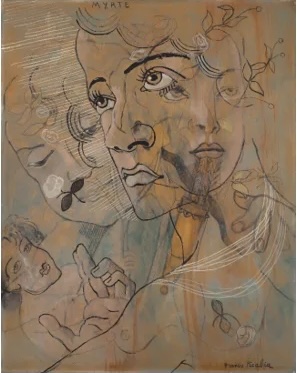 Francis Picabia, Myrte (from the Transparency series), 1928. Image: © Christie’s
Real liquidity sits in the 1930s and 1940s figurative pictures
For many collectors, this is the practical market. Paintings dated 1933 to 1945 sold 46 of 55 offered works, with a median around US$200,000. That is a very different proposition from Pavonia, but it is still a meaningful and active level of liquidity. It is also where seller discipline matters most, because the gap between an ordinary late work and a strong one is wide.
The market is telling you what it rewards. Deux amies, Nu de dos, Homme et femme au bord de la mer and La corrida (le matador dans l'arène) show buyers leaning toward resolved figuration, scale, and compositions with enough visual authority to stand above the crowd. Recent programming helps here too: Michael Werner framed women as a through-line across Picabia’s last decades, while Hauser & Wirth first focused on the final years in 2025 and then scheduled a broader London overview for 21 May to 1 August 2026 [3][4][5][6]. That does not guarantee a higher price. It does mean late Picabias currently have a live curatorial story rather than a dormant one.
Works on paper trade often, but paper is not one market
This is where many sellers go wrong. They see activity and assume comparability. In reality, Picabia’s paper market is split between recurring, lower-value formats and rarer, historically charged sheets that behave like a different asset altogether.
The best lower-barometer example is the recurring Sans titre charcoal sheet at roughly 26 x 34 cm. That format sold 48 times from 54 offerings, with a median around US$34,000. That is genuine liquidity, and for the right seller it can make public auction an efficient route. But it is not the same market as a dated Dada or transitional sheet. Tournez rare, a 1919 gouache, ink and pencil work on cardboard, made about US$1.1 million in London in March 2026. Paper buyers are not paying for “a work on paper by Picabia.” They are paying for period, image and narrative placement inside the artist’s reinvention story [2][6].
Paperwork is part of the price
Picabia is not a casual paperwork market. The Comité Picabia states that it safeguards the archives, authenticates works and is publishing the catalogue raisonné in chronological volumes, while also noting that some works were lost, destroyed, reworked, or still require additional research or first-hand examination before inclusion [1][2]. For a seller, that means documentation is not an afterthought. It is one of the value-forming variables.
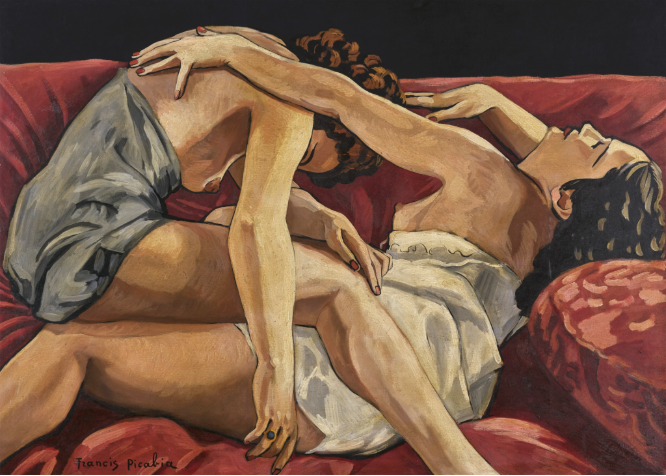 Francis Picabia, Deux amies, circa 1940-41. Image: © Sothebys
Why private sale often makes more sense
Private sale is not a consolation prize in a Picabia market like this. Public auction works brilliantly for the small number of pictures that already carry clear period recognition and can justify Paris or London theatre. It is less efficient for works whose value depends on sequence, scholarship, or speaking to a narrow set of buyers who already understand the period.
That is especially true because Picabia’s public high end is narrow. In this tape, 20 of the 21 public results above US$1 million happened in Paris or London. So if your work belongs to the late-1920s painting lane, or to a late picture that benefits from the current Hauser and Michael Werner framing, private placement can preserve control while you speak only to buyers who are already equipped for the conversation. That is not secrecy for its own sake. It is routing discipline.
The broader market supports that logic. Art Basel and UBS reported that in 2024 private sales by auction houses rose 14% even as public auction values fell 25%, and that in 2025 reported private sales eased but still remained just under US$4.2 billion while the broader market recalibrated into a more disciplined range [9][10]. When the public market becomes selective, private sale becomes a tool for reducing comparables risk, not a retreat from demand.
For Picabia, the right channel should follow the work. A Saint Antoine-scale canvas, a late-1940s painting that benefits from current final-period attention, and a small charcoal Sans titre sheet should not all be asked to prove themselves in the same arena. Private sale is most rational when your work is good enough to deserve context, but too thinly compared to benefit from being thrown straight into the open tape.
Sell now or wait?
Sell now if the work already reads clearly
Sell now if your Picabia already sits cleanly inside a recognised lane: a documented 1930s or 1940s figurative painting, a strong early landscape, or a rare Dada paper with obvious period identity. The public market is currently more absorbent than it was a year ago, and the 1933 to 1945 painting lane in particular placed 8 of 8 offered works over the last 12 months, with a median just under US$200,000. That combination of liquidity and live curatorial attention is good enough to act on.
The same is true for the right early work. Les arbres en fleurs à Villeneuve-sur-Yonne, a 1906 painting, made about US$882,000 in London on 6 March 2026. That matters because it confirms that pre-Dada Picabia is not just an appendix to the later market. It has its own collector base when the image, date and quality are convincing. Sell now when your work can be understood quickly and defended easily.
Wait if the work needs context more than urgency
Wait if your Picabia belongs to the thin top tier or if the file is not yet strong enough to survive public scrutiny. The late-1920s painting barometer is already healthy: the 1925 to 1932 painting lane sold 18 of 19 works, with a median around US$1.2 million. That suggests the upside from waiting is less about hoping for a generic market boom and more about improving stagecraft, literature and timing.
That logic becomes stronger because the near-term programme is real. Hauser & Wirth’s London Picabia overview opens on 21 May 2026 and explicitly ranges from early landscapes and Dada works to Transparencies, wartime figuration and final abstractions [4]. If your work belongs to one of those eras but needs sharper framing, use the time to tighten the file and choose the route. Do not wait passively. Wait with a purpose.
Calmly put, Picabia rewards clarity and punishes over-generalisation. The next marginal gain for most sellers is more likely to come from better paperwork, tighter period placement and smarter buyer selection than from simply hoping the whole market gets hotter.
Sell your Francis Picabia with more control
Whether you own a late-1920s painting closer to Pavonia or Saint Antoine, a 1940s picture closer to Deux amies, or a small charcoal Sans titre sheet, the first step is the same: place the work in the right lane. Get a price range in about 60 seconds. If it looks right, request purchase offers within 48 hours with 0% seller fee.
- Start with a 60-second estimate. You get an instant price range backed by auction data refreshed every 24h, so your Picabia is judged against the right period, scale and product type, not against a generic artist average.
- Pick your path. Choose Fast Sale if speed matters, or Maximise Returns if the work deserves a more strategic route. For a recurring charcoal Sans titre, speed can be rational. For a 1929 painting, a 1906 landscape, or a strong 1940s figurative picture, advisor-led strategy is usually the better instrument.
- Match the route to the work: Fast Sale. Get a non-binding offer in 1–3 working days (where eligible). For the right Picabia, that can be the cleanest solution.
- Maximise Returns. Choose private placement vs targeted auction vs hybrid. Strategy based on what your work actually is.
- Close cleanly. 0% seller commission, transparent costs, escrow-protected. Payout within 7 days of collection (Fast Sale payout initiated same day once in our care). Once your Picabia is correctly placed, the final stage should feel administrative, not uncertain.
Sources and references
[1] Comité Picabia, “Home / Presentation.” Comité Picabia. Accessed 16 March 2026.
[2] Comité Picabia, “Catalogue Raisonné.” Comité Picabia. Accessed 16 March 2026.
[3] Hauser & Wirth, “Francis Picabia: Eternal Beginning.” Hauser & Wirth, 2025. Accessed 16 March 2026.
[4] Hauser & Wirth, “Francis Picabia.” Hauser & Wirth, exhibition page for London, 21 May–1 August 2026. Accessed 16 March 2026.
[5] Michael Werner Gallery, “Francis Picabia: Femmes.” Michael Werner Gallery, 2024. Accessed 16 March 2026.
[6] Michael Werner Gallery, “Francis Picabia: Women: Works on Paper 1902–1950.” Michael Werner Gallery, 2024. Accessed 16 March 2026.
[7] The Museum of Modern Art, “Francis Picabia: Our Heads Are Round so Our Thoughts Can Change Direction.” MoMA, 2016. Accessed 16 March 2026.
[8] The Museum of Modern Art, “Francis Picabia. Transparence - Tête et Cheval. (c. 1930).” MoMA Collection. Accessed 16 March 2026.
[9] Art Basel & UBS, “The Global Market — The Art Market 2025.” Art Basel / UBS / Arts Economics, 2025. Accessed 16 March 2026.
[10] Art Basel, “Global sales rise 4% to $59.6 billion in 2025, amid ongoing market recalibration.” Art Basel, 12 March 2026. Accessed 16 March 2026.
