
Helen Frankenthaler market analysis. Is now a good moment to sell? (March 2026)
Last updated: 16 March 2026.
If you own a significant Helen Frankenthaler, the problem is not recognition. It is routing. A late-1970s canvas, a Painted Book Cover, and a Tales of Genji sheet all benefit from her name, but they do not compete in the same buyer universe. The wrong channel can flatten that difference before the right collector even sees the work. This is a market where validation, selectivity, and control have to be balanced. Selective, not soft.
Data note: This analysis reflects public auction results from March 2018 to February 2026, expressed in USD equivalents. Prices use the public sale amount available in the record; where a premium-inclusive result was published, that is the figure reflected. Across 446 public lots, sell-through is about 93%, excluding one withdrawal [1].
→ Start with a valuation. Click here and get a price range in about 60 seconds.
In this article
- A benchmark that reset expectations
- How the Frankenthaler market actually works
- Why private sale makes structural sense here
- What buyers will ask for before they stretch
- Sell now or wait?
- How to start with Artscapy
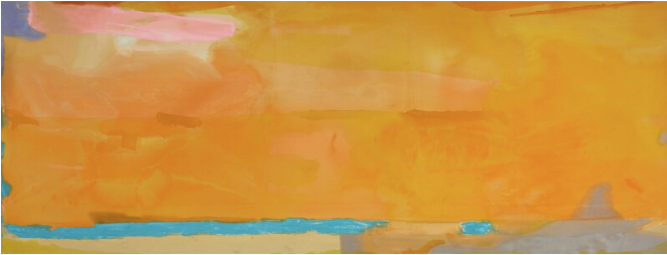 Helen Frankenthaler, Royal Fireworks, 1975. Image: © Sothebys
A benchmark that reset expectations
When Basin, a 1979 acrylic on canvas, realised about $4.53 million at Christie’s New York in May 2025, it mattered because it kept Frankenthaler’s top lane visibly active [1]. The market had already seen the exceptional $7.90 million result for Royal Fireworks in 2020, but Basin showed that the ceiling for a major late-1970s Frankenthaler was not a one-cycle anomaly [1].
Inference: buyers are still willing to compete when a work combines scale, assurance, and a recognisable period signature. That is the real signal. A serious Frankenthaler can still generate competition, but only when it reads as a central example rather than a secondary one.
How this market actually works
Liquidity sits at the repeat-print end. The ceiling lives with large 1970s canvases. The middle — late papers, painted book covers, and distinctive unique works — only performs when the object is clearly legible.
The public median for paintings is about $780,000, for works on paper about $82,000, and for prints about $8,000 [1].
Inference: the market is not pricing the name alone. It is pricing product, rarity, and how clearly your work fits a recognised Frankenthaler hierarchy.
The ceiling lives in large 1970s canvases
The strongest public price signal sits in Frankenthaler’s large 1970s paintings. That decade carries a public median of about $1.27 million and is most consistently associated with her highest auction benchmarks [1]. That ceiling is also New York-centred in public sale, which matters when choosing between public exposure and controlled placement [1].
Current museum programmes are reinforcing this exact image of Frankenthaler: ambitious, large-format paintings and a sustained narrative of painterly reinvention [4][6][7].
Inference: if your work belongs to that family of expansive, compositionally commanding canvases, you are selling into a lane the market already understands. If it does not, forcing it into a trophy conversation can be counterproductive.
Works on paper can outperform the middle, but only when the object is legible
Frankenthaler’s works on paper are not a uniform middle tier. The public median sits around $82,000 [1], but this category spans Painted Book Covers, Canal Street X, late untitled acrylics, and small gouaches that behave very differently in the market.
Recent curatorial framing has reinforced late works on paper as a serious field in their own right, particularly in her final decade [3].
Inference: a strong late paper with scale, date, and convincing provenance should not be treated as generic supply. It requires deliberate placement.
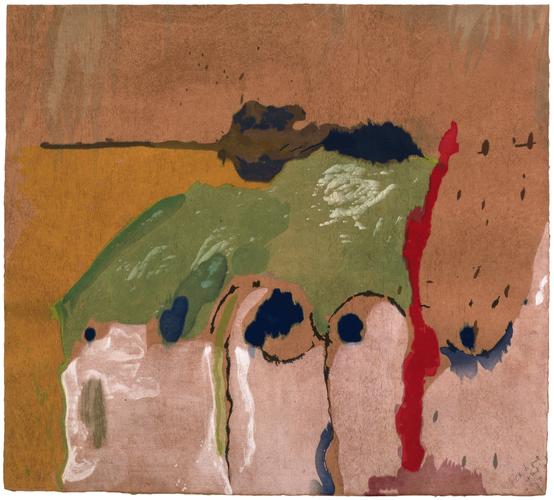
Helen Frankenthaler, Tales of Genji I, 1998. Image: © Helen Frankenthaler Foundation
The print market splits in two
In Frankenthaler, “print” is not a single category. Deluxe woodcuts, monoprints, and mixografias — Tales of Genji, Freefall, Book of Clouds, Gateway, Guadalupe — carry a public median of about $38,500, while standard editioned prints sit closer to $6,500 [1].
This division reflects how her print practice is understood: collaboration, process, paper, and scale matter as much as the image [9].
The clearest public barometer is Tales of Genji. It has traded consistently, holds a median around $60,000, and the strongest sheets have reached about $252,000 [1].
Inference: when Tales of Genji is firm — as it was again after a softer 2024 result — buyers are rewarding technically ambitious printmaking, not simply buying “a Frankenthaler print” [1].
By contrast, recurring titles such as Plaza Real, Solar Imp, Southern Exposure, and the Reflections sheets behave more like disciplined comparables than trophies [1][10][11].
Why private sale makes structural sense here
Frankenthaler’s public market runs on different tempos: rare major canvases, repeat-print liquidity, and an ambiguous middle of distinctive papers and deluxe editions. Private sale matters because it allows you to keep those tempos separate rather than forcing them into one public rhythm.
In the broader art trade, public auction sales fell 25% in 2024 even as private sales rose 14%. In 2025, after a high-end auction rebound, private sales still accounted for just under $4.2 billion globally [12][13].
This matters because Frankenthaler is a selective market where control over timing, audience, and narrative can preserve value.
For a major painting or a strong late paper, private placement allows you to approach collectors already primed by the current museum cycle without risking a public pass if colour, scale, or condition reads poorly in catalogue photography [3][4][5][6][7].
For a deluxe print, private sale solves a different problem. It allows works such as Tales of Genji, Freefall, or Book of Clouds to be discussed in terms of workshop, proof type, paper, and process, rather than being absorbed into a generic print session [1][9][10][11].
For routine editions, private sale is less about outperforming auction benchmarks and more about timing, documentation, and avoiding direct competition with comparable impressions.
There is a Frankenthaler logic to this. Her work balances control and chance; effective selling strategy does the same. You want enough exposure to attract conviction, but not so much that a nuanced work is reduced to an inappropriate comparable.
Inference: in a selective Frankenthaler market, private sale is strongest not when the work is weak, but when it is distinctive.
What buyers will ask for before they stretch
A certificate is not something you can improvise at the last minute in Frankenthaler. The Helen Frankenthaler Foundation states that neither it nor the Helen Frankenthaler Catalogue Raisonné, LLC, authenticates or attributes works. At the same time, the catalogue raisonné for unique works is ongoing, while the published print catalogue currently covers editions from 1961 to 1994, with an addendum for later prints planned [2][8].
Inference: provenance does more of the commercial work here than a generic certificate. Gallery invoices, publisher or workshop documentation, exhibition history, literature references, labels, verso photography, and a clear condition report all directly affect buyer confidence.
This is especially relevant for later prints or unusual works on paper.
Inference: a Tyler Graphics, ULAE, Pace Editions, or Mixografia paper trail can move a work from routine supply into a premium lane by clarifying exactly which Frankenthaler product the buyer is assessing [3][9][10][11].
A gallery invoice, publisher record, catalogue reference, or documented chain of title would confirm where the work should sit.
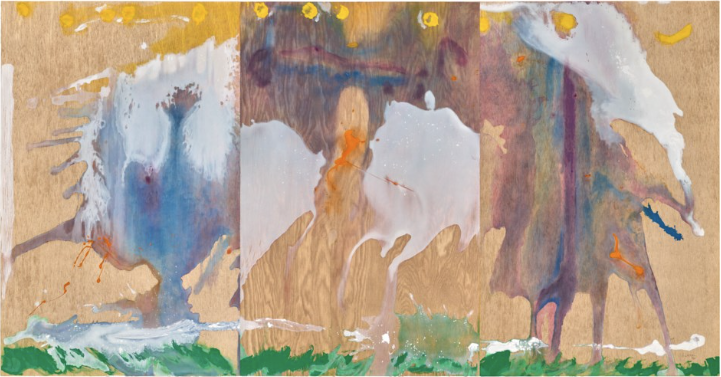
Helen Frankenthaler, Book of Clouds, 2007. Image: © Christie’s
Sell now or wait?
Sell now if your work already sits in a recognised lane
Sell now if what you own clearly fits the market’s hierarchy: a major 1970s painting, a strong late painting on paper, or a technically ambitious, well-documented print.
Frankenthaler’s upper tiers are being reinforced. The public market still pays for the right painting, and the Tales of Genji barometer indicates that advanced print buyers will stretch when the object warrants it [1].
Inference: if your work can be positioned alongside the current curatorial focus on scale, experimentation, and late paper, you are selling into recognition rather than anonymity [3][4][6][7].
Wait if your work looks more like routine supply
Wait if your work is a routine edition print, a tired impression, or something whose strongest argument depends on documentation you do not yet have.
In the last 12 months, Frankenthaler prints sold through at about 83%, down from roughly 89% in the prior comparable period [1]. This is not a collapse, but it does signal crowding.
The market will still absorb works such as Plaza Real, Solar Imp, Reflections, or Southern Exposure, but it will benchmark them tightly and penalise weak condition, poor timing, or unclear provenance.
If that is your position, waiting only makes sense if you can improve the documentation or rethink the routing before going to market.
The clear conclusion is this: now can be a good moment to sell a Helen Frankenthaler, but only if you are precise about what you own. The right moment depends on legibility, documentation, and placement within the correct buyer universe. This is a decision about hierarchy, not hope.
Start with the valuation, then choose the channel
Get a price range in about 60 seconds.
- Start with a 60-second estimate.
- Instant price range, backed by auction data refreshed every 24h.
- Pick your path.
- Fast Sale for speed, or Maximise Returns for adviser-led strategy.
- Choose the execution that matches your Frankenthaler.
- Fast Sale provides a non-binding offer in 1–3 working days, where eligible. Maximise Returns allows for private placement, targeted auction, or a hybrid route, depending on whether your work is a major canvas, a distinctive paper, or a repeat edition.
- Close cleanly.
- 0% seller commission, transparent costs, escrow-protected. Payout within 7 days of collection when applicable, with Fast Sale payout initiated the same day once the work is in our care.
Sources and references
[1] Public auction results for Helen Frankenthaler. Public sales data used for this page, March 2018–February 2026. Accessed 16 March 2026.
[2] FAQ - Foundation. Helen Frankenthaler Foundation. Accessed 16 March 2026.
[3] Helen Frankenthaler: Painting on Paper, 1990–2002. Gagosian. Published 25 July 2024; accessed 16 March 2026.
[4] Helen Frankenthaler: Painting Without Rules. Guggenheim Museum Bilbao. Published 11 April 2025; accessed 16 March 2026.
[5] Helen Frankenthaler. Move and Make. Museum Reinhard Ernst. Exhibition page accessed 16 March 2026.
[6] Helen Frankenthaler: A Grand Sweep. The Museum of Modern Art. Exhibition page accessed 16 March 2026.
[7] Exhibitions: Upcoming. Helen Frankenthaler Foundation. Accessed 16 March 2026.
[8] Catalogue Raisonné. Helen Frankenthaler Foundation. Accessed 16 March 2026.
[9] Without Limits: Helen Frankenthaler, Abstraction, and the Language of Print. Blanton Museum of Art. Exhibition page, 4 September 2021–20 February 2022. Accessed 16 March 2026.
[10] Tales of Genji I. Sheldon Museum of Art. Exhibition page, 11 August–23 December 2020. Accessed 16 March 2026.
[11] Tales of Genji VI. Smithsonian American Art Museum. Accessed 16 March 2026.
[12] The Global Market. The Art Basel & UBS Art Market Report 2025, by Arts Economics. Accessed 16 March 2026.
[13] The Art Basel and UBS Global Art Market Report 2026. Art Basel / UBS / Arts Economics. Published 12 March 2026; accessed 16 March 2026.