
Christie’s lecture: how the art market actually makes money
“A lot of people say they want to work in the art world. Much fewer can explain how the art world actually makes money.” - Emilia De Stasio
This observation captures a fundamental disconnect. The art market is often approached through the lens of culture, taste, and headline auction results, yet far less attention is given to the underlying mechanics that make it function as a set of businesses. To understand the market properly, it is necessary to move beyond the romantic narrative and examine how revenue is generated, how costs behave, and where risk accumulates.
This is not a discussion about whether art outperforms traditional asset classes, nor is it a guide to collecting. It is an exploration of how businesses in the art market are structured, how they operate, and why some models prove more resilient than others.
One of the most effective ways to understand the art market is to see it as an ecosystem rather than a category. On one side sit the producers, including artists, studios, primary galleries, publishers, and fairs, all of which are responsible for creation and initial placement. On the other side are the buyers and facilitators, such as collectors, advisors, dealers, auction houses, museums, and family offices, who shape demand and enable transactions. Surrounding both is an infrastructure layer that includes insurers, logistics providers, lenders, valuers, legal specialists, compliance professionals, and increasingly, software platforms. The art market is therefore not a simple chain but a network of interdependent actors, and the most durable businesses are often those that operate across more than one of these layers.
This distinction becomes critical when considering business models. The phrase “the art world” suggests uniformity, but financially the sector is highly fragmented. A gallery, an auction house, a lender, and a software company may all interact with the same artwork, yet they function in entirely different ways. One resembles retail, another brokerage, another secured lending, and another enterprise software. Without identifying the underlying model, it is not possible to analyse the business with any precision.
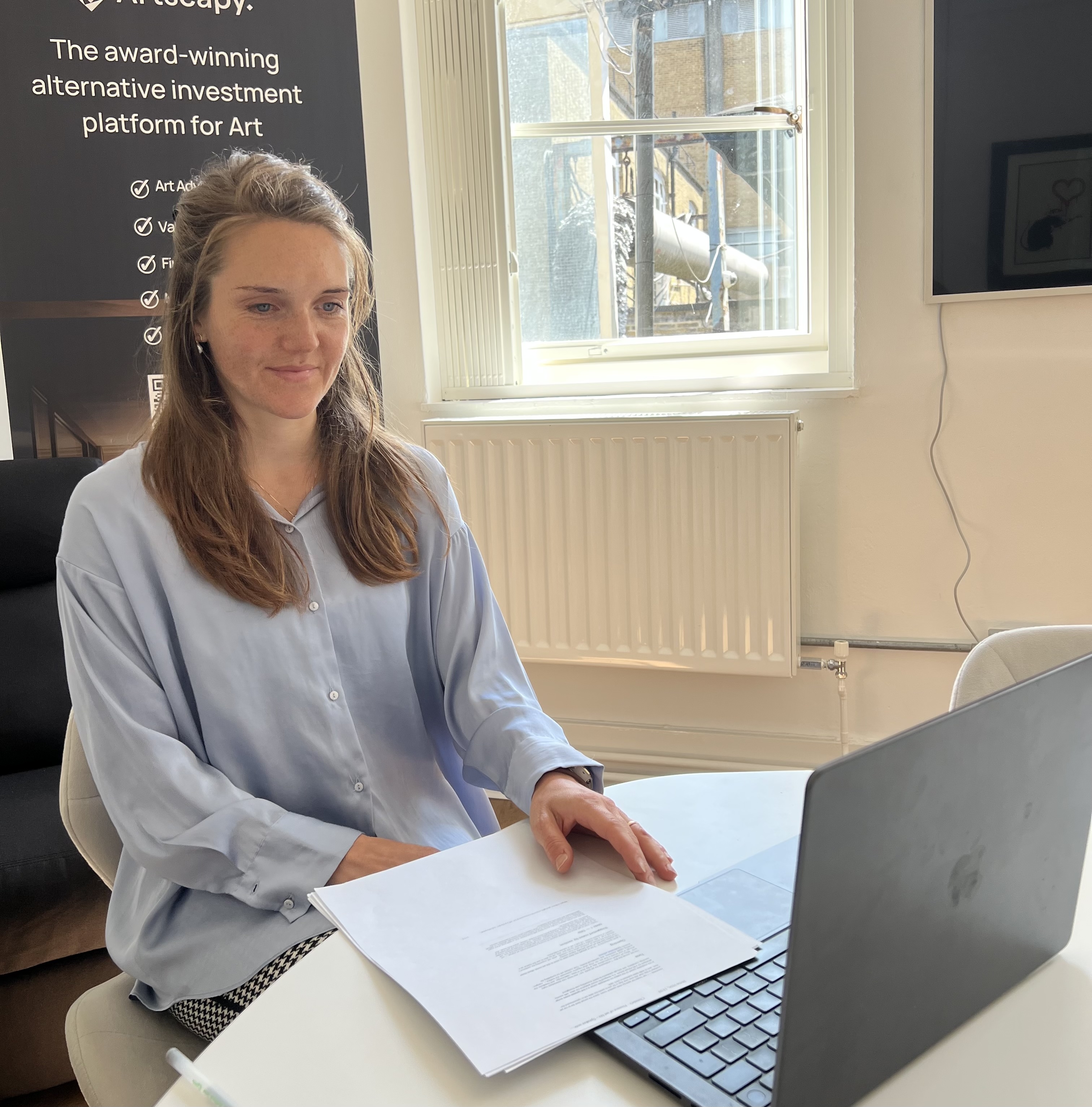
Emilia De Stasio delivering her lecture to Sotheby’s students in an online session.
Business models in the art market
Trading: Primary market
The oldest and most familiar model in the art market is trading. This includes galleries, dealers, and certain advisory structures that effectively monetise access to artworks. The principle appears straightforward, as value is generated through the spread between acquisition and sale, but the operational reality is considerably more complex. In the primary market, the widely cited fifty-fifty revenue split between gallery and artist provides a useful reference point, yet it obscures a substantial cost base. Galleries must absorb expenses related to rent, staffing, art fairs, logistics, marketing, installation, and the long-term development of artists. As a result, the sustainability of the model depends less on individual transactions and more on the ability to generate consistent demand and sufficient volume over time.
Trading: Secondary market
In the secondary market, the economics become more variable. Dealers may buy outright, broker transactions, or operate on consignment, and margins are often thinner and highly dependent on access and timing. The perception of successful dealing as a matter of intuition and taste is only partially accurate. In practice, it requires disciplined sourcing, negotiation, and careful management of liquidity, particularly to avoid capital becoming tied up in illiquid works.
Art fairs
Art fairs provide a particularly clear illustration of these dynamics. Participation requires significant upfront expenditure, including booth costs, shipping, insurance, staffing, and travel, all of which must be committed before any revenue is realised. Sales, by contrast, are uncertain and irregular. This creates a structural imbalance in which costs are fixed and immediate, while revenue is both delayed and unpredictable.
Advisory
Advisory businesses offer a different configuration. Because they typically do not hold inventory, they avoid many of the financial burdens associated with trading. This can result in a more asset-light model with potentially stronger margins. However, the trade-off lies in dependence on trust, reputation, and personal relationships. The service being sold is often judgment itself, which makes scaling inherently challenging.
Auctions
Auctions represent another major component of the market and are often the most visible, yet they are also frequently misunderstood. The hammer price reported in the press captures only part of the economic reality. Additional layers, including buyer’s premiums, seller’s commissions, guarantees, and significant marketing costs, shape the overall transaction. Auction houses operate as sophisticated intermediaries that manage both transactional flow and reputational risk, while sometimes taking on financial exposure through guarantees.
These guarantees are particularly instructive because they function as embedded financial instruments. They transfer downside risk to a third party in exchange for fees or potential upside, illustrating how financial logic is already integrated into the art market, even when it is not explicitly described in those terms.
Financing
The growing field of art-secured lending introduces a more direct connection to finance. In this model, collectors borrow against artworks rather than selling them, allowing them to access liquidity while retaining ownership. Revenue is generated through interest and fees, but the core challenge lies in underwriting. Assessing value, liquidity under stress, title clarity, and borrower behaviour is far more complex than simply determining whether an artwork is valuable. The critical question is whether the asset can be reliably recovered and monetised if required.
Within this framework, the loan-to-value ratio becomes a central variable. It reflects the balance between risk and attractiveness, as overly aggressive lending erodes downside protection, while overly conservative terms limit demand. This balance depends on confidence in valuation, depth of market, and the lender’s risk tolerance.
Other models
Other models, such as art funds and fractional ownership platforms, attempt to bring structures from traditional finance into the art market. These approaches aim to broaden access and create more investable formats, yet they introduce their own challenges. Issues such as valuation frequency, liquidity, regulatory compliance, and alignment between investor expectations and the inherently illiquid nature of art complicate their execution. Their long-term viability depends on whether they solve genuine market inefficiencies without introducing new structural weaknesses.
Software-based businesses
In contrast, software-based businesses operate on entirely different principles. Subscription models generate recurring revenue by providing tools for inventory management, client relationships, reporting, and logistics. Their economics are defined by metrics such as acquisition cost, lifetime value, retention, and churn, rather than transaction-based margins. While this creates the potential for scalability and predictability, adoption within the art market can be slow due to cultural preferences for relationship-driven processes.
Trade-offs across models
Comparing these models reveals that each represents a distinct trade-off between margin, capital intensity, predictability, and control. Trading offers high upside but uneven cash flow, auctions provide scale but involve operational complexity, lending generates recurring income but requires disciplined risk management, and software delivers predictability but depends on achieving sufficient scale.
These dynamics become even more complex when operating internationally. While the art market is global in demand, it is highly local in execution. Taxation, particularly mechanisms such as the UK margin scheme, can materially influence deal structures and profitability. Tools such as freeports and temporary admission facilitate cross-border movement and storage, yet they also introduce regulatory scrutiny. Currency fluctuations can quietly erode margins across multi-currency operations, requiring at least a basic treasury approach. At the same time, compliance obligations, particularly in relation to anti-money laundering regulations, have become an integral part of doing business rather than an optional administrative layer.
Beyond these structural considerations, the behaviour of collectors introduces another layer of complexity. Transactions in the art market are not purely transactional but relational. Collectors represent ongoing relationships and sources of future business, which affects how firms manage issues such as delayed payments. Late payment is not uncommon and has direct consequences for cash flow, storage costs, and operational efficiency. Similarly, the completion of a sale is not defined solely by agreement or invoicing, but by payment, collection, and physical transfer of the artwork. Until these steps are completed, financial and operational exposure remains.
A multi-model perspective highlights how these elements interact. Businesses that operate across trading, lending, and software gain insights that are not visible within a single model. Lending sharpens the understanding of liquidity and value under stress, software emphasises process and data discipline, and trading maintains proximity to collector behaviour and market timing. However, combining these models introduces significant managerial complexity, as each requires different capabilities, systems, and regulatory frameworks.
What emerges from this analysis is a more grounded view of the art market. While it may appear glamorous, its day-to-day operation is often characterised by friction, including slow payments, fragmented documentation, cross-border challenges, and heavy reliance on personal relationships. These factors make financial discipline essential, as they directly affect the sustainability of the business.
Ultimately, the most important conclusion is that there is no single way to operate within the art market. Each business model carries its own structure, risks, and opportunities. Strong margins do not guarantee strong cash flow, international reach introduces practical complications, and collector behaviour is inseparable from the economics of the business. At the same time, the most significant developments in the market are occurring at the intersection of finance, technology, and traditional practice. It is in this intersection that the market becomes more transparent, more structured, and more open to new forms of participation.
Understanding these dynamics does not diminish the cultural significance of art. Instead, it provides a clearer framework for engaging with the market, whether as an operator, investor, or advisor.
→ Interested in learning more? Explore Artscapy Advisory or book a call.