
Jonas Wood market analysis. Is now a good moment to sell? (March 2026)
Last updated: 16 March 2026.
If you are thinking about selling a Jonas Wood, the dilemma is not whether the artist is validated. He is. The real question is whether your work belongs to the part of the market that buyers still chase hard in public, or the part they now treat with much more discipline. Wood’s auction ceiling was built by large, unmistakably “Jonas Wood” paintings such as Japanese Garden 3, Two Tables with Floral Pattern, and Interior with fireplace, while current gallery and museum activity through Gagosian, Whitney, and the forthcoming Amorepacific Museum of Art survey shows that visibility is still there.[1][6][7][11][12] This is a market for disciplined routing, not casual consignment.
Data note: the figures below reflect public auction results from 7 March 2018 to 26 February 2026 and use hammer prices normalised to USD for consistency.[1] Public auction data is only one part of Jonas Wood’s market, especially for stronger paintings and better works on paper, so benchmarks can move as fresh private placements and new sale-room results appear.
→ Start with a valuation. Click here and get a price range in about 60 seconds.
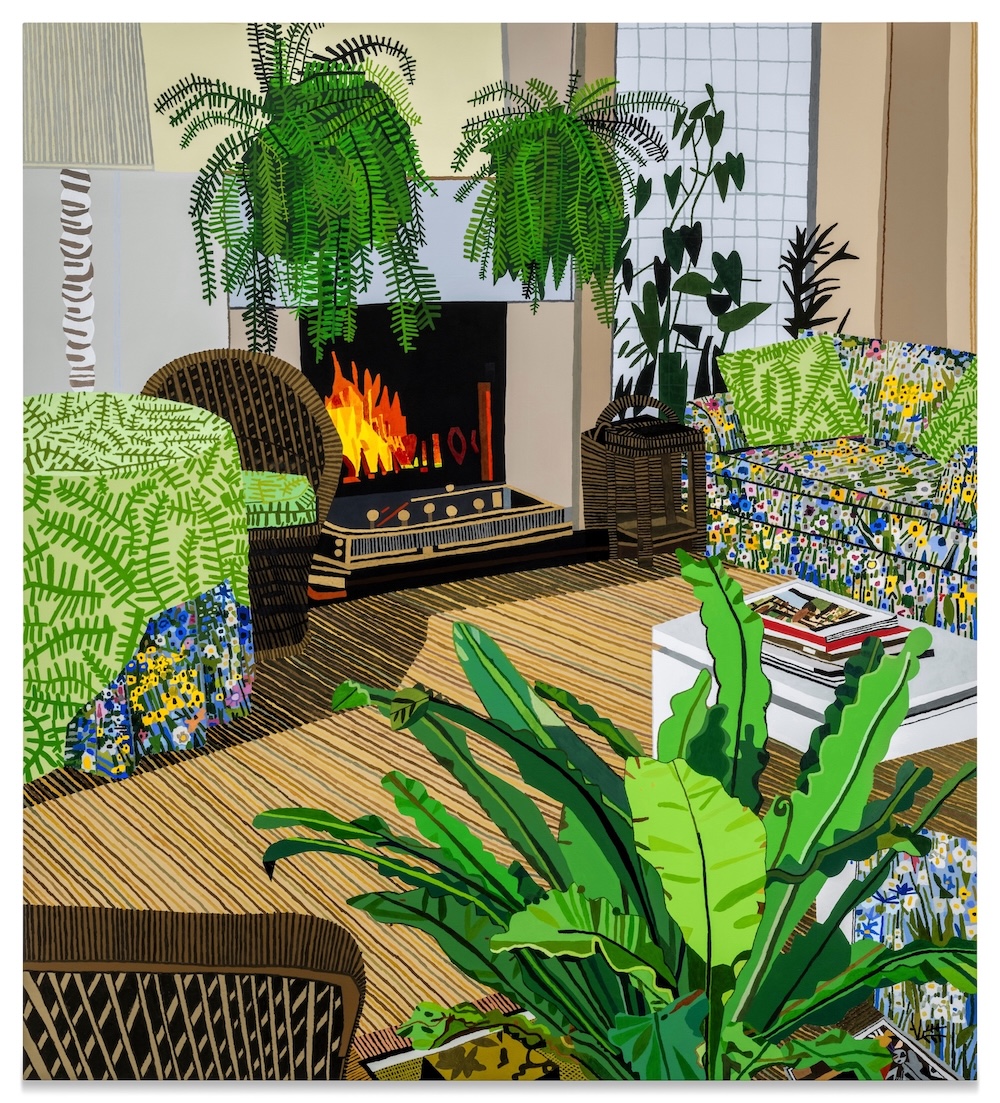
Jonas Wood, Interior with Fireplace, 2012. Image: © Jonas Wood
In this article
- How one Jonas Wood sale reset the ceiling
- How this market actually works
- Why private sale is structurally useful for Jonas Wood
- Sell now or wait?
- How to start with Artscapy
The sale that reset the ceiling
One sale still explains why Jonas Wood sellers have to think in tiers. When Japanese Garden 3 sold at Christie’s New York in 2019, it hammered at about $4.93m against a high estimate of $700k.[1] That result did more than set a benchmark. It taught buyers that a major Jonas Wood landscape at scale could jump from “strong contemporary painting” into trophy territory.
The later record of $6.51m for Two Tables with Floral Pattern in 2021 confirmed that the leap was not a one-off.[1] Since then, the ceiling has stayed real, but buyers have become far less willing to project that ceiling onto every pot, plant, basketball, or print. That is the mechanism you need to understand before you decide between auction and private sale.
How this market actually works
Jonas Wood does not have one market. He has several.
Just over half of sold Jonas Wood lots in the public tape are prints and multiples, and that segment’s median hammer is only about $2,450.[1] That is where a lot of public liquidity sits: accessible, frequent, and highly comparable. For a seller, that means visible activity, but it also means very fast buyer comparison.
Unique works on paper sit nearer $30,000, while paintings sit around $300,000.[1] So the name “Jonas Wood” is not a price point on its own. The object type is the first filter. If you own a painting, you are not in the same market as a poster. If you own a drawing, you should not let poster-level activity set your expectations.
That is why the overall median, at roughly $10,000, is more misleading than helpful.[1] It is pulled downward by the sheer volume of accessible print material, not by the paintings and stronger works on paper that serious sellers usually mean when they ask where their Jonas Wood sits.
Buyers reward recognisable Jonas Wood, not generic Jonas Wood
In the painting segment, plant, pot, and orchid pictures sit in a very different lane from smaller sports works. Plant-and-pot paintings median around $756,000, while basketball paintings sit closer to $37,500.[1] That gap is the hierarchy. The market pays for Wood’s most recognisable visual language, not merely for his signature.
That hierarchy also fits the artist’s public-facing programme. David Kordansky describes Wood’s recurring genres as still lifes, landscapes, portraits, and interior scenes; Gagosian’s recent London exhibition again centred plants, family, and interiors; and Gagosian’s artist page notes how imagery migrates between Shio Kusaka’s ceramics and Wood’s paintings.[4][5][6] If your work sits in that plant–pot–interior ecosystem, buyers tend to understand it faster and stretch further for it.
The clearest barometer is not a trophy canvas. It is Large Shelf Still Life.
The most useful public sentiment gauge is Large Shelf Still Life, because it is the most-traded Jonas Wood print image in the tape.[1] In the hotter 2018–2021 phase it was almost automatic at auction, with a median around $1,400.[1] That told you broad demand was willing to absorb familiar Jonas Wood imagery with very little hesitation.
By 2024–2026, the median had slipped to roughly $624 and sell-through had fallen to about 61%.[1] That does not mean buyers have stopped buying Jonas Wood. It means they now separate poster-level material from stronger signed, published editions much more aggressively. For a seller, that distinction is critical.
This is where many owners underprice or overprice. Screenprints such as Landscape Pot with Plant still operate in a different print tier from Large Shelf Still Life poster material, and Gagosian’s print survey, Prints 2, and Pace Prints’ Five Bonsais presentation all underline how developed and publisher-specific Wood’s print practice has become.[1][8][9][10] Use the barometer to read mood. Do not use it to value unlike objects.
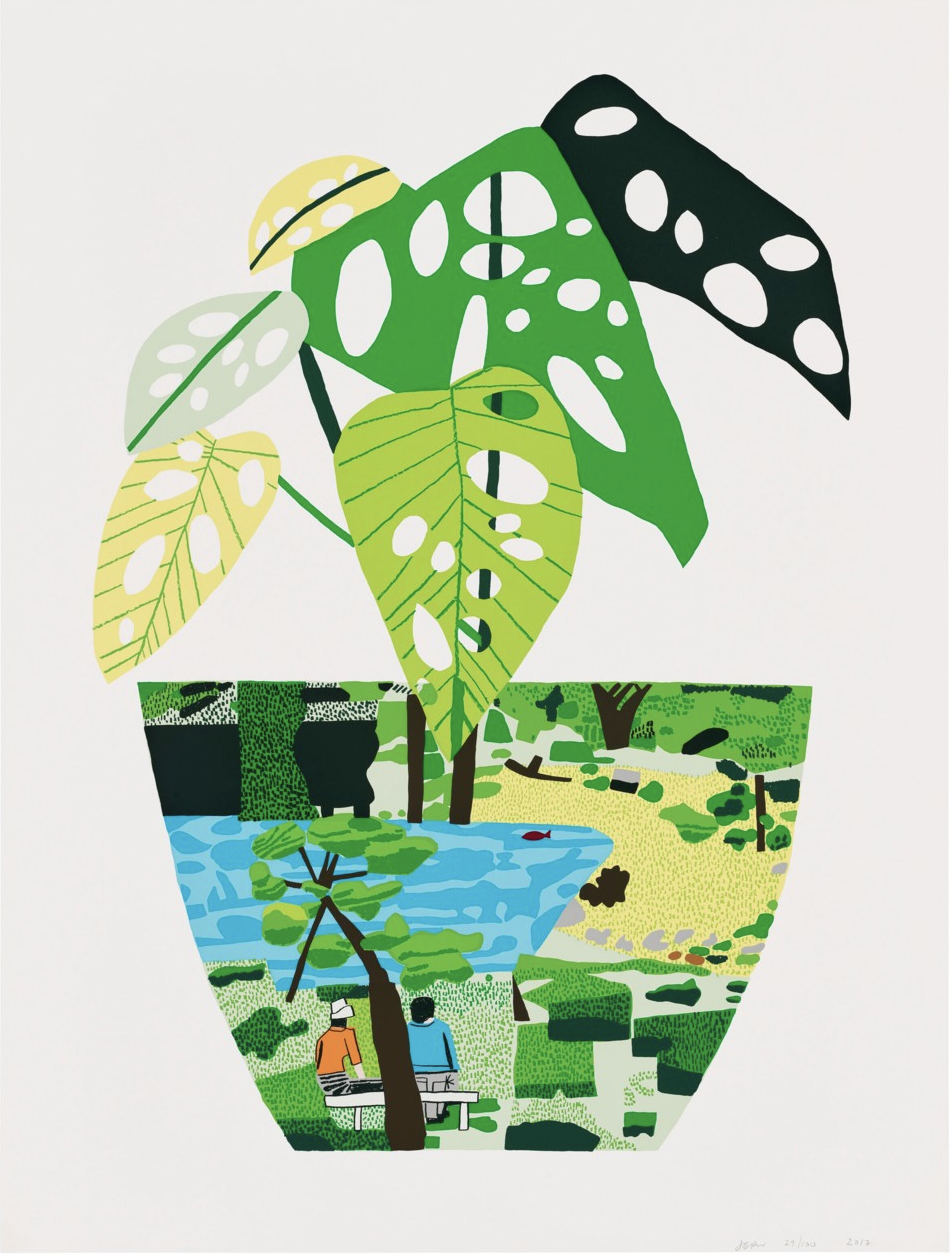
Jonas Wood, Landscape Pot with Plant, 2017. Image: © Jonas Wood
The recent tape is disciplined, not dead
The broadest sign of change is estimate behaviour. In 2018–2021, roughly 59% of sold lots beat their high estimate; in 2024–2026, that figure is about 17%.[1] The market has shifted from momentum bidding to price discipline.
Paintings still sit at the top of the hierarchy, and the larger painting tier still carries an overall median around $1.34m, but painting sell-through since 2024 is closer to 73% than to the near-clean absorption of the earlier run-up.[1] That is the practical difference between a supportive market and an easy market. Serious demand exists, but it is choosy.
External context matters here. Wood’s programme has not gone quiet: Gagosian showed new paintings in London in 2024, opened a new Beverly Hills exhibition in March 2026, Whitney recently accessioned Chelsea (2024), and the Amorepacific Museum of Art in Seoul will open Wood’s first institutional survey in Asia later in 2026.[6][7][11][12] So the softer auction tape is not about invisibility. It is about selectivity inside an artist market that still has strong institutional and gallery scaffolding.
Paperwork, certificates, and provenance
For Jonas Wood prints and editions, the paperwork question is unusually important because the market spans posters, publisher-backed screenprints, etchings, woodcuts, and works released under Wood’s own WKS Editions imprint.[8][9][10] Buyers do not just buy the image. They buy the edition structure, the publisher trail, the printer, the condition, and the confidence that the work belongs to the right release history.
A current written statement from Wood’s studio, WKS Editions, or the relevant publisher would confirm whether your specific work was originally issued with a certificate, whether replacement documentation is available, and what authentication or provenance documents buyers now expect.
Why private sale is structurally useful for Jonas Wood
Private sale is not a fallback here. In Jonas Wood, it is often the cleaner mechanism.
The reason is structural. More than half of the public tape is prints and multiples, which means the public market constantly produces fresh low-end and mid-tier comparables.[1] If your work is a large pot painting, a strong interior, or a substantial coloured-pencil work on paper, you usually do not want it judged in the same atmosphere as poster-heavy liquidity. You want it isolated and placed against the right comp set.
That logic also matches the wider market. Art Basel reported that private sales by auction houses rose 14% in 2024 even as public auction values fell, and its January 2026 market editorial notes that private transactions now account for around 20% of auction-house revenue, up from 12% a decade ago, because sellers value control over price and protection against a public failure.[2][3] In a Jonas Wood market where estimate-beating bids have become much rarer, that control is not cosmetic. It is rational.
Private placement is especially sensible if your work sits in one of Wood’s recognised premium lanes: large plant or pot paintings, important interior scenes, strong unique works on paper, or publisher-backed editions that should never be benchmarked against poster material.[1][4][5][8][9] A targeted private process can reach buyers who know the difference between Japanese Garden 3 and Large Shelf Still Life without exposing your work to a public pass. That is not consolation. It is better routing.
It can also be the right answer for better prints. Gagosian’s Prints 2 and the earlier Prints survey make clear that Wood’s editions are collaborative objects made with publishers such as Pace Editions, Cirrus, Hamilton Press, Mixografía, and WKS Editions, while Pace Prints’ Five Bonsais underscores the premium that comes with a specific, high-craft release structure.[8][9][10] In private sale, that nuance can be explained. In a crowded public editions sale, it can be flattened.
Sell now or wait?
Sell now if your work already sits in the market’s preferred lane
If your Jonas Wood is a strong plant, pot, garden, or interior painting, a substantial unique work on paper, or a signed publisher-backed edition with clean provenance, the case for selling now is solid.[1][4][5][8][9] Wood’s institutional and gallery visibility is active rather than historical, from Gagosian’s current Beverly Hills show and recent London exhibition to Whitney’s recent accession and the coming Seoul survey.[6][7][11][12] That gives buyers current reasons to pay attention.
The more sobering reason is the tape itself. The record remains $6.51m, but the strongest public result since the start of 2024 is $1.865m for Still Life with Cat and Fruit.[1] The ceiling has not vanished, but it has narrowed. If you can sell into today’s still-active visibility with the right routing and realistic price discipline, you are dealing with the market that exists, not the market you remember from the record years.
Wait if your work needs better evidence, not just better weather
Waiting makes more sense if your work sits in the crowded, substitutable part of the Jonas Wood market: posters, secondary print editions with weak paperwork, smaller sports studies, or unusual design and textile collaborations that do not slot neatly into his main painting hierarchy.[1][8][9] The Large Shelf Still Life barometer matters here. When the most-traded image softens in both price and sell-through, average material becomes easier for buyers to swap out rather than chase.
Inference: if you own a genuinely strong sports-related Jonas Wood, the current Beverly Hills tennis-court exhibition may improve narrative fit for that strand of the oeuvre.[7] But the auction history still shows that the public ceiling was built by major interiors, gardens, and pot paintings, not by smaller basketball studies.[1] Waiting only makes sense if your work needs cleaner provenance, stronger comparative evidence, conservation, or a more targeted buyer list. It does not make sense if you are simply hoping for the room to recreate 2021 on its own.
The calm conclusion is this: in Jonas Wood, timing helps, but classification helps more. If you know whether you own a trophy painting, a selective mid-tier drawing, or accessible print material, the sell-now versus wait decision becomes much more rational.
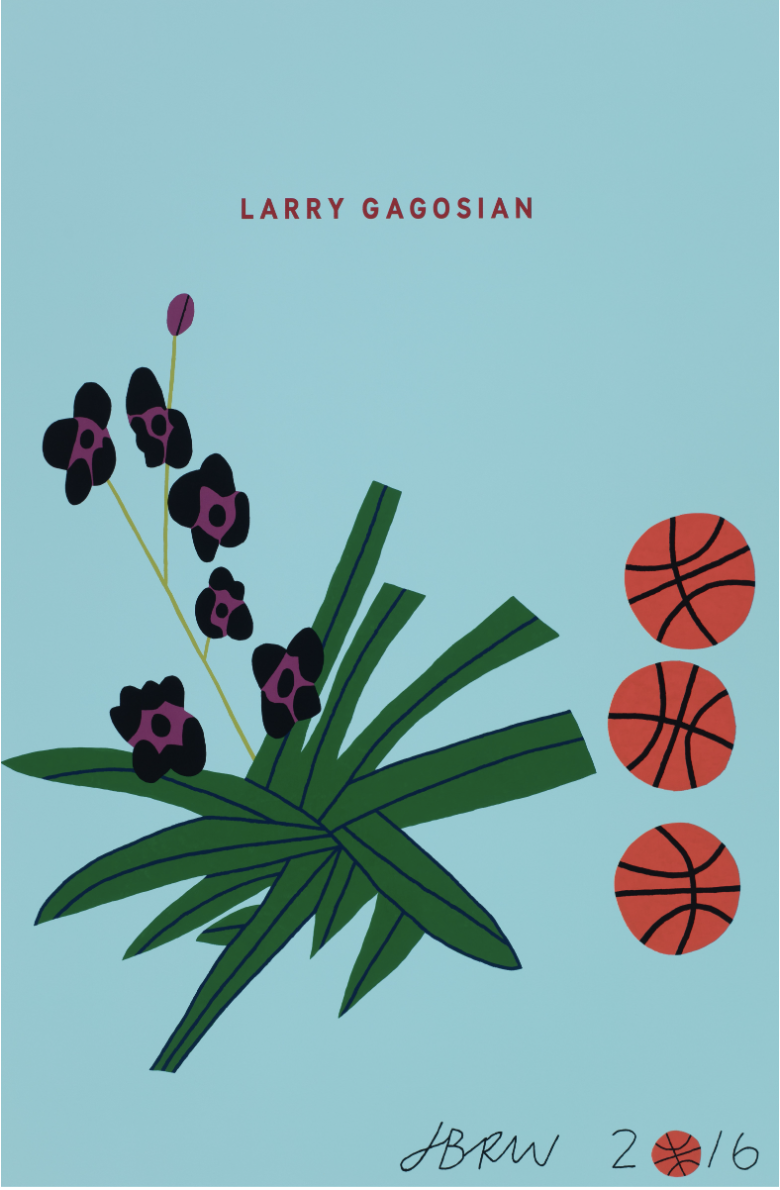
Jonas Wood, LG NPP #2, 2017. Image: © Jonas Wood
Start with a valuation, then choose the route
- Get a price range in about 60 seconds.
- If it looks right, request purchase offers within 48 hours with 0% seller fee, where eligible.
- Start with a 60-second estimate. Instant price range, backed by auction data refreshed every 24h.
- Pick your path. Fast Sale (speed) vs Maximise Returns (advisor-led strategy).
- Fast Sale. Get a non-binding offer in 1–3 working days (where eligible).
- Maximise Returns. Choose private placement vs targeted auction vs hybrid. Strategy based on what your work actually is.
- Close cleanly. 0% seller commission, transparent costs, escrow-protected. Payout within 7 days of collection (Fast Sale payout initiated same day once in our care).
For a Jonas Wood seller, the point is not to guess the market. It is to place the work in the right tier, through the right channel, with the right evidence.
Sources and references
[1] Public auction results for Jonas Wood, sales dated 7 March 2018 to 26 February 2026, analysed by Artscapy. Accessed 16 March 2026.
[2] The Art Basel & UBS Art Market Report 2025, Art Basel / Arts Economics, 2025. Accessed 16 March 2026.
[3] Anny Shaw, Six art market trends to watch in 2026, Art Basel Stories, 6 January 2026. Accessed 16 March 2026.
[4] Jonas Wood, David Kordansky Gallery, n.d. Accessed 16 March 2026.
[5] Jonas Wood, Gagosian, n.d. Accessed 16 March 2026.
[6] Jonas Wood, Grosvenor Hill, London, October 7–November 23, 2024, Gagosian, 2024. Accessed 16 March 2026.
[7] Jonas Wood, Beverly Hills, March 12–April 25, 2026, Gagosian, 2026. Accessed 16 March 2026.
[8] Jonas Wood: Prints 2, Gagosian, 2023. Accessed 16 March 2026.
[9] Jonas Wood: Prints, Gagosian Quarterly, 5 November 2018. Accessed 16 March 2026.
[10] Jonas Wood: Five Bonsais, Pace Prints, 6 September 2024. Accessed 16 March 2026.
[11] Jonas Wood and Chelsea (2024), Whitney Museum of American Art, n.d. Accessed 16 March 2026.
[12] Jonas Wood | Museum Exhibitions | News | Amorepacific Museum of Art, Seoul, Gagosian, 2026. Accessed 16 March 2026.