
Katharina Grosse market analysis. Is now a good moment to sell? (March 2026)
Last updated: 16 March 2026.
If you own a Katharina Grosse, the temptation is to use auction for public validation, especially after major programmes such as Déplacer les étoiles, Wunderbild and CHOIR have kept her scale, colour and spatial ambition in front of collectors.[4][5][6] But her secondary market is now selective enough that publicity can either sharpen value or flatten it. Control matters as much as exposure. Verdict: now can be a good moment to sell, but only if the work is routed with discipline.
Start with Artscapy valuation. Get a price range in about 60 seconds.
Data note. The figures below reflect public auction results for Katharina Grosse from 26 June 2018 to 8 March 2026, covering the main traded products in her market: Untitled/Ohne Titel canvases, works on paper, prints and smaller auxiliary objects.[1] Prices are discussed in approximate USD equivalents for comparability, and the picture can move as new sales for Grosse, Kopf- und Lesehilfe works or large studio canvases enter the public tape.[1]
In this article
- The Munich sale that reset expectations
- How the Katharina Grosse market actually works
- Why private sale often fits this market better
- Sell now or wait?
- How to start with Artscapy
The Munich sale that reset expectations
The defining public moment in this tape is 9 June 2023 in Munich. On that day, Ketterer Kunst sold five 2017 Ohne Titel canvases at roughly 193 x 290 cm, with results ranging from about $63,000 to about $329,000.[1] That mattered because it proved two things at once. Buyers were willing to absorb concentrated supply in one of Grosse’s most recognisable large sprayed formats. But they were also already ranking seemingly similar works very hard.
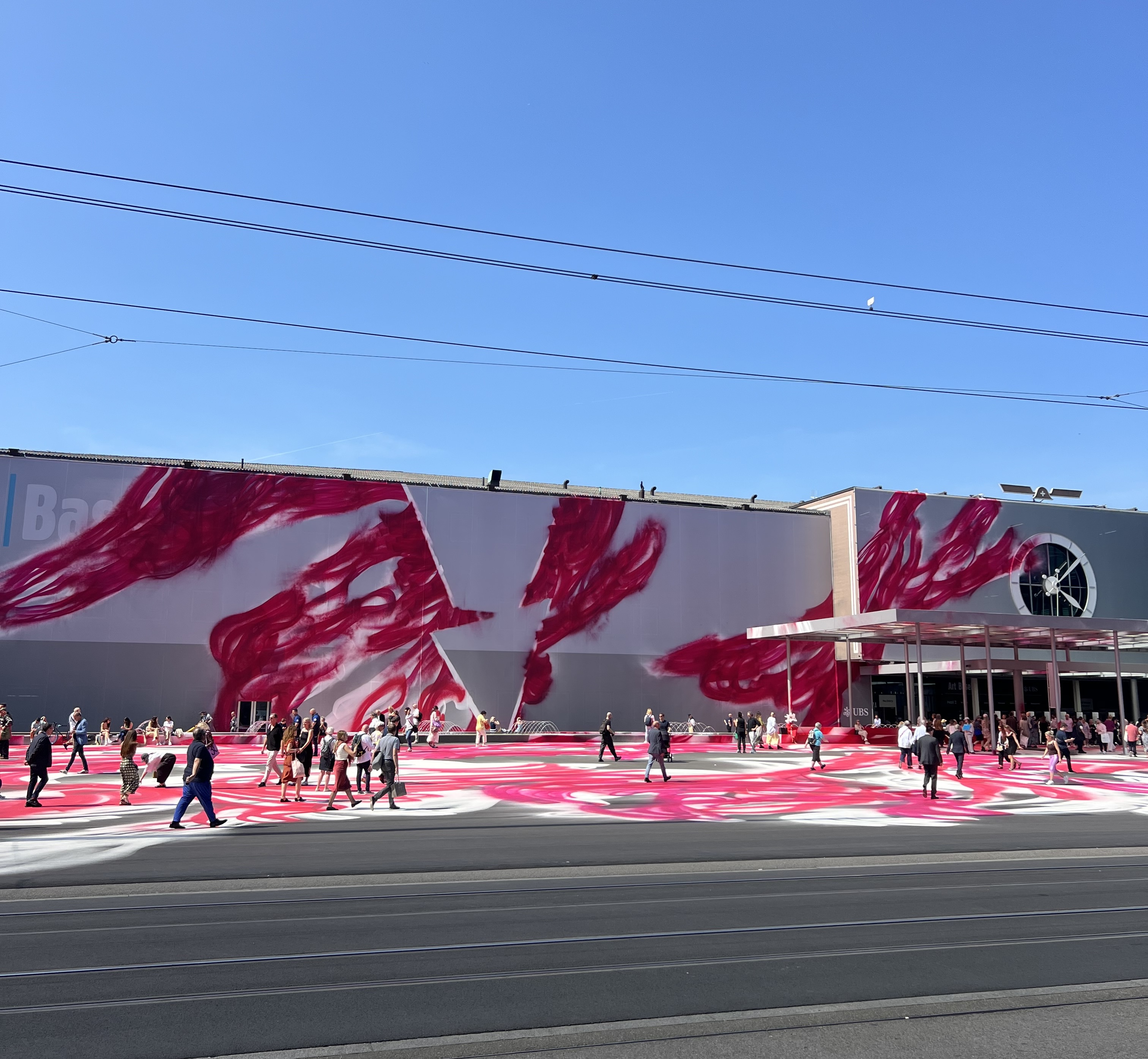
Katharina Grosse, CHOIR (Art Basel), 2025. Image: © Oliver Elst
That sale changed seller psychology. It made the market look deep, and in one sense it was. But it also revealed that “large 2017 canvas” was never a guarantee of a single price level. Some works were treated as benchmarks. Others were treated as merely adjacent. For you, that distinction is everything.[1]
The broader ceiling is real. Within the public results reviewed here, the high watermark is about $347,000 for a 2016 Ohne Titel sold in London.[1] But the lesson of Katharina Grosse is not that there is one number to chase. It is that the top number only belongs to the right work, in the right context, with the right comparables.
How this market actually works
Buyers pay for contained overflow
Inference: Grosse’s market rewards contained excess. Buyers pay most when a studio canvas feels like a transportable fragment of the same logic that drives Déplacer les étoiles, Wunderbild or CHOIR: paint behaving as if it could outrun the support, space behaving like surface, and colour refusing to stay inside the picture.[4][5][6] That is why the ceiling sits with large untitled canvases rather than peripheral branded objects. The buyer is chasing pressure, not just pigment.
That reading now has institutional backing. Kunstmuseum Bonn’s 2024 Studio Paintings 1988–2023 was presented as the first authoritative survey of her canvases; Gagosian’s 2024 Park & 75 exhibition followed directly from that museum tour; and Staatsgalerie Stuttgart’s 2025 The Sprayed Dear was framed as the first retrospective of her three-dimensional work.[2][3][9] White Cube then added Grosse in late 2025, joining Gagosian, Galerie Max Hetzler and Galerie nächst St. Stephan in her representation.[7][10] Inference: for owners of serious studio paintings, the cultural framing is stronger than it was a few years ago.
Where liquidity sits
This remains a painting-led market. Roughly three quarters of the reviewed lots are paintings, and sold examples centre around $63,000.[1] That is where the main liquidity sits, and it is the format buyers recognise fastest.
Works on paper sit nearer $23,000 and turn more consistently than paintings.[1] Prints and multiples clear lower, which means the first decision is not simply whether to sell a Katharina Grosse. It is whether you are selling a canvas, a work on paper, or an edition, because each is read by a different buyer constituency.
The market is also not rewarding every extension of the name equally. Recent Berlin passes for BRLO Art Edition and Kopf- und Lesehilfe: Der Grosse Rückbau are a useful reminder that auxiliary or novelty-adjacent objects do not carry the same buyer urgency as a strong Untitled/Ohne Titel canvas or a convincing work on paper.[1] The presence of the artist’s name alone is not the route. The product is the route.
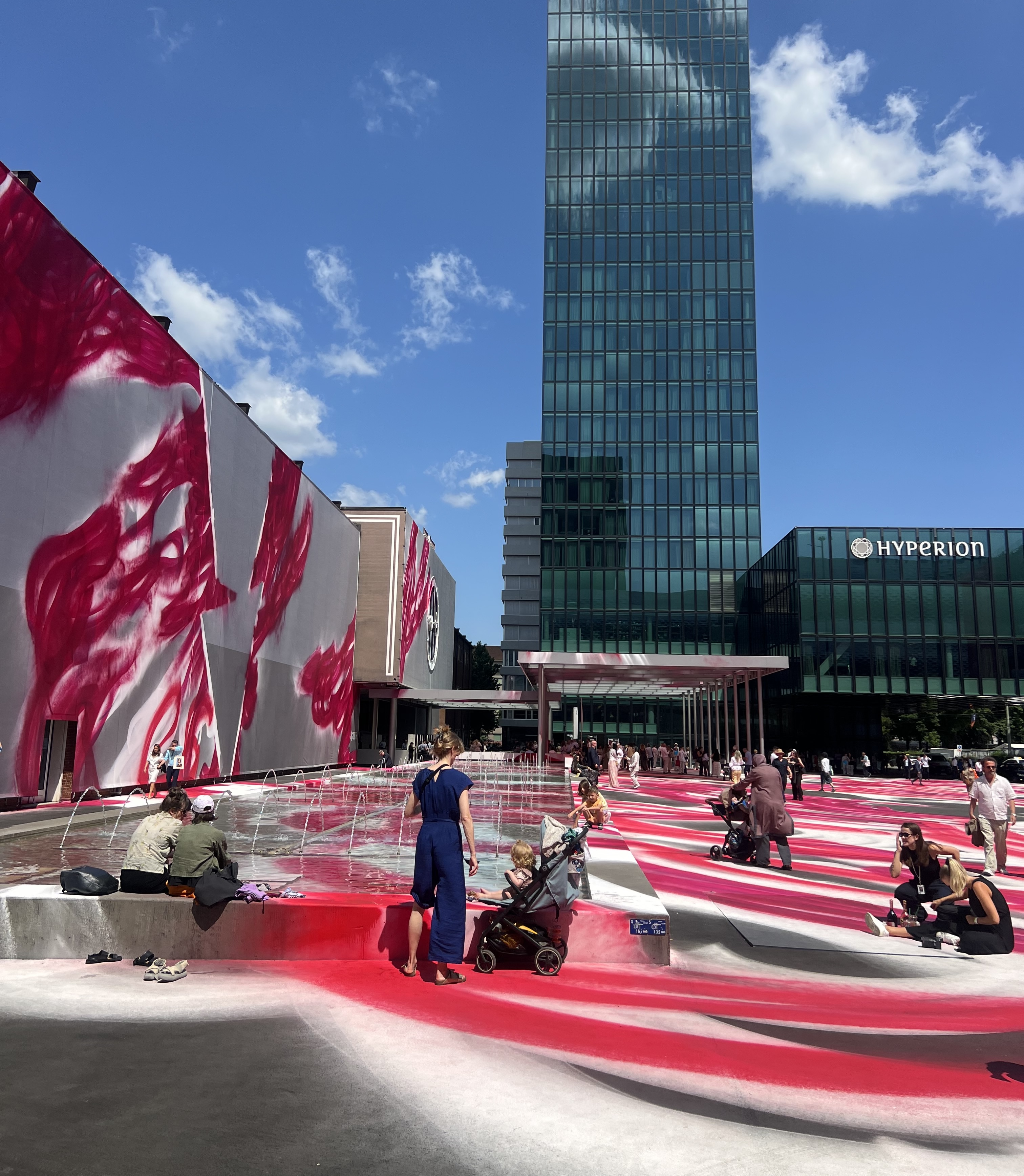
Katharina Grosse, CHOIR (Art Basel), 2025. Image: © Oliver Elst
The barometer: the 2016–17 Untitled/Ohne Titel canvas at about 193 x 290 cm
The clearest barometer in this market is the recurring 2016–17 Untitled/Ohne Titel acrylic-on-canvas format at about 193 x 290 cm. It appears 81 times in the reviewed public record, and its lifetime median sits around $68,000.[1] In other words, this is the product through which the market keeps signalling what it currently believes about Grosse.
What that barometer now says is uncomfortable but useful. Earlier results in this cluster centred at just over $100,000.[1] Across the last two years, the median has fallen to roughly $17,500.[1] The artist has not lost relevance. The market has lost patience with treating every work in this family as interchangeable.
Sell-through tells the same story. In the earlier part of the tape, this barometer cleared above 90%.[1] Over the last two years, it has slipped below 80%.[1] That is the practical meaning of selectivity: auction is still available, but it no longer forgives average examples.
And yet the best works still punch through. Munich produced results around $235,000 in June 2024 and around $202,000 in December 2024 for examples in this family.[1] The correct conclusion is not that the market is weak. It is that the market now insists on hierarchy.
Why private sale often fits this market better
Private sale is not a consolation prize in a Katharina Grosse market like this. It is often the cleaner instrument. In 2024, private sales by auction houses rose 14% even as public auction values fell 25%, according to the Art Basel and UBS report.[8] When the public tape is this selective, discretion is not about hiding a work. It is about protecting benchmark discipline.
That logic is unusually strong for Grosse because her public barometer is crowded. A 2016–17 Untitled/Ohne Titel can sit in a collector’s mind alongside CHOIR, Wunderbild, the Bonn studio-painting survey and the White Cube representation news, or it can be forced into the same public conversation as lower-estimate online comparables.[2][5][6][7] Private placement lets you choose which context leads. That is not spin. It is market control.
Her gallery structure reinforces that point. The current public-facing network around Grosse includes Gagosian, Galerie Max Hetzler and Galerie nächst St. Stephan, with White Cube added in late 2025.[7][10] Inference: when a market is mediated by several strong primary gatekeepers, off-market placement can align a secondary work with the right collector constituency rather than with the bluntest public comparable. For a selective artist, that is often the difference between placement and discount.
Certificate, provenance and route
Paperwork is price here. Data needed. A studio certificate or archive number, full dimensions, front-and-back photography, exhibition history, and the first-acquisition invoice would confirm whether your Untitled/Ohne Titel canvas belongs with stronger evening-sale comparables or the weaker online cohort.
The same applies lower down the ladder. Recent 2012 and 2019 works on paper have sold through Phillips, Christie’s and Sotheby’s, but the spread is wide enough that incomplete provenance, missing installation history or vague medium description can shift a work into the wrong category before bidding even starts.[1] In a market like Grosse’s, the file is part of the artwork.
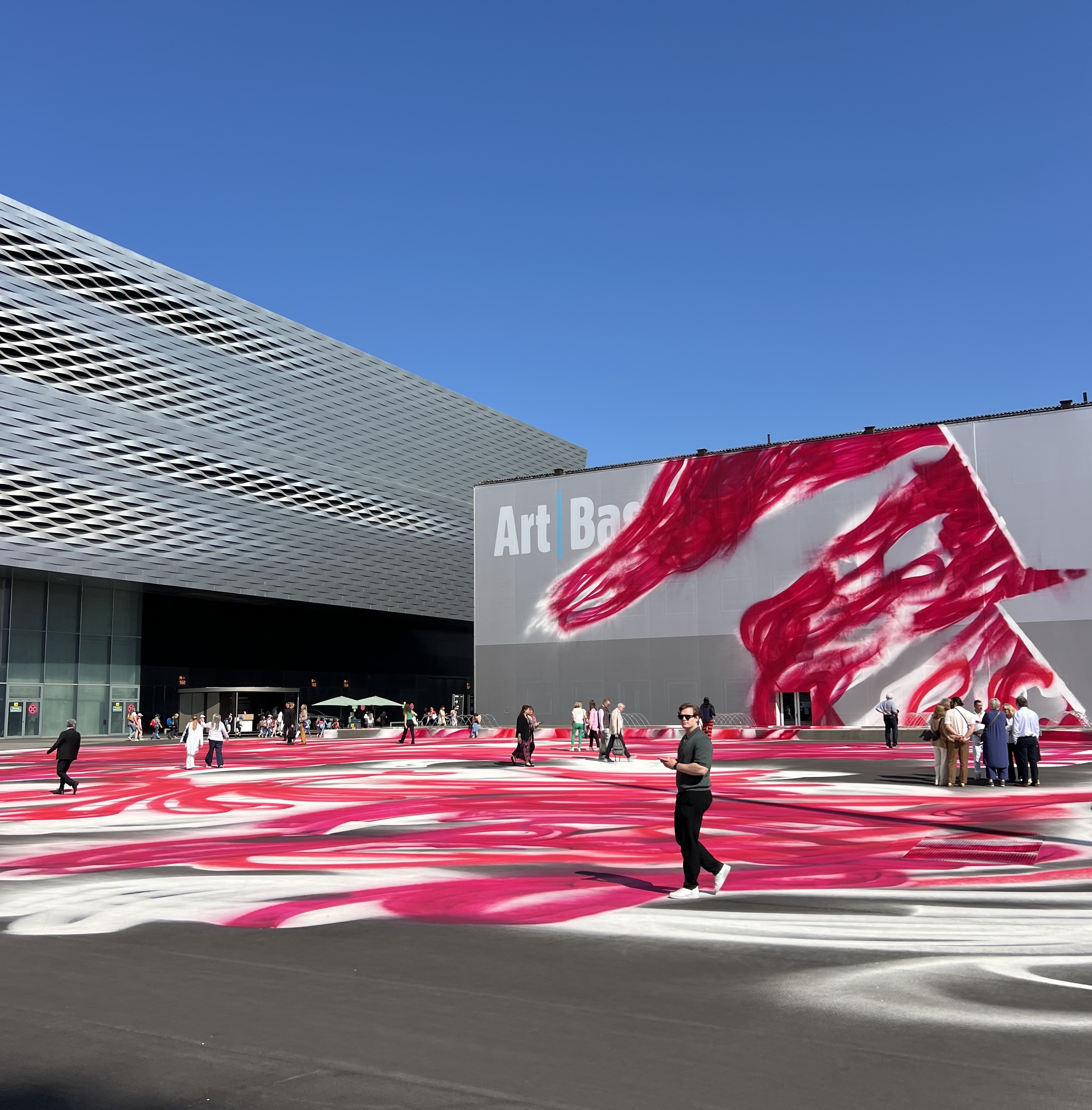
Katharina Grosse, CHOIR (Art Basel), 2025. Image: © Oliver Elst
Sell now or wait?
Sell now if the work already tells the right story
Sell now if your work is a strong studio canvas with convincing provenance, or a work on paper that already sits in the tighter part of the market. Within the public results reviewed here, the ceiling is still about $347,000, and the last two years have still produced multiple painting sales above $200,000.[1] That is sufficient evidence that demand exists for the right Grosse.
The institutional backdrop also supports this. The recent emphasis on studio paintings at Kunstmuseum Bonn and Gagosian, on three-dimensional work at Staatsgalerie Stuttgart, and on immersive projects at Deichtorhallen and Art Basel means serious buyers are being reminded that Grosse’s practice is not one-dimensional.[2][3][5][6][9] If your work reads as part of that wider programme rather than a loose afterthought, waiting for a universally “hotter” market is not necessarily the rational move. Precision is.
Wait, or re-route, if the market will read the work as interchangeable
Wait, or change channel, if your work sits in the crowded 2016–17 barometer without standout provenance, or if it is edition material likely to be benchmarked against lower public comparables. Over the last two years, the overall market median has fallen from roughly $38,500 in the prior two-year window to about $21,000.[1] More supply has emerged at the lower end, and buyers have become harder to surprise.
Sell-through has also eased from about 85% to about 75%.[1] That is what the correction looks like in practical terms: the market still buys Grosse, but it buys with less latitude.
If that is your position, waiting should not mean inactivity. It should mean improving the file, tightening the comparable set, or choosing private placement over public exposure. In June 2025, two 2016 Ohne Titel canvases around the main 193 x 290 cm barometer format failed at six-figure estimates.[1] The risk is not that the artist is unfashionable. The risk is that your work is read as one more example in a segment the market is now pricing very publicly.
The measured conclusion is this: for most owners, the real choice is not simply sell now versus sell later. It is public exposure versus controlled placement. In Katharina Grosse, control is often what preserves value.
Start with a valuation, then choose the route
For a Katharina Grosse canvas, a 2012 work on paper, or even a 2021 o.T. print, the sequence matters because route is a material part of price.
- Start with a 60-second estimate. Instant price range, backed by auction data refreshed every 24 hours.
- Pick your path: Fast Sale (speed) vs Maximise Returns (advisor-led strategy).
- Fast Sale. Get a non-binding offer in 1–3 working days (where eligible).
- Maximise Returns. Choose private placement vs targeted auction vs hybrid, based on what your work actually is.
- Close cleanly. 0% seller commission where eligible, transparent costs, escrow-protected. Payout within 7 days of collection (Fast Sale payout initiated once the work is in our care).
- Get a price range in about 60 seconds. If it looks right, request purchase offers within 48 hours with 0% seller fee where eligible.
Sources and references
[1] Public auction results reviewed for this analysis, 26 June 2018–8 March 2026. Accessed 16 March 2026.
[2] Katharina Grosse. Studio Paintings 1988–2023, Kunstmuseum Bonn, exhibition materials and digital guide, 2024. Accessed 16 March 2026.
[3] Katharina Grosse: Pie Sell, Lee Slip, Eel Lips, Gagosian, 31 October 2024 / exhibition 12 November–21 December 2024. Accessed 16 March 2026.
[4] Katharina Grosse: Shifting the Stars, Centre Pompidou-Metz, 1 June 2024–24 February 2025. Accessed 16 March 2026.
[5] Katharina Grosse – Wunderbild, Deichtorhallen Hamburg, 5 June–14 September 2025. Accessed 16 March 2026.
[6] Art Basel in Basel | Messeplatz Project, Art Basel, 2025. Accessed 16 March 2026.
[7] Katharina Grosse joins White Cube, White Cube, 13 November 2025. Accessed 16 March 2026.
[8] The Art Basel and UBS Global Art Market Report 2025 / The Global Market, Art Basel and UBS, 2025. Accessed 16 March 2026.
[9] 01 Welcome, Staatsgalerie Stuttgart, Katharina Grosse. The Sprayed Dear, 2025. Accessed 16 March 2026.
[10] Contact, Katharina Grosse official website. Accessed 16 March 2026.