
Lee Ufan market analysis. Is now a good moment to sell? (March 2026)
Last updated: 16 March 2026.
A Lee Ufan seller is usually balancing three things at once: the public validation that a great From Line or With Winds can still achieve, the selectivity that greets routine untitled material, and the control you gain when the work is placed privately rather than exposed to the wrong saleroom. The market is real. The harder question is whether your work belongs in its narrow premium lane or its much broader ordinary lane. This is a selective market.
Data note. The figures below reflect public auction results for Lee Ufan from March 2018 to February 2026, expressed in US$ equivalents for comparability across Seoul, Tokyo, Hong Kong, Paris, London and New York. Where a buyer’s-premium-inclusive result was published, that is used; where it was not, the hammer price is used. As new public sales appear, these benchmarks will move.
Start with valuation, then choose a route: If you’re considering selling a Lee Ufan work, the cleanest next step is to establish which part of the market your work actually sits in.
- 👉 Get a price range in about 60 seconds.
- If it looks right, request purchase offers within 48 hours with 0% seller fee (where eligible).
- We’ll tell you what the auction record supports, what it doesn’t establish, and which route is structurally appropriate for your work.
In this article
- The sale that reset the ceiling
- How Lee Ufan’s market actually works
- Why private sale is often the rational route
- Sell now or wait?
- How to get your Lee Ufan price range
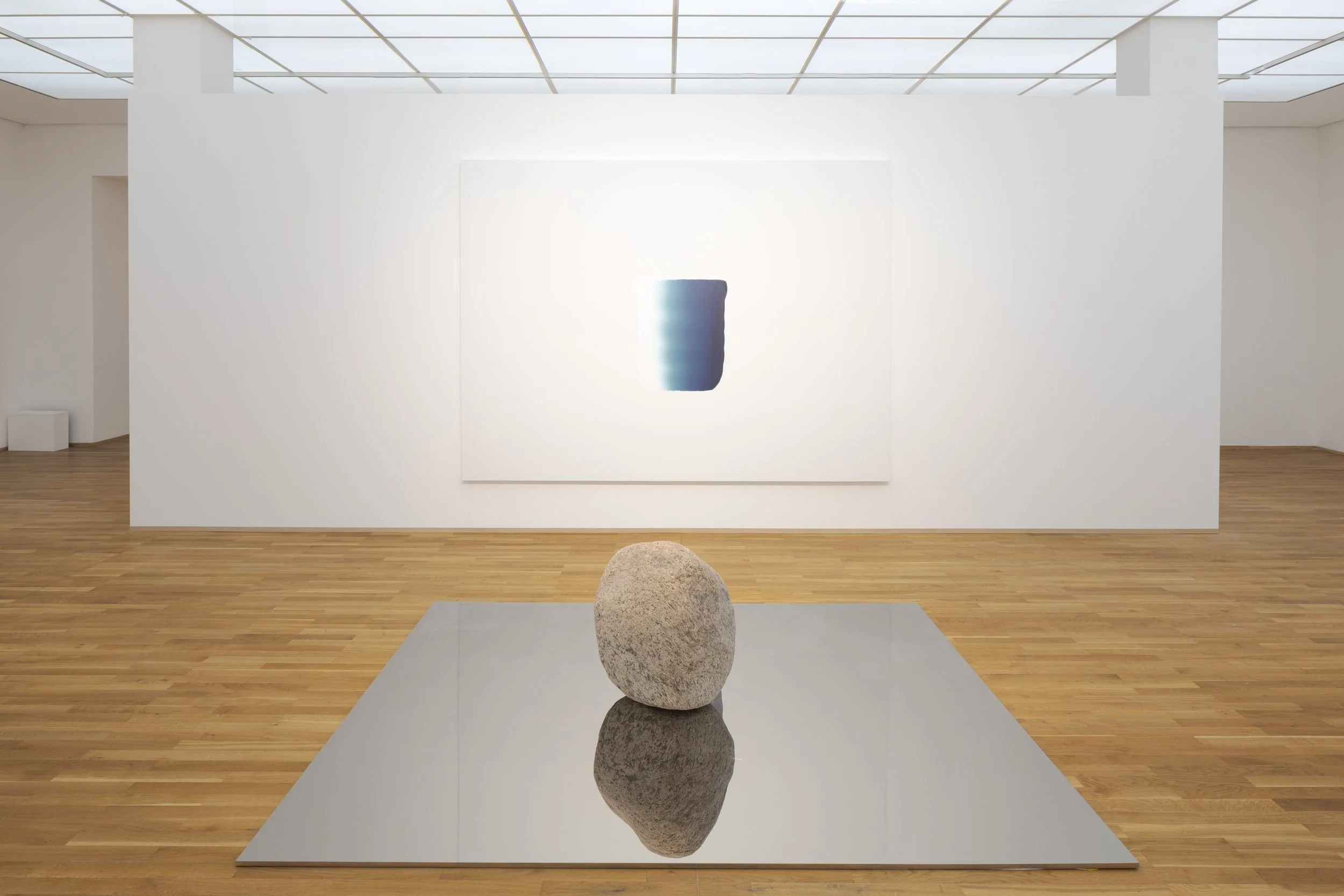
Lee Ufan, Retrospective At Hamburger Bahnhof, 2023. Image: © Lee Ufan / VG Bild-Kunst
The sale that reset the ceiling
In October 2025, Christie’s Paris sold a 1983 From Line for about US$2.34m against an estimate of roughly US$1.2m–1.7m. The revealing detail was not just the price. It was the scale: the work was only around 38 × 46 cm.
That sale mattered because it clarified how Lee Ufan buyers actually think. They were not rewarding bulk. They were rewarding a canonical programme, a strong period and an international route that framed the work as post-war benchmark material rather than regional supply. Inference: in Lee Ufan, series usually comes before size, and placement often comes before square metres.
It also reset the hierarchy in plain sight. Every one of the five highest public results in this tape is a named painting, not a print, not a work on paper, and not a generic untitled canvas. So the first seller question is not “How big is it?” It is “Which Lee Ufan am I selling?”
How this market actually works
Lee Ufan’s market is an encounter market. Buyers pay for works that make one of his core relationships legible: point and duration in From Point, stroke and fading in From Line, brush and void in Correspondance, or stone and steel in Relatum. That is also how institutions and galleries continue to frame him, from Dia and Lisson to Benesse and the Rijksmuseum.[1][2][4][7]
Across 859 public lots in this tape, sell-through excluding withdrawals sits just above 73%. That sounds solid until you see the split underneath it. Lee Ufan is not one market. He is several overlapping ones, and sellers lose money when a painting is routed like a print or a paper is marketed like a canvas.
The liquid lane is prints and multiples. They clear at about 80%, which is useful if you want turnover, but the median result is only around US$8,000. That is real liquidity. It is not the benchmark for a significant painting.
Works on paper sit in the middle lane, with a median around US$36,000. Paintings sit in a different tier altogether, with a median around US$137,000. The implication is simple: if you own a serious canvas, the broad auction average is too low to guide you.
Within paintings, the decisive divider is not merely medium. It is whether the work sits inside a recognised programme such as From Line, From Point, With Winds, Dialogue or Correspondance, or whether it reads as a routine untitled canvas. Untitled paintings in this tape sit around a US$16,000 median. That is why title, series and date are not catalogue niceties in Lee Ufan. They are value architecture.
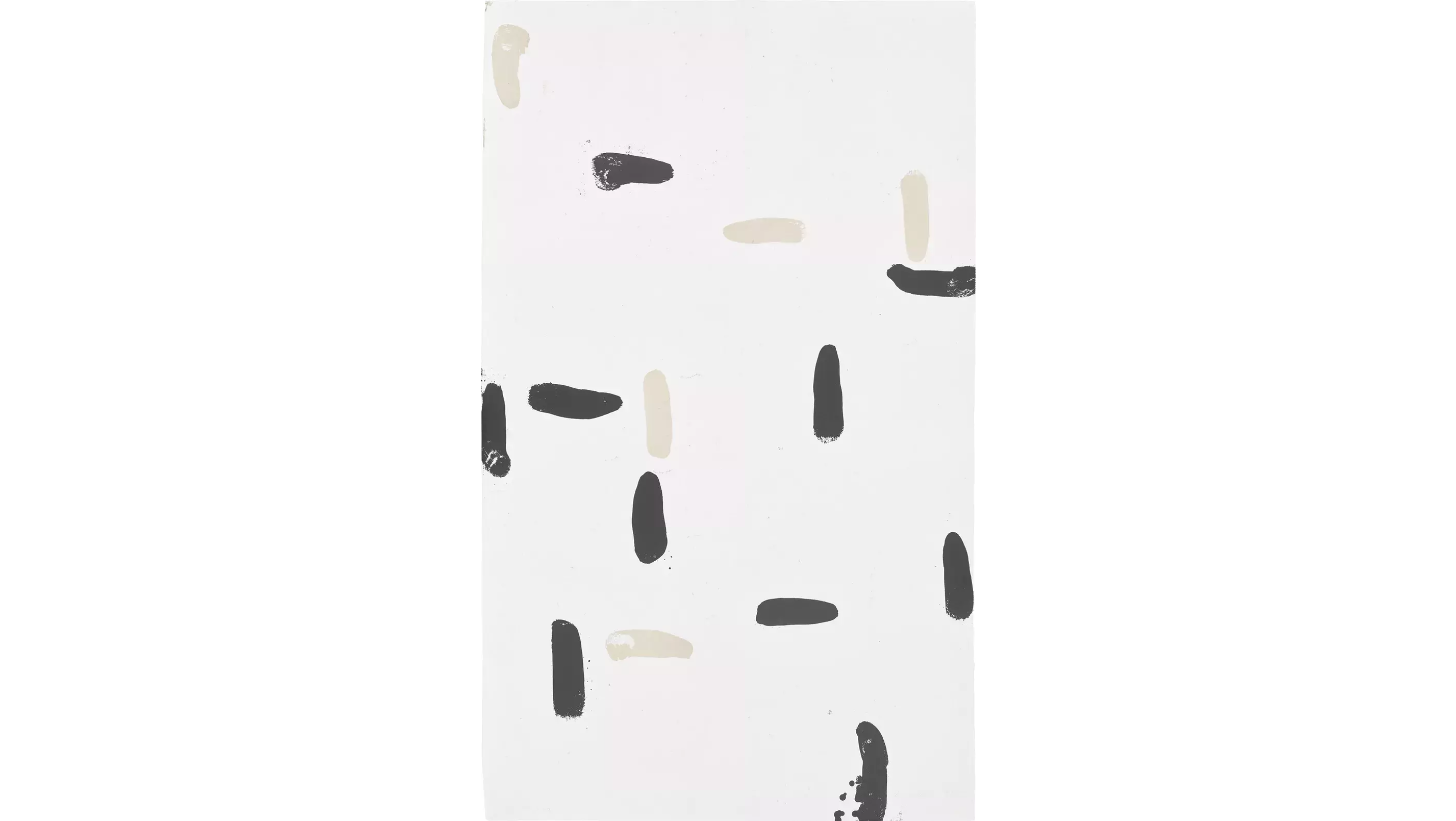
Lee Ufan, In Milano 1, 1992.
The barometer: From Line
The clearest barometer in this public tape is From Line. Nearly 90% of offered From Line paintings sold, and the series median sits around US$358,000. When From Line is firm, the serious Lee Ufan buyer is still present.
That barometer is not floating free of the artist’s broader positioning. In May 2025, The Art Newspaper reported that Lee donated eight paintings to Dia from the From Point, From Line and With Winds groups; Pinault’s Minimal placed him inside a global account of Mono-ha and post-war minimalism; and Dia’s official Venice presentation opens on 9 May 2026 with historical paintings, installations and a new site-specific commission.[9][10][11]
Route matters too. On a small but telling sample, Paris paintings in this tape carry a median of about US$403,000, while Seoul, the deepest venue by volume, sits nearer US$126,000 for paintings. Inference: top Lee Ufan material often wants post-war framing and scarcity, not just the biggest pool of day-to-day domestic supply.
Lee Ufan is also not being maintained by nostalgia alone. Naoshima and Lee Ufan Arles remain dedicated sites; Lee Ufan Arles kept an active 2025 programme; the Rijksmuseum devoted its 2024 garden show to Relatum sculptures; Pace lists recent museum and gallery programmes in Seoul, Sydney and New York; and Mennour staged Response in Paris through early January 2026.[3][5][6][7][8][13]
Why private sale is often the rational route
Private sale is not consolation in Lee Ufan. It is often the structurally correct tool. Public auction works best when the work already reads instantly to the room: named series, right decade, clean provenance, confident estimate, strong city. It works far less well when the piece needs contextual selling, such as a quieter Correspondance, a strong paper that sits above routine paper comparables, or a canvas whose importance is better than its headline size suggests.
That logic fits the wider market as well as this artist’s tape. UBS reports that dealer sales reached US$34.8bn in 2025 versus US$20.7bn for public auctions, and that galleries and dealers remained the most-used and highest-spend buying channel for high-net-worth collectors.[12] Inference: for a selective Lee Ufan work, the off-market buyer is not outside the market. Often, that is the market.
In Lee Ufan specifically, private placement lets you target the collector who already understands the artist through Mono-ha, Naoshima, Lee Ufan Arles, Dia, Pace, Lisson or Mennour, rather than hoping the saleroom will explain all of that in a few catalogue lines.[1][3][5][8][13] That is not about secrecy for its own sake. It is about control over who sees the work, how it is framed, and which comparables get used against it.
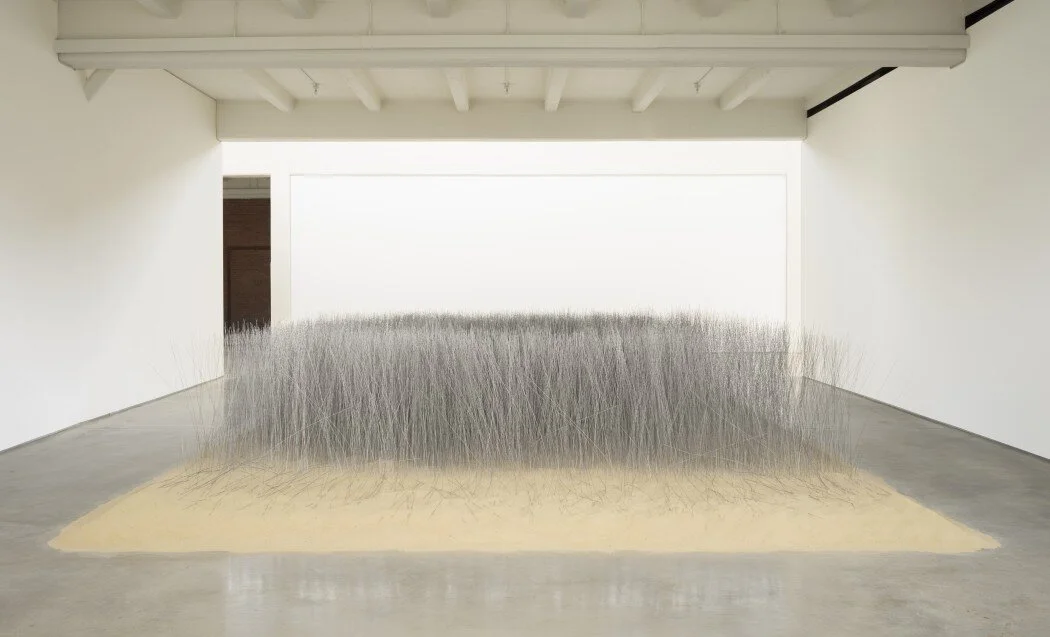
Lee Ufan, Relatum (formerly Iron Field), 2019. Image: © Lee Ufan
Certificate language is not a trivial detail here. A current written authentication policy from Studio Lee Ufan, the gallery currently handling your work, or another authorised body would be needed to confirm whether your certificate, invoice trail and exhibition history are sufficient for your specific series. Inference: if that file is incomplete, private placement usually gives more room for orderly diligence than a public sale deadline.
The same is true of sculpture. Relatum is institutionally central, from the Rijksmuseum’s 2024 presentation to Lisson’s Art Basel Unlimited 2025 display, but the public sculpture sample is too thin to price a major example with confidence.[1][7] Recent private comparables, installation photographs, condition reporting and provenance would be needed for a defensible seller estimate on a significant Relatum.
Sell now or wait?
Sell now if your work sits inside the canonical painting lane
If your work is a From Line, From Point, With Winds, Dialogue or strong Correspondance painting with clean provenance, the evidence favours action. Over the last 12 months in this tape, sold paintings carried a median around US$164,000 while the market-wide median was still only around US$16,000. That does not mean everything is rising. It means the right Lee Ufan is being separated from the rest more aggressively than before.
The From Line barometer is firm, and the last year produced the Paris record. You would also be selling into active programme support rather than historical memory alone: Pace lists recent Lee Ufan exhibitions in Seoul and Sydney, Mennour ran Response in Paris from October 2025 into January 2026, and Dia’s Venice presentation opens in May 2026.[8][10][13] Inference: that does not guarantee a higher price, but it does mean top material is still being seen through a current lens.
Wait if your work is routine supply, or if the file needs work
If your Lee Ufan sits outside that named-painting barometer, waiting can be rational, but only if waiting means improving the sale rather than simply delaying it. Prints clear well, yet the median is only around US$8,000, and untitled paintings sit around US$16,000. The strength of From Line is exactly why the rest of the market remains selective.
The practical version of waiting is not passive. It means rebuilding provenance, confirming the series title, locating old invoices, photographing the verso, checking exhibition history, and deciding whether the right route is Seoul liquidity, Paris or London framing, or private placement to a collector already following Lee Ufan through Naoshima, Arles, Dia or the gallery network.[3][5][8][10][13] A current statement on accepted authentication or certification procedure would confirm what paperwork, if any, still needs to be added before marketing.
So the calm conclusion is this: in Lee Ufan, waiting only makes sense when it improves your route, your paperwork or your buyer pool. Time on its own is not the thesis.
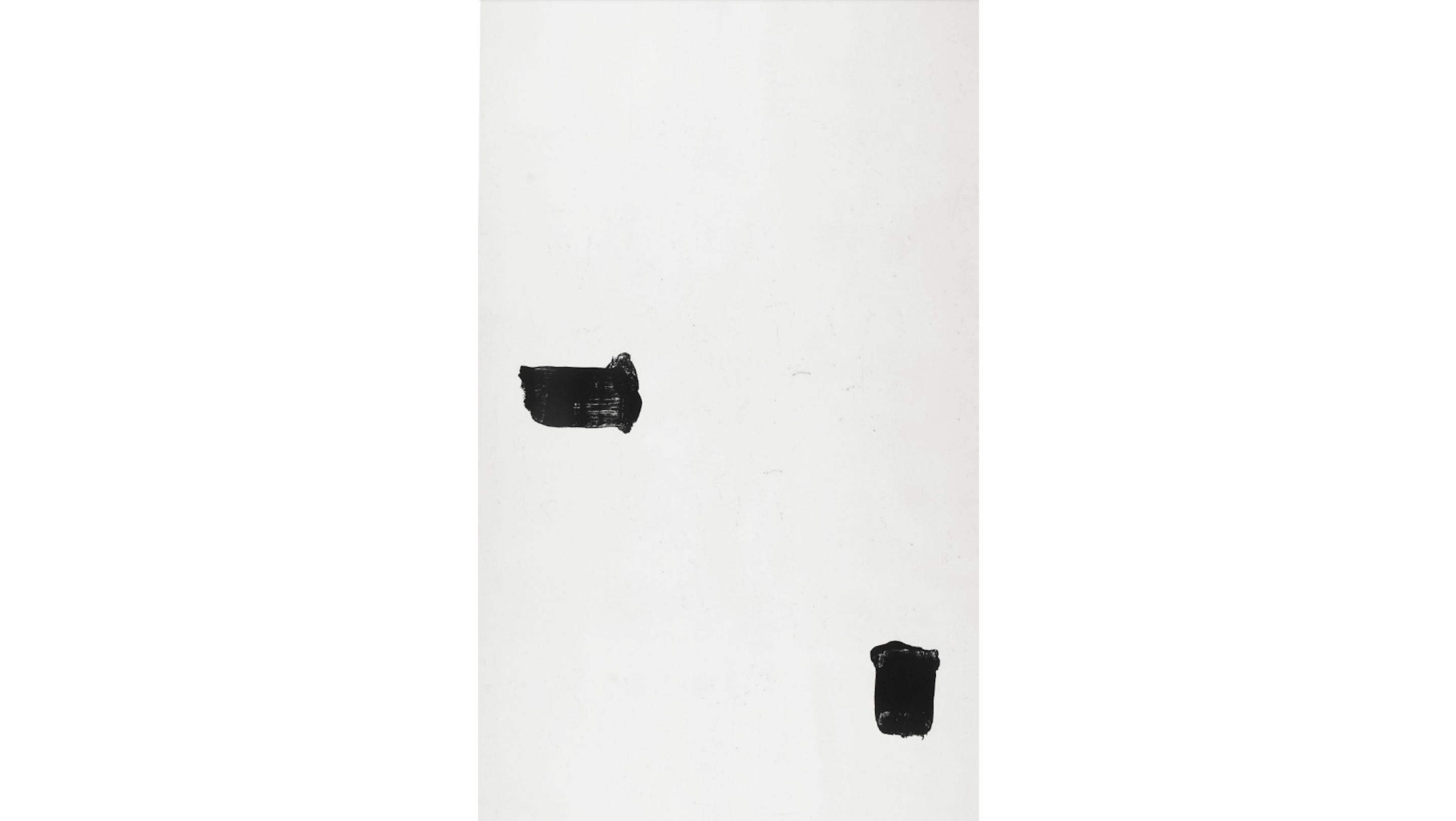
Lee Ufan, In Milano 2, 1992.
Get your Lee Ufan price range
Get a price range in about 60 seconds. If it looks right, request purchase offers within 48 hours with 0% seller fee.
- Start with a 60-second estimate. Instant price range, backed by auction data refreshed every 24h.
- Pick your path. Fast Sale for speed, or Maximise Returns for an advisor-led strategy.
- Fast Sale. Get a non-binding offer in 1–3 working days (where eligible). Or choose Maximise Returns and decide between private placement, targeted auction or a hybrid route, based on what your work actually is.
- Close cleanly. 0% seller commission, transparent costs, escrow-protected. Payout within 7 days of collection. Fast Sale payout initiated same day once in our care.
For most Lee Ufan sellers, the question is not whether a market exists. It does. The question is which Lee Ufan the market is being asked to buy. Start with the valuation, then route the work rather than the ego.
Sources and references
[1] “Lee Ufan | Artists,” Lisson Gallery, accessed 16 March 2026.
[2] “Lee Ufan | Exhibitions & Projects,” Dia Art Foundation, accessed 16 March 2026.
[3] “Lee Ufan Museum | Art,” Benesse Art Site Naoshima, accessed 16 March 2026.
[4] Akiko Miki, “Lee Ufan: Outward-bound Spirit / The Road Towards Infinity (#1),” Benesse Art Site Naoshima, 5 September 2024, accessed 16 March 2026.
[5] “Lee Ufan Arles,” Lee Ufan Arles, accessed 16 March 2026.
[6] “Exhibitions” and “Prix Art & Environnement 2025,” Lee Ufan Arles, accessed 16 March 2026.
[7] “Summer-long show of Lee Ufan sculptures in the Rijksmuseum Gardens,” Rijksmuseum, 26 March 2024, accessed 16 March 2026.
[8] “Lee Ufan,” Pace Gallery, accessed 16 March 2026.
[9] Benjamin Sutton, “Lee Ufan donates eight paintings to Dia Art Foundation,” The Art Newspaper, 22 May 2025, accessed 16 March 2026.
[10] “LEE UFAN,” SMAC Venice, accessed 16 March 2026.
[11] “Minimal,” Pinault Collection, accessed 16 March 2026.
[12] “Art Market Research: The Art Basel and UBS Global Art Market Report 2026,” UBS, accessed 16 March 2026.
[13] “Lee Ufan: Response,” Mennour, 3 October 2025–7 January 2026, accessed 16 March 2026.