

Olga de Amaral market analysis. Is now a good moment to sell? (March 2026)
Last updated: 16 March 2026.
Owning an Olga de Amaral now can feel like a fortunate problem. A Pueblo, Paisaje heredado or Alquimia may be entering a stronger market, but the field is still selective enough that the wrong route can turn a good work into the wrong comparable. Auction validation is available. Control still matters. It is a good moment for the right work.[1] Do you own an Olga de Amaral? Start with a valuation. Get a price range in about 60 seconds.
Data note. This analysis covers public auction results for Olga de Amaral from Alquímia 80 in May 2018 to Obra 500 in February 2026.[1] Figures may shift as new sales occur. Because buyer’s premium is not recorded consistently across every sale record, market-wide price figures below use hammer prices in USD; individual lot pages are cited separately where paperwork or published sale context matters.
In this article
- The sale that reset the ceiling
- How this market actually works
- Why private sale is structurally sensible here
- Sell now or wait?
- Sell with Artscapy
Olga de Amaral, Imagen perdida 27, 1996. Image: © Phillips
The sale that reset the ceiling
The moment that changed the conversation was Pueblo H at Christie’s New York in November 2025. It made $2.5 million hammer against a $400,000–600,000 estimate, pushing well beyond the previous hammer ceiling of $920,000.[1] That result did more than set a record. It told collectors that the very best Olga de Amaral works had moved out of the old upper-middle band and into a different pricing conversation altogether.
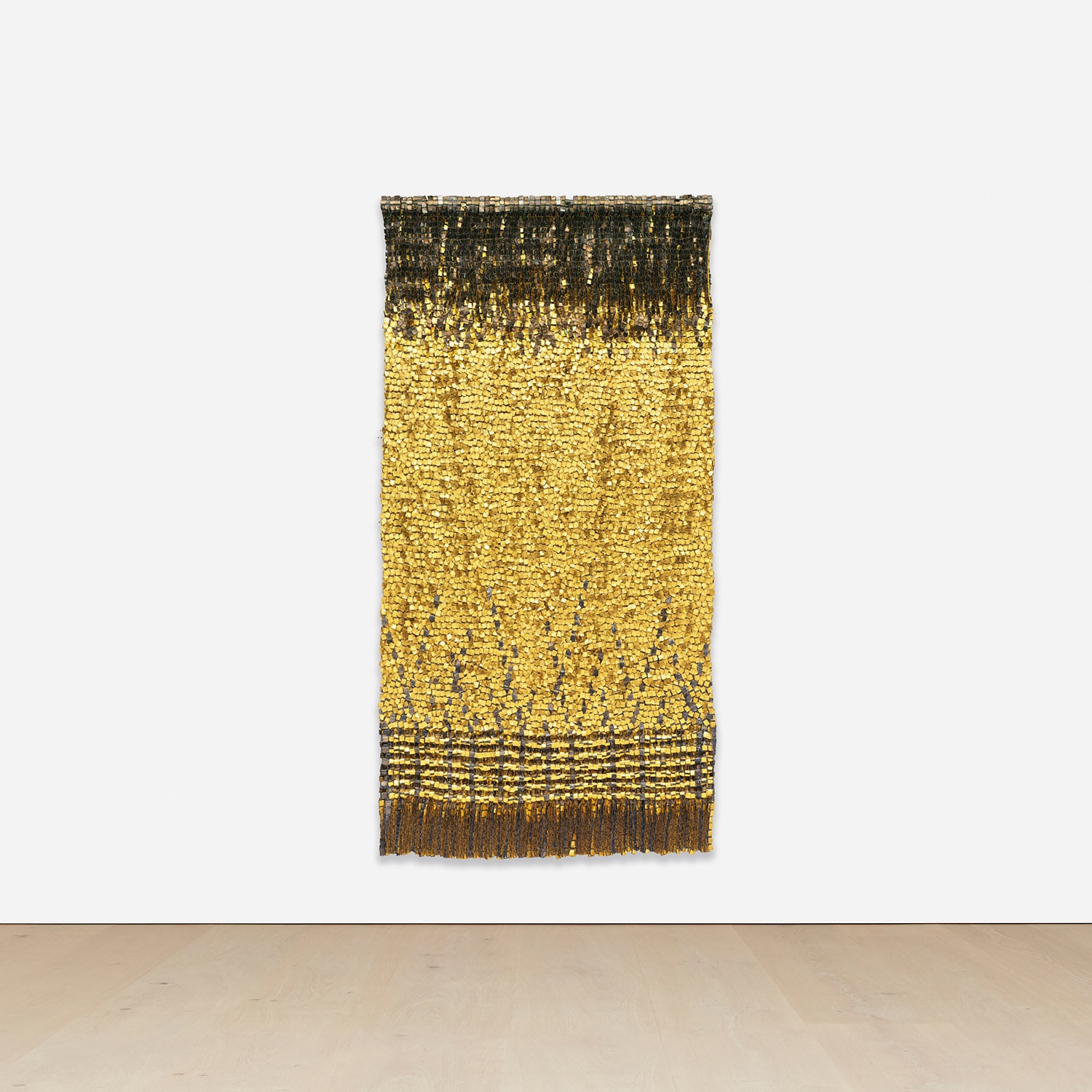
Just as important, Pueblo H did not arrive in isolation. The same season also produced strong New York results for Imagen perdida 27 and Paisaje heredado 4, which makes the record look less like a one-off trophy incident and more like a reset of the top tier.[1] For a seller, that is the key distinction. A single aberration can be ignored; a changed ceiling starts to pull neighbouring works upward.
How this market actually works
The market is pricing reclassification
This is now a painting-led market, even though Amaral’s institutional story runs through Brumas, Estelas and Riscos as well as the better-known gold-leaf wall works. In public sale terms, buyers are gravitating towards the pieces that read most clearly as painting, sculpture and textile at once, rather than towards works that can be mistaken for design objects or minor decorative material.[1][7][8]
The public record is unusually clean: 64 of 65 lots sold.[1] That looks like universal liquidity, but it is better understood as selective supply. Houses have mostly brought recognisable works such as Alquimia, Cesta lunar, Lienzo ceremonial, Pueblo and Paisaje heredado, not a flood of marginal material. So the strength is real—but it is not evenly distributed.
Across the full period, the median hammer is about $220,000.[1] That is the anchor number for a good, saleable Amaral that is not trying to compete with the record-setting end of the market.
The middle half of results sits roughly between $140,000 and $380,000.[1] That is a broad spread, and it explains why series, scale and routing matter more here than they do in flatter markets.
The recent tape is markedly stronger. Over the past 12 months, the median hammer has risen to about $440,000, versus roughly $176,000 beforehand.[1] That indicates a clear upward repricing, but not interchangeability across all works.
Inference: Amaral’s market is pricing an art-historical reclassification, not just surface beauty. Since Lisson announced representation ahead of To Weave a Rock at MFA Houston, Amaral has moved through a sequence of major programmes that includes the Fondation Cartier retrospective and its ICA Miami presentation.[2][3][4][7]
That trajectory did not stop there. Amaral also appeared in the Venice Biennale, in Woven Histories at the National Gallery of Art, and in recent Lisson presentations in Los Angeles and at Art Basel Qatar.[5][6][15][16] When collectors feel they are buying into a live institutional narrative rather than a settled craft category, they bid with more conviction.
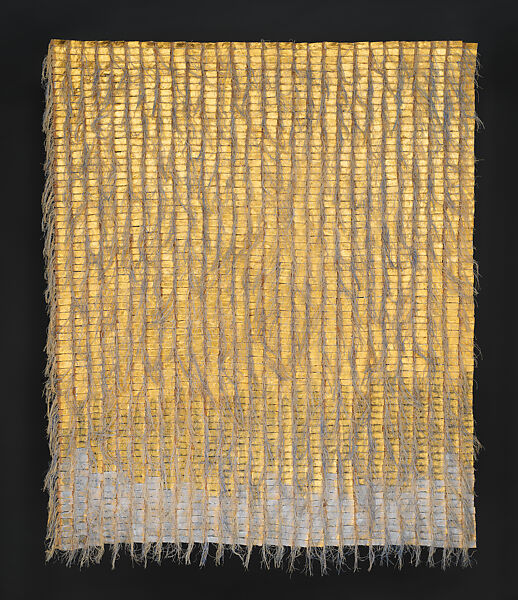
Amaral’s own site frames the work through architecture, landscape and the use of gold shaped by pre-Hispanic and Colonial histories. The Met similarly connects her woven walls to Colombian landscape, adobe architecture and golden churches, while MoMA links the Riscos series to her native landscape.[8][9][10] This helps explain why certain series are moving faster than others: buyers are rewarding the works that most clearly carry that full language.
The barometer: landscape-memory works
The clearest barometer is the landscape-memory cluster: Pueblo H, Paisaje heredado 3, Paisaje heredado 4, Imagen perdida 27, Imagen Paisaje I and Montaña 38. In the past 12 months, that cluster sold at a median hammer of about $900,000, against about $200,000 before the current rerating.[1] These works combine title recognition, scale, and Amaral’s most legible synthesis of landscape, memory, architecture and luminous surface. They are currently the clearest read on top-buyer sentiment.
Below that sits a strong upper-middle tier: Alquimia, Strata, Obra, Cesta lunar and some Nudo works. These are not consolation prizes; they are where buyers are still prepared to transact at meaningful levels without requiring a headline result. For many sellers, this is where a clean sale is most achievable.[1]
Olga de Amaral, Alquimia 13 (Alchemy 13), 1984. Image: © TheMET
Where the ceiling lives
All five highest hammer results were made in New York, at Christie’s, Sotheby’s or Phillips.[1] That is where the ceiling sits. A major gold-leaf Paisaje heredado should not be benchmarked against a Rago Modular 77 or a smaller Vestige simply because they share the same artist.
In practical terms, a Pueblo or Imagen Paisaje belongs in a different market conversation from Modular 77, 15th Vestige or Cartas. The first group is sold on placement, hierarchy and museum language; the second on specialist fit and disciplined expectation. Most seller errors begin by collapsing those two markets into one.[1]
Why private sale is structurally sensible here
For Olga de Amaral, private sale is not a fallback channel. It is often the control channel.
The wider market supports that logic. In the Art Basel & UBS Art Market Report 2025, public auction sales fell 25% in 2024 while auction-house private sales rose 14%.[14] When public bidding becomes more selective, sophisticated sellers tend to prioritise control over exposure.
That dynamic fits Amaral particularly well because the channel gap is wide. The median hammer in New York is about $233,000; in Lambertville it is about $70,000.[1] These are distinct buyer pools, and a public result in the wrong venue can become the comparable that defines a work for years.
Inference: private placement is often the rational first move for a strong but not completely obvious work—an Alquimia with excellent provenance, a Lienzo ceremonial with unusual scale, an early horsehair piece, or a Strata with cross-category appeal. You retain pricing control, align the work with buyers already primed by recent institutional programming, and avoid forcing it into an estimate bracket built from the wrong peer group.[2][3][15][16]
Inference: paperwork is part of the product at the top of this market. Recent high-value offerings such as Pueblo H, Paisaje heredado 3 and Alquimia 62 were presented with Casa Amaral certificates and archive references, or with certification explicitly forthcoming.[11][12][13] If documentation is incomplete, it is advisable to address that before choosing a sale route.
Data needed. A published policy from Casa Amaral or the artist’s studio would be required to confirm whether every historical work can be retrospectively certified, and on what timetable.
Sell now or wait?
Sell now if your work sits inside the current conviction zone
If you own a New York-grade wall work in gold or silver leaf, with a recognisable title and a clear place in the current hierarchy—Pueblo, Paisaje heredado, Imagen perdida, Imagen Paisaje, Alquimia, Strata, Cesta lunar, Obra or a strong Nudo—the evidence supports action now. The recent tape is stronger than the long view, the landscape-memory barometer remains elevated, and the institutional programme is still active in collectors’ minds.[1][2][3][15][16]
In that case, the sensible first step is valuation rather than immediate consignment. You need to establish whether the work belongs in the Pueblo / Paisaje / Imagen tier, the Alquimia / Strata / Cesta lunar tier, or a private-placement category before exposing it publicly.[1]
Wait, or start privately, if your work sits outside the current sweet spot
If your work is closer to the regional-housing side of the market—smaller Vestige, Modular 77, Cartas, some Flores, or fibre-led horsehair pieces without current Casa Amaral documentation—the more effective approach is often patience or a private-first strategy.[1][11][12][13] The recent rerating has not lifted all works equally, and the strongest demand remains concentrated in pieces combining scale, title recognition and the gold/silver architectural language reinforced by museums and galleries.[1][8][9]
A quiet placement, or a deferred sale after documentation and positioning improve, is often preferable to establishing a public comparable at the wrong level. This is not inactivity; it is controlled timing.
The underlying question is not simply whether to sell now, but whether the work aligns with the segment of the market currently being repriced—and whether public exposure will support or weaken that position. In the current conditions, strong, well-documented gold-leaf wall works justify decisive pricing and careful routing. Everything else still requires strategy.[1][11][12][13]
Sell your Olga de Amaral with Artscapy
- Get a price range in about 60 seconds. Instant price range, backed by auction data refreshed every 24h.
- Pick your path. Fast Sale (speed) vs Maximise Returns (advisor-led strategy).
- Fast Sale. Get a non-binding offer in 1–3 working days (where eligible).
- Maximise Returns. Choose private placement vs targeted auction vs hybrid. Strategy based on what your work actually is.
- Close cleanly. 0% seller commission, transparent costs, escrow-protected. Payout within 7 days of collection (Fast Sale payout initiated same day once in our care).
- If it looks right, request purchase offers within 48 hours with 0% seller fee.
Sources and references
[1] Public auction results for Olga de Amaral, supplied to Artscapy, sale dates 16 May 2018 to 26 February 2026. Accessed 16 March 2026.
[2] Olga de Amaral, Fondation Cartier pour l’art contemporain, exhibition page, 2024–2025. Accessed 16 March 2026.
[3] Olga de Amaral, Institute of Contemporary Art, Miami, exhibition page, 2025. Accessed 16 March 2026.
[4] Announcing representation of Olga de Amaral, Lisson Gallery, 9 July 2021. Accessed 16 March 2026.
[5] Biennale Arte 2024 | Olga de Amaral, La Biennale di Venezia, 2024. Accessed 16 March 2026.
[6] Woven Histories: Textiles and Modern Abstraction, National Gallery of Art, exhibition page, 2024. Accessed 16 March 2026.
[7] Olga de Amaral: To Weave a Rock, The Museum of Fine Arts, Houston, exhibition page, 2021. Accessed 16 March 2026.
[8] About, Olga de Amaral Official Site. Accessed 16 March 2026.
[9] Alquimia 13 (Alchemy 13), The Metropolitan Museum of Art, collection page. Accessed 16 March 2026.
[10] Riscos IV. 1987, The Museum of Modern Art, collection page. Accessed 16 March 2026.
[11] Pueblo H, Christie’s lot page, November 2025 sale. Accessed 16 March 2026.
[12] Paisaje heredado 3, Christie’s lot page, February 2026 sale. Accessed 16 March 2026.
[13] Alquimia 62, Phillips lot page, November 2025 sale. Accessed 16 March 2026.
[14] The Art Basel & UBS Art Market Report 2025, Arts Economics / Art Basel & UBS, auctions and global market sections, 2025. Accessed 16 March 2026.
[15] Olga de Amaral, Lisson Gallery, Los Angeles exhibition page, 14 November 2025–31 January 2026. Accessed 16 March 2026.
[16] Art Basel Qatar 2026, Lisson Gallery exhibition page, February 2026. Accessed 16 March 2026.
