
Satellite art fair market analysis: the bridge between discovery and auction results
The main idea in 30 second: Satellite fairs do not create durable auction markets on their own. They accelerate the moment when an artist’s market has to prove itself.
- Visibility is not the same as depth. The move from satellite fair exposure to blue-chip attention matters, but it is only the beginning of the market test.
- Auction supply reveals the strength of conviction. Fresh-to-market works, disciplined estimates and sustained demand suggest that early visibility has become durable market depth.
- The warning signs appear before sell-through breaks down. Repeated resale, short holding periods, softer estimate performance and falling price per cm² can signal that supply is beginning to outrun demand.
- The strongest satellite fair stories are not the fastest spikes. They are the markets where visibility develops into a broader collector base, measured supply and more resilient pricing.

Figure 1. Satellite fairs accelerate the path from early visibility to public pricing. Auction results then reveal whether that visibility has developed into durable market depth or created pressure through premature supply.
→ Join Artscapy at VOLTA Basel
Satellite fairs occupy a liminal position in the contemporary art market, bridging early-stage discovery and established market validation. Close enough to major fairs to draw collectors, curators, and advisors, yet early in an artist’s market development to proceed meaningful auction activity. This positioning makes them valuable on both sides: collectors gain timely access to emerging talent within the same geographic and temporal circuit as blue-chip activity, while artists and galleries benefit from exposure to active buyers before secondary-market pricing is fully established.
Satellite fairs are strategic complements to the main fair: places where collectors test early conviction, galleries introduce artists to a concentrated international audience, and interest begins to form before auction results harden into benchmark. The value lies less in guaranteeing future success than in compressing the distance between first visibility and serious collector consideration.
This analysis examines auction data for four artists whose markets moved through different forms of fair, gallery and institutional validation: Pol Taburet, Loie Hollowell, Nicolas Party and Jadé Fadojutimi. Taburet provides the clearest verified satellite-to-main sequence, moving from Liste Art Fair Basel in 2021 to later Art Basel visibility. Hollowell, Party and Fadojutimi follow related but different routes, showing how early fair visibility, gallery upgrades and institutional validation can enter the auction market in distinct ways. Across the four cases, the report asks not whether fair exposure causes price growth, but what happens when early visibility becomes public supply.
Data and scope
This report analyses 553 auction lots from 2018 through May 2026 across four artists: Pol Taburet, Loie Hollowell, Nicolas Party and Jadé Fadojutimi. The dataset is assessed for sell-through, median hammer price, estimate performance, price per cm², medium composition, repeat-sale proxies and short-hold resale proxies.
The report examines artists whose markets moved from satellite or satellite-adjacent fair visibility into broader fair, gallery or institutional validation, and then into public auction testing. The focus is not simply on artists who became more visible, but on artists whose early fair exposure preceded a measurable shift in secondary-market activity. Each case study therefore begins with a verified satellite-fair or satellite-adjacent starting point, followed by a later stage of broader market validation.
Several limitations apply. Auction performance is not treated as a direct result of fair exposure. Repeat-sale and short-hold figures are based on repeat-work proxies rather than confirmed ownership histories. Sale location is not treated as buyer geography. Primary-market price references are used only where available and should be read as selective fair or gallery-sale evidence, not complete pricing histories. Price per cm² is calculated only where dimensions are reliable, and thinly traded markets, particularly Pol Taburet’s, are treated cautiously.
How to read the auction test after satellite fair visibility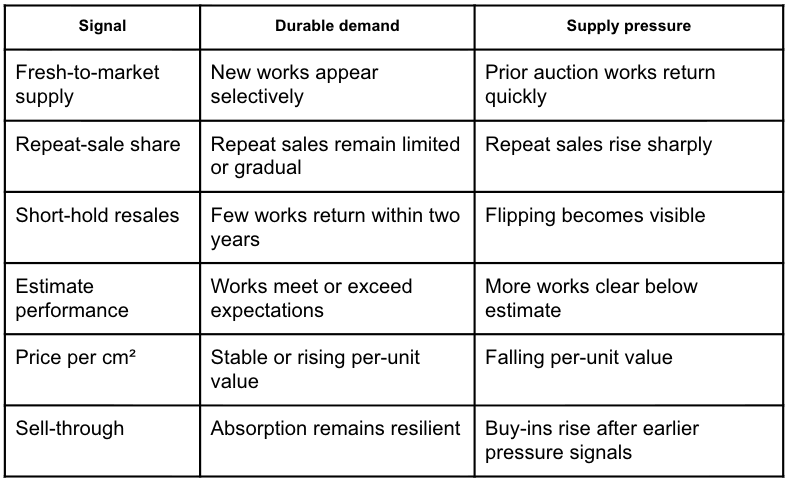
Figure 2. Auction-market health is rarely visible through headline records alone. Repeat-sale behaviour, estimate performance and price per cm² often reveal whether demand is deepening or whether supply is beginning to outrun conviction.
→ Explore auction-market data with Artscapy's Market Intelligence