

Sigmar Polke market analysis. Is now a good moment to sell? (March 2026)
Last updated: 16 March 2026.
Selling a Sigmar Polke is not a question of institutional validation. MoMA’s retrospective fixed the canonical baseline, and recent major programmes at the Prado, Fondation Vincent van Gogh Arles, Michael Werner, and the Anna Polke Foundation keep the artist in active curatorial circulation.[1][2][3][4][5] What you are deciding is narrower and more practical: does your work belong in the part of the Polke market that still benefits from public theatre, or in the part that benefits from control, narrative, and exact placement? This is a selective market, not a shut one.
Data note. The figures below reflect public auction results from January 2018 to March 2026 across Polke’s paintings, works on paper, photographs, and editions. The public tape covers 363 lots and a sell-through of about 66% excluding withdrawals, so benchmarks should be read as current rather than permanent.
→ Start with a valuation. Click here and get a price range in about 60 seconds.
In this article
- The current verdict
- A benchmark that matters more than the record
- How this market actually works
- Why private sale is often the rational route
- Sell now or wait
- Get your Sigmar Polke price range with Artscapy
 Sigmar Polke, Alpenveilchen, 1967. Image: © Sothebys
The current verdict
The regime changed after the post-pandemic surge. Sell-through ran at about 90% across 2018–21, then about 57% across 2022–25. That is the change that matters more than any one headline result. A public sale still works for the right Polke, but it is no longer a default validator.
For you as a seller, that means the market is usable only when the work is correctly tiered. The name still opens doors. The wrong route still closes price.
A benchmark that matters more than the record
The most useful recent benchmark is Alpenveilchen, not the record. A 1967 dispersion-on-canvas picture matching that title and size made about US$7.1m in London in 2019 and about US$5.3m in New York in 2025, the latter within estimate. That is how Polke behaves now. Canonical material still attracts serious buyers, but they are bidding with discipline, not adrenaline.
The ceiling still exists. Rasterbild mit palmen reached about US$21.5m in 2021, and nothing else in the public tape comes close. That sale still matters because it tells you what museum-grade 1960s Polke can do. It does not tell you what the rest of the market will do for a merely good work.
How this market actually works
Polke’s market turns on a simple constant: how much uncertainty a buyer is willing to pay for. Museums and galleries consistently frame him through dot pictures, patterned fabrics, chemically active surfaces, photography, and alchemical experimentation.[1][2][3][4][5][6] The auction tape rewards exactly the parts of the oeuvre where that uncertainty feels historically meaningful rather than merely unruly.
Paintings account for about 96% of auction value in this period. So when you ask what the Polke market is doing, you are mostly asking what buyers think of unique paintings, not what happens to edition traffic.
Beneath the trophy end, the broad commercial core is still unique painting. Outside the repeatable 1999 paper group, those works sold 75 times and carry a median around US$173,000. The relevant comparables here are not generic “Polkes” but historically legible pictures: 1960s raster and dispersion works, ambitious fabric pieces, or later resin-led paintings such as The Copyist, Plastic tubs, and related material experiments.
That hierarchy is unusually clean. The top five public prices in this period are all unique paintings, led by Rasterbild mit palmen, Stadtbild II, Alpenveilchen, Plastic tubs, and The Copyist. If your work is not competing at that level of art-historical legibility, it needs a different route and a different price logic.
 Sigmar Polke, Rasterbild mit Palmen, 1966. Image: © Sothebys
The barometer
The clearest public barometer is the group catalogued as 1999 acrylic-on-paper works at 200 x 150 cm. They sold 43 times with about 72% sell-through, which gives you enough tape to read buyer behaviour rather than anecdote. This cluster is liquid enough to be measurable, but not strong enough to be automatic.
Its median sat around US$208,000 in 2020–21 and around US$67,000 in 2024–25. That is a sharp reset. The lesson is not that buyers disappeared. The lesson is that image quality, paperwork, venue, and freshness now separate the best late paper works from the merely adjacent ones.
What gets ignored
Prints and multiples are a reference layer, not the engine of the market. Their median sits around US$1,800 and sell-through is about 56%. In other words, edition volume creates visibility, but not reliable pricing power.
Works on paper and photographs sit between the major paintings and the editions. That middle zone can sell well when the image is strong or the provenance is unusually clean, but category alone is not enough. In Polke, the buyer is usually paying for a position in the oeuvre, not for a medium label.
Why private sale is often the rational route
This is why private sale is often the rational route for Sigmar Polke. A patterned-fabric picture, a chemically active resin work, or a late acrylic-on-paper sheet can be flattened by a routine day-sale entry. In private placement, you can present the work as a specific Polke problem — raster logic, alchemical surface, Goya afterlife, photographic experimentation — rather than as another lot in a mixed room.[2][3][4][5][6]
The public ceiling is still built in New York and London, while German and Austrian rooms are more useful as barometers for lower- and mid-tier material than for price-setting masterpieces. That does not make regional houses wrong. It means you should not let a regional comparable define a work that belongs in an international conversation.
The broader market also supports this logic. Art Basel and UBS reported that auction-house private sales rose 14% in 2024 while public auction sales fell 25%.[7] That is exactly the kind of environment in which sellers choose discretion over theatre.
By 2025, the rebound was led by the high end, with the value of works sold above US$1m up 21%.[8] For Polke, that makes private sale feel like control, not consolation. You can protect the narrative on a mid-tier or barometer work, or use private competition to test a stronger painting before exposing it publicly.
Paperwork is part of the price
Paperwork matters more here than in a looser name market. The estate says it is compiling a comprehensive catalogue raisonné, and auction houses explicitly flag estate registration, certificates of authenticity, and publisher blindstamps on some Polke lots.[9][10][11] That is your clue that provenance and documentation are not administrative extras. They are part of the pricing mechanism.
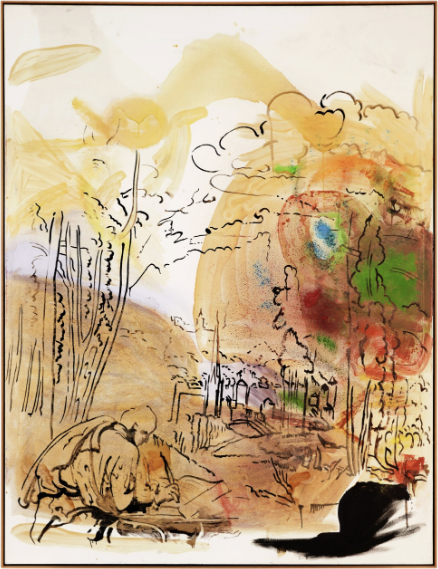 Sigmar Polke, The Copyist, 1982. Image: © Sothebys
Sell now or wait
Sell now if your work sits above the barometer
Sell now if you own the kind of Polke that rises above the 1999 paper barometer: a canonical 1960s painting, a resolved 1980s fabric or resin picture, or a late unique work with unusually strong provenance and image. This branch benefits from three things already visible in the tape: paintings still absorb almost all value, the barometer cluster has cooled enough to make stronger works easier to isolate, and the wider market’s 2025 recovery favoured the top end.[8] The right question is not “auction or private sale?” in the abstract. It is “which route best preserves the gap between my work and the average comparable?”
If that describes your work, waiting is not obviously safer than selling. In a market this selective, fresh, well-routed material can command attention precisely because weaker comparables have already taught buyers to discriminate.
Wait if the work is still generic on paper
Wait if the work is still too easy to misread. That is often the case for late acrylic-on-paper sheets inside the crowded 1999 cluster, for photographs without sharp provenance, or for editions where the certificate trail is thin. Here the recent tape argues for patience only if you can change the file: improve the paper trail, sharpen the condition story, separate the work from weaker comparables, or hold for a less crowded supply moment. Waiting for time alone is not a strategy.
So is now a good moment to sell? Yes, if you treat routing as part of price rather than as an afterthought. For a strong Polke, this is a workable market. For an average Polke, it is still workable — but only if you choose control over exposure.
Get your Sigmar Polke price range with Artscapy
The next step is not to guess where your work sits. It is to map it against the right Polke comparables and then choose the least wasteful route.
- Start with a 60-second estimate. Instant price range, backed by auction data refreshed every 24h.
- Pick your path. Fast Sale (speed) vs Maximise Returns (advisor-led strategy).
- Fast Sale. Get a non-binding offer in 1–3 working days (where eligible). Maximise Returns. Choose private placement vs targeted auction vs hybrid. Strategy based on what your work actually is.
- Close cleanly. 0% seller commission, transparent costs, escrow-protected. Payout within 7 days of collection (Fast Sale payout initiated same day once in our care).
Sources and references
Alibis: Sigmar Polke 1963–2010. The Museum of Modern Art, 2014. Accessed 16 March 2026.
Sigmar Polke. Affinities Revealed. Museo Nacional del Prado, 2024–2025. Accessed 16 March 2026.
Sigmar Polke: Under the Paving Stones, The Earth. David Zwirner / Fondation Vincent van Gogh Arles, 2025. Accessed 16 March 2026.
Sigmar Polke: Photographs. Michael Werner Gallery, 2025. Accessed 16 March 2026.
ATHANOR NOW. Anna Polke Stiftung, 2026. Accessed 16 March 2026.
Kathreiner’s Morning Wood. Guggenheim Museum Bilbao, n.d. Accessed 16 March 2026.
The Global Market. The Art Basel & UBS Art Market Report 2025. Art Basel / Arts Economics / UBS, 2025. Accessed 16 March 2026.
The Art Basel and UBS Global Art Market Report 2026. Art Basel / Arts Economics / UBS, 2026. Accessed 16 March 2026.
The Estate of Sigmar Polke: Catalogue raisonné. Estate of Sigmar Polke, n.d. Accessed 16 March 2026.
Sigmar Polke, Ohne Titel (Fenster). Phillips, accessed 16 March 2026.
Sigmar Polke Evening & Day Editions. Phillips, accessed 16 March 2026.
