
Stanley Whitney market analysis. Is now a good moment to sell? (March 2026)
Last updated: 16 March 2026.
If you own a Stanley Whitney, you are no longer deciding whether the artist is validated. That part is settled. The harder question is whether your work belongs to the Whitney market that still draws decisive buying, or to the part of the tape now treated with far more discipline. In other words: validation is real, selectivity is back, and control matters more than excitement. Routing matters.[1][2][3][4][5]
→ Start with a valuation. Get a price range in about 60 seconds. We’ll tell you what the auction record supports, what it doesn’t establish, and which route is structurally appropriate for your work.
Data note: figures below reflect recorded public auction results from 9 March 2018 to 5 March 2026 and are normalised into USD. Where a public sale reports a full sale figure, that benchmark is used; where only hammer is published, hammer is used. As fresh sales land, benchmarks can move.
In this article
- The sale that changed perception
- How the Stanley Whitney market actually works
- Why private sale is structurally rational here
- Sell now or wait?
- What to do next with Artscapy
Stanley Whitney, Forward to Black, 1996. Image: © Sothebys
The sale that changed perception
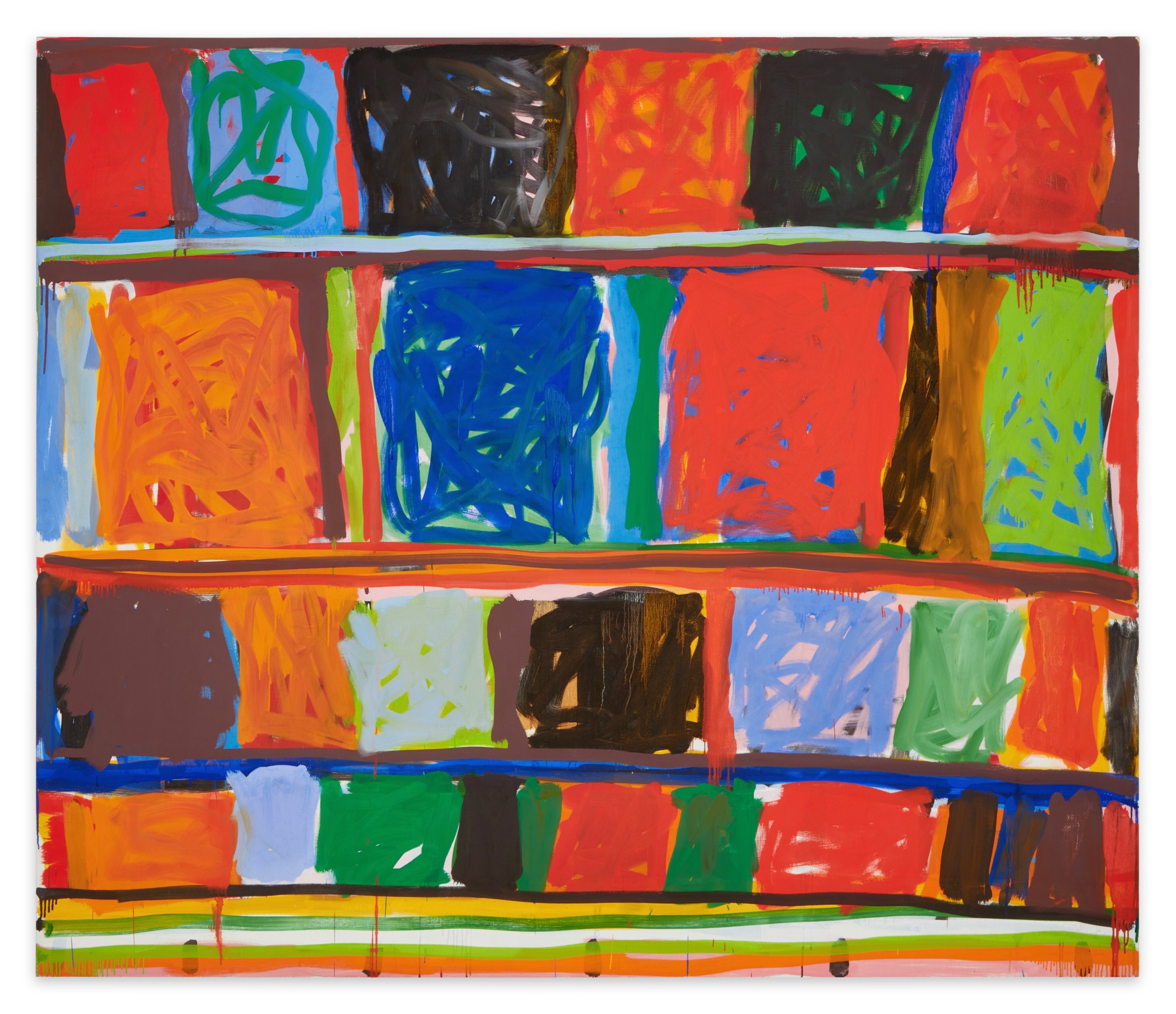
The most vivid public signal in Stanley Whitney’s market was Forward to black. On 29 October 2021, the 1996 painting made about $2.3 million in New York, more than 11 times its high estimate. That was not just a strong result. It was a statement that a museum-scale Whitney from the mature colour-block language could command true trophy pricing in public.
What mattered next was the pattern, not only the record. Whitney’s top five public auction prices all landed between late October 2021 and early May 2022, spanning New York, London, Shanghai and Seoul. That made the re-rating global. It also taught buyers that the ceiling lived in major paintings, not in the market as a whole.
Inference: this was the moment Whitney stopped being priced merely as a respected abstractionist with momentum and started being priced, at the top end, as an internationally routable postwar colour painter with real institutional weight. That inference is strengthened by the surrounding programme: the Venice Biennale collateral exhibition The Italian Paintings in 2022, followed by the first full retrospective at Buffalo AKG and its travel to Walker and ICA/Boston, alongside recent solo exhibitions at Gagosian in New York and Athens.[1][2][3][4][5][6]
For a seller, the implication is plain. If your work sits near that upper tier, it should not be measured against the whole Whitney tape.
How the Stanley Whitney market actually works
Whitney’s market works the way the paintings do: a fixed grammar, then variation within it. Buyers recognise the loose grid, the stacked colour blocks, the call-and-response logic, the jazz-inflected rhythm. But they do not pay evenly for those recognisable features. They pay for the point where scale, colour tension, date, title and conviction feel inseparable.[7][8][12]
Across the public record there are 222 lots, with 193 sold, 27 passed and 2 withdrawn. Sell-through excluding withdrawals sits just under 88%, and the overall median public sale price is around $52,000. That appears healthy, but it is only meaningful once the tape is segmented by product.
The real barometer: small square Untitled paintings
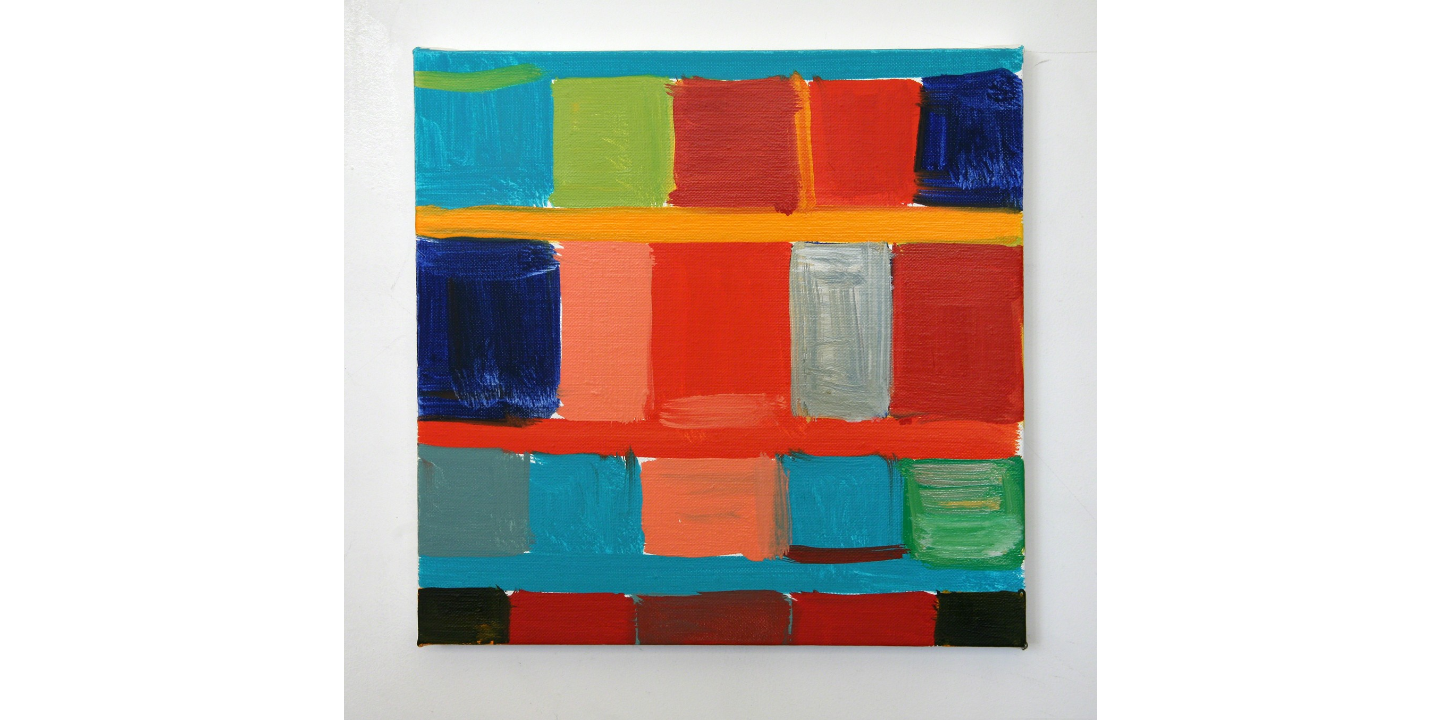
The clearest Stanley Whitney barometer is the small square Untitled painting, often from the recognisable 2010s group that appears repeatedly in auction catalogues. This is where the market’s mood is most visible because comparable examples are sufficiently numerous.
Around 80 sold examples of that product appear in the public record. Their median jumped to roughly $110,000 in 2022, fell to roughly $12,000 in 2024, then recovered to around $30,000 in 2025. This is not noise; it is a sentiment indicator.
The implication is clear. When these smaller Untitled works are strong, buyers are willing to pay for access to Whitney’s signature grammar. When they soften, the market stops rewarding repetition and begins demanding distinction. If your work sits within this barometer cluster, emphasis should shift from headline results to supply, estimate discipline and paperwork.
Stanley Whitney, Untitled, 2010. Image: © Stanley Whitney
Where the ceiling actually lives
The ceiling remains with serious paintings. Museum-scale Whitney paintings carry a median around $640,000, while strong mid-sized paintings sit nearer $325,000. Every top-five public result is a painting, not a work on paper and not an edition.
That hierarchy aligns with how institutions and major galleries frame the oeuvre. Buffalo AKG, ICA/Boston and the Met all centre Whitney’s mature colour-block paintings as the core of the achievement, while the Venice project underlined how Italy shaped the geometry and structure of those works.[1][3][6][7] Gagosian’s framing is consistent: colour, cadence, improvisation, and the ability of a stable structure to hold very different energies at different scales.[4][5][12]
This is why titles such as Forward to black, Radical openness, Nightwatch, Blue Note and First Fire matter. They sit in the segment of the market where a buyer is evaluating a painting, not simply recognising a signature.
Paper, monotypes and editions
Whitney’s works on paper are not secondary in an art-historical sense. Lisson describes them as a critical component of how he develops space, rhythm and colour placement, and ICA/Boston’s retrospective gave drawings, prints and sketchbooks a defined role in the narrative of the career.[3][8]
However, the auction market treats them differently. Works on paper have sold through at about 63% in public sale, well below the painting market. This reflects a more selective public environment rather than an absence of demand.
Medium confusion is a recurring seller risk. A Stay Song painting is not the same product as a Stay Songs monotype, and the market does not price them interchangeably. Nor should an editioned print be expected to trade on the same logic as a unique work on paper. For example, Peace Be Still was issued in an edition of 125 and marketed as signed, numbered and dated.[9] This level of publisher and edition clarity is standard expectation for print buyers.
Data needed. A current written policy from Stanley Whitney Studio, Gagosian, Lisson, or any catalogue raisonné or authentication body confirming whether unique paintings are routinely accompanied by certificates of authenticity.
Why private sale is structurally rational here
Private sale is not a fallback in Stanley Whitney. It is often the cleaner instrument.
The reason is structural. Whitney has a broad public tape because smaller Untitled paintings and works on paper circulate regularly, but the best paintings are rarer and materially distinct from the noisiest public comparables. If you own a strong Whitney—particularly a large named canvas or a painting with exhibition history—you may not want the market anchored to the repeatable small-square barometer. A private placement allows the work to be framed within the correct hierarchy: major paintings, institutional visibility, and a buyer base shaped by Buffalo, Walker, ICA/Boston, Venice and Gagosian.[1][2][3][4][5][6]
The broader market context reinforces this. Public auction sales have rebounded, but private sales remain a meaningful share of auction-house activity, reflecting sellers’ preference for pricing control and protection against the signalling risk of a failed lot.[10][11]
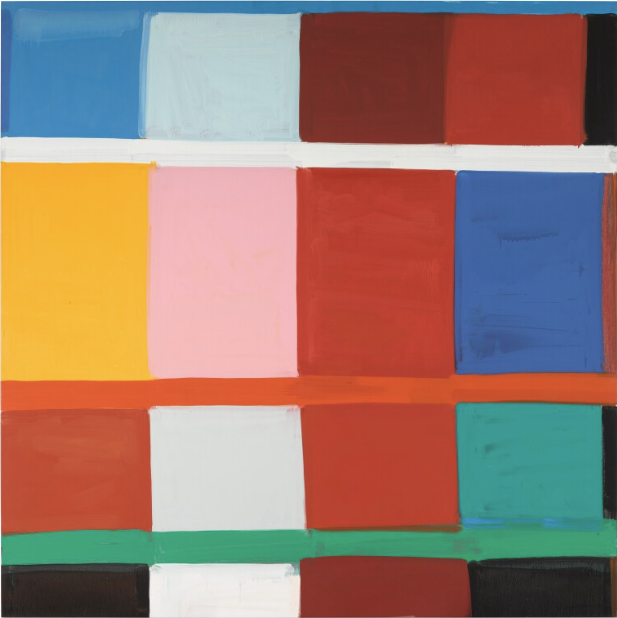
This matters because Whitney’s auction market now performs two functions simultaneously: it still demonstrates a credible ceiling, but it also penalises overreach. The March 2026 pass of Healing the Feeling, a large painting, illustrates that selectivity is now explicit rather than implied.
Inference: in a Whitney market where the ceiling remains intact but the barometer has reset, private sale provides what open auction cannot consistently guarantee—control over the peer group against which a work is judged.
Stanley Whitney, Healing the Feeling, 2013. Image: © Stanley Whitney
Sell now or wait?
Sell now if your work sits above the barometer
Now can be a viable selling moment if your Whitney clearly belongs to the established hierarchy: a strong painting, a named canvas, meaningful scale, or a work with clean provenance that can be placed decisively. The public record continues to support this. Painting results in 2024 and 2025 still reached around $600,000, with works such as Blue Note, Agean and First Fire indicating sustained buyer commitment beyond the 2021–2022 peak.
The institutional context is also stronger than before. The Buffalo retrospective and its tour, the Venice Biennale collateral exhibition, and recent Gagosian exhibitions have made Whitney easier to position and justify at higher levels.[1][2][3][4][5][6]
This is not a euphoric market. It is a legible one—and that can be sufficient.
Wait if your case depends on hope rather than hierarchy
Waiting is rational if your work sits within the most repeated segment of the Whitney market, if it is a weaker work on paper, or if provenance is thin enough that the market defaults to the lowest-risk comparable. The barometer for smaller Untitled paintings already demonstrates what happens when supply overtakes demand: prices correct sharply and only partially recover.
The same caution applies if your valuation relies on historic headline results without a clear basis for comparison. The market is now disciplined enough to distinguish Forward to black from a routine small Untitled, and a strong Stay Song painting from a minor monotype. If the case requires too much explanation in a live sale setting, a private route or delay is often more effective.
A practical rule holds: sell when the work is demonstrably above the barometer; wait when the argument relies on generosity from the room.
What to do next with Artscapy
- Get a price range in about 60 seconds. Instant price range, backed by auction data refreshed every 24h.
- Pick your path. Fast Sale for speed, or Maximise Returns for an advisor-led strategy.
- Choose the route that fits the work. Fast Sale means a non-binding offer in 1–3 working days where eligible. Maximise Returns means private placement, targeted auction, or a hybrid strategy based on what your Stanley Whitney actually is.
- Close cleanly. 0% seller commission, transparent costs, escrow-protected. Payout within 7 days of collection, with Fast Sale payout initiated the same day once in our care.
- If your Whitney belongs to the upper tier, the objective is not simply to sell—it is to route it intelligently.
Sources and references
[1] Stanley Whitney: How High the Moon. Buffalo AKG Art Museum. Exhibition page. 2024. Accessed 16 March 2026.
[2] Walker Art Center to Open 50-Year Career Retrospective of Artist Stanley Whitney. Walker Art Center. Press release. 2024. Accessed 16 March 2026.
[3] Stanley Whitney: How High the Moon. Institute of Contemporary Art/Boston. Exhibition page. 2025. Accessed 16 March 2026.
[4] Stanley Whitney: By the Love of Those Unloved. Gagosian. Exhibition page. 2024. Accessed 16 March 2026.
[5] Stanley Whitney: Return to the Garden. Gagosian. Exhibition page. 2025. Accessed 16 March 2026.
[6] Biennale Arte 2022 | Stanley Whitney: The Italian Paintings. La Biennale di Venezia. Exhibition page. 2022. Accessed 16 March 2026.
[7] Fly the Wild. The Metropolitan Museum of Art. Collection page. Accessed 16 March 2026.
[8] Stanley Whitney: Drawings. Lisson Gallery. Exhibition page. 2017. Accessed 16 March 2026.
[9] Stanley Whitney: Peace Be Still Print. Gagosian Shop. Product page. Accessed 16 March 2026.
[10] Global sales rise 4% to $59.6 billion in 2025, amid ongoing market recalibration. Art Basel. 12 March 2026. Accessed 16 March 2026.
[11] Six art market trends to watch in 2026. Art Basel. 6 January 2026. Accessed 16 March 2026.
[12] Stanley Whitney: Vibrations of the Day. Gagosian Quarterly. 13 February 2024. Accessed 16 March 2026.