
The Great Wealth Transfer is redrawing the art market
Market overview
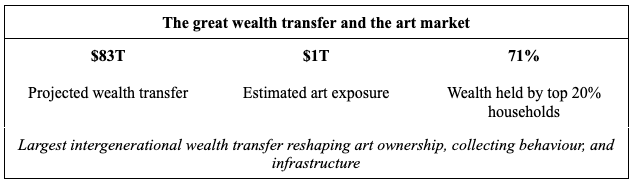
The global art market is entering a structural transition driven by the largest intergenerational wealth transfer in modern history. Over the coming decades, more than $83 trillion is expected to pass between generations, a profound shift that will redefine family dynamics, passion pursuits, and philanthropic priorities across the globe. [1]
A significant portion of this wealth transfer will occur through inheritance, trusts, and estate planning structures, passing both financial capital and significant collections of art and cultural assets to the next generation. [2] Several important post-war and contemporary collections were assembled during the late twentieth century by collectors who accumulated art alongside financial wealth. [3] As these collections pass to heirs, the art market is entering a generational transition in ownership.
However, the implications extend beyond a simple redistribution of artworks. For these families, art now represents a meaningful component of overall wealth, and inherited collections are increasingly evaluated within broader financial contexts. Younger generations are demonstrating a more asset-oriented perspective, often prioritising diversification across categories rather than concentrating on a single artist or period. [4] As collections move into the hands of a new generation of wealth holders, the infrastructure used to document, monitor, and administer art assets becomes increasingly consequential.
This transition is unfolding within an increasingly concentrated wealth landscape. 20% of U.S. households now control 71% of U.S. total wealth, meaning that inheritance flows will largely originate from existing wealth clusters, including family offices, entrepreneurial fortunes, and established collecting networks. [5] Roughly a quarter of wealthy investors, those with $5 million or more in investable assets, identify as collectors, and wealth allocated to art has grown by approximately 18% in recent years. [6]
Even a modest allocation of transferred wealth to art would represent a substantial shift in the scale of the market. Assuming that roughly 5% of transferred wealth pertains to art, this could represent close to $1 trillion in art-related assets moving between generations over the coming decades. [6]

The most significant impact of the Great Wealth Transfer may therefore lie less in the volume of capital entering the art market than in how that capital is managed. Ownership is gradually shifting from individual collectors toward multi-generational wealth frameworks involving advisors, family offices, and estate planning strategies. This shift in collector demand requires a corresponding expansion in the infrastructure and expertise needed to support it.
Early signals: a new type of collector
The first indications of this transition are emerging among second- and third-generation wealth holders.
First-generation collectors built their collections organically while accumulating wealth. Their acquisitions were frequently guided by personal taste, long-standing relationships with dealers, galleries and artists, and a commitment to cultural patronage. Collections evolved alongside business success, with artworks acquired as both financial and cultural capital expanded. They reflect decades of personal engagement with the art world. [1]
Heirs inheriting these collections approach art from a fundamentally different starting point. Rather than building wealth through entrepreneurial activity, they are often responsible for overseeing existing capital across multiple asset classes. As a result, inherited collections are increasingly evaluated within the broader context of family wealth rather than as an entirely separate cultural pursuit.[4]
This perspective is reinforced by broader generational investment behaviour. Younger wealthy investors tend to have long-term investment horizons and are more comfortable with alternative assets. Having come of age during the rapid expansion of venture capital, private equity, and hedge funds, they are accustomed to allocating capital to assets that may require extended holding periods or offer limited liquidity, balancing those investments with more liquid, short-term holdings. [7]

Decision-making processes are also evolving. Collectors increasingly rely on data, analytics, and digital market intelligence to evaluate acquisitions. Online research platforms, portfolio dashboards, and alternative market data allow collectors to monitor artist markets, track auction performance, and compare artworks across price tiers.
Collecting priorities are shifting as well. Since information about artists and markets has become more accessible in the digital age, cultural prestige increasingly derives from discovery rather than acquisition power and ownership. There is status associated with identifying artists outside the traditional canon before they achieve widespread recognition, a role that prior generations relied more heavily on galleries and dealers to fill. As a result, younger collectors gravitate towards historically overlooked artists, women artists, and emerging figures whose work is gaining institutional recognition. In this context, prestige lies in recognising cultural shifts early, rather than acquiring already canonical works.
Taken together, these behavioural changes point toward a shift in how inherited collections are managed, with greater emphasis on oversight, strategy, and portfolio integration. As ownership transitions to heirs raised in sophisticated wealth-management environments, art is increasingly likely to be evaluated, monitored, and integrated within broader portfolio strategies. The heirs may not necessarily be financially savvier than their predecessors, but have access to the structural wealth management support.
Market implication: the rise of the middle market
One of the most significant structural consequences of the Great Wealth Transfer may be the expansion of the middle tier of the art market.
When major collections are divided among multiple heirs, wealth that once supported acquisitions at the highest price levels is redistributed across a larger number of collectors. While the aggregate capital remains constant, the size of individual acquisition budgets may shift downward.
A collector who historically acquired works valued at $1 million or more may be succeeded by several heirs whose acquisition budgets fall closer to the $200,000–$400,000 range. Assuming the heirs continue to participate in their parents’ interests, the result is a larger number of collectors participating in the market, each writing smaller checks.
This dynamic is particularly significant because the art market does not operate like traditional financial markets, but is categorised as a participation market. Unlike equities or real estate, where a handful of institutional investors can deploy vast amounts of capital, the art market lacks that scale, so it is driven by individual collectors. For many artists, the global pool of serious collectors may number only a few dozen individuals. Even small increases in the number of bidders can therefore have disproportionate effects on price formation.
These conditions exhibit what economists describe as superstar market dynamics, where a small number of artists capture a disproportionate share of market value. Since the supply of works by leading artists is often fixed, modest increases in demand can produce substantial price movements when competition among collectors intensifies.
Case study: early adopters in family office networks
The earliest adopters of this new approach to collecting are second- and third-generation principals within large family offices, particularly those managing more than $500 million in assets under management and overseeing globally diversified investment portfolios.
These next-generation wealth holders differ meaningfully from the wealth creators who originally built the capital. Financially literate and operating with an investor mindset, they tend to view art within the broader context of portfolio construction rather than as a purely discretionary purchase. Their broader portfolios resemble institutional endowments, combining traditional investments with allocations to alternative assets including private equity, venture capital, real estate, and collectibles.[2],[8]
Within this framework, art occupies a distinctive role. Although it represents a relatively small portion of total portfolio value, it provides a combination of cultural value, diversification benefits, and the potential for long-term capital appreciation.[2]
In contrast to earlier generations of collectors, who frequently built collections gradually through personal relationships with dealers and artists, family offices tend to approach art ownership through the lens of asset allocation and portfolio oversight. Investment dashboards, portfolio analytics, alternative data, and market intelligence tools increasingly inform decision-making.[4] Collecting strategies may incorporate signals such as institutional exhibition histories, curatorial attention, and auction market performance alongside aesthetic considerations.
This shift in mindset often leads to more active collection management than in previous generations. Strategic deaccessions may occur to rebalance holdings, release capital for new acquisitions, or reduce concentration in particular artists or categories. Rather than remaining static over decades, collections may evolve as dynamic portfolios that are periodically refined, expanded, and repositioned.[4]
Acquisition strategies also reflect broader generational priorities. Many next-generation collectors demonstrate strong interest in historically underrepresented artists, emerging voices, and themes related to identity, impact, or social relevance. This reflects both a cultural shift and a strategic one, as collectors increasingly seek opportunities to identify artists gaining institutional recognition or market momentum.
These dynamics are contributing to the broader professionalisation of art ownership. Surveys of wealth managers indicate rising demand for services related to art valuation, collection oversight, and estate planning as artworks become more integrated into family wealth portfolios.[6] Art therefore occupies a dual role within these portfolios: it remains a deeply personal cultural asset that reflects identity, taste, and intellectual engagement, while also functioning as a financial asset requiring oversight, strategy, and infrastructure.
Yet the infrastructure available to support this evolving approach to collecting remains underdeveloped relative to other asset classes.
The infrastructure gap
Despite art’s growing integration into wealth portfolios, the infrastructure for managing art assets remains fragmented. While traditional financial markets benefit from highly developed systems for monitoring and administering assets, the tools available for managing art collections remain comparatively underdeveloped.
In financial markets, investors rely on integrated platforms that provide portfolio tracking, transparent pricing data and standardised records of transactions, ownership and valuation. Centralised dashboards allow investors and advisors to monitor performance across asset classes, maintain consistent documentation, and make informed decisions using real-time data.
Art ownership operates differently. Even among major collectors, documentation is frequently dispersed across invoices, insurance records, gallery correspondence, and auction catalogs accumulated over decades. Provenance records, exhibition histories, and valuation reports may exist in separate formats or locations, making it difficult to maintain a comprehensive, up-to-date overview of a collection’s composition and value.
These challenges become more pronounced during generational transitions. As collections pass from one generation to the next, heirs may inherit artworks whose documentation is incomplete or difficult to interpret. Valuations may be outdated, insurance coverage unclear, and transaction histories difficult to reconstruct. In some cases, the original collector may have maintained records informally, relying on personal knowledge rather than structured record keeping. The next generation is therefore often underprepared, as 61% have not discussed the collection, and 21% have mentioned it but not in great depth.[8]
At the same time, artworks are increasingly expected to function within broader wealth portfolios, and clients are increasingly demanding assistance with art-related matters. Advisors, family offices, and estate planners require reliable valuation data, documentation, and ownership records in order to integrate art into financial planning, lending decisions, and estate strategies.[6] Without standardised systems for managing these assets, even sophisticated wealth structures can struggle to monitor collections effectively.
This challenge is reflected within the financial services industry itself. The share of wealth managers offering art services has declined from 63% in 2023 to 51% in 2025, highlighting the difficulty institutions face in maintaining the expertise required to navigate the art market.[6]
The result is a growing misalignment between the financial importance of art assets and the infrastructure available to manage them. However, digital infrastructure is beginning to emerge to address this gap. Platforms, such as Artscapy, provide collectors and their advisors with centralised systems for managing art collections, allowing documentation, valuation data, and market intelligence to be consolidated within a single platform. This includes sophisticated portfolio management tools, comprehensive collection management services, and in-depth market research and intelligence. By introducing structured data and portfolio-level visibility, these systems enable art to be monitored and administered with a level of oversight more comparable to traditional financial assets.
For collectors navigating generational wealth transfer, this type of infrastructure is becoming increasingly important. Tools that provide transparency into collection value, documentation, and market positioning allow heirs and advisors to manage inherited artworks more strategically while preserving the cultural and personal significance of the collection.
As the art market becomes more closely integrated with wealth management frameworks, platforms that bridge the gap between cultural assets and financial infrastructure are likely to become central components of the evolving art market ecosystem.