

What the results of the marquee auctions this season tell us about the market
After months and months of doomsday reporting by the art world press, the past two months beginning at the October auctions in London to the most recent marquee sales in New York last week tell a different story. After a clear downturn since the Covid market bubble, we see a new excitement for art collecting, but it is through a correction and a different kind of buying. The pendulum hasn’t swung the other way for the market, yet it is certainly healthier and more focused.
Of course there are the press worthy headlines about the Gustav Klimt selling from the Lauder collection at $236,400,000 and the Frida Kahlo record breaking sale at $54,600,0000 (though amazing to see that it marks a record breaking number for a woman artist ever sold at auction), but it is actually an examination of the majority of other results that happen at auctions that are better indicators of where the market is. Last week’s results prove that there is appetite for art, albeit quality, type, pricing are all important for someone to shell out money, and ultimately they truly have to love the work. All good things!
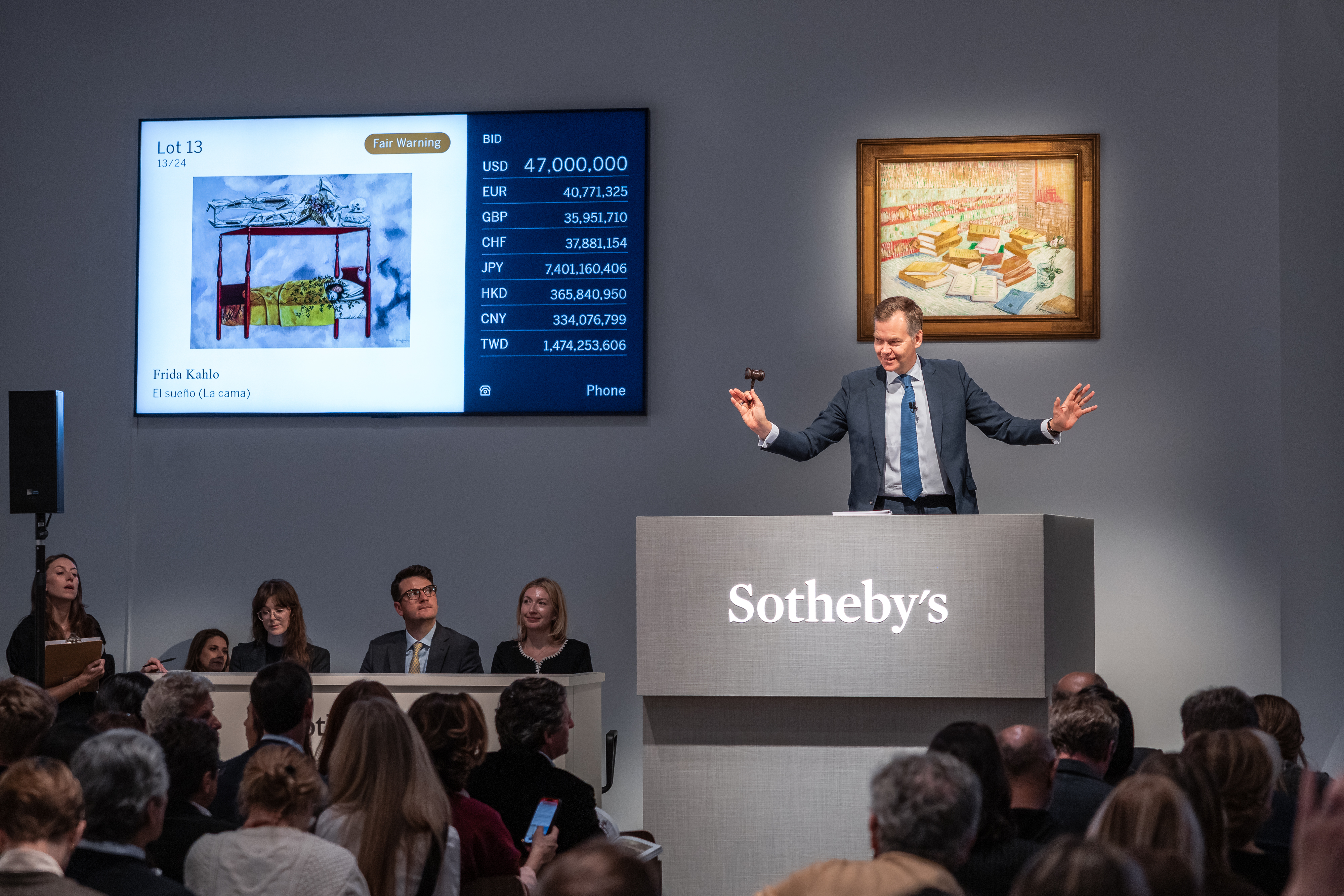
Image from Sotheby's New York auction, sale of Frida Kahlo’s El Sueño (La Cama). Photo: Alive. Courtesy of Sotheby’s.
Here some analysis of the results last week gleaned a change in approach that shows if you’re only in the art market to make money, you will have a hard time making it. First, the strong results for Modern works, in particular women Surrealists, show the continued prevalence of Modern art and that increasingly mixing different genres of art in one’s collection is becoming more popular. A sign that your generation does not necessarily dictate the art you buy, and that collectors are interested in art history in parallel with what is happening in contemporary art today. Perhaps a more curated strategy is taking precedence over that of looking for the next “hot” emerging artist, an exhausted approach.
There is an enormous appetite for Roy Lichtenstein and Alexander Calder works. The fact that 30 lots in a row by the artist were in the Sotheby’s day sale and all found buyers barring one, with 15 of them selling at the high estimate or over shows a remarkable stability in his market. As well as, in Alexander Calder, whose works were represented in depth across the auctions and all sold well. Bluechip names are timeless buys.
Quality and type matters. Cecily Brown’s “High Society” sold at a record breaking $9,810,000 (with premium), while “It’s not Yesterday Anymore” a more recent and in my opinion lesser example from 2022 in the Christie’s evening sale failed to sell. The same thing happened for other artists such as Ed Ruscha where an A+ work on paper sold well above estimate, whilst a larger painting on canvas failed to sell. The works across the auctions that didn’t find buyers were often due to quality of the examples, as clearly consignors are still hesitant to put their best assets for sale in a hesitant market. Or they didn’t find buyers because they were too expensive.
Lastly, pricing matters. Buyers are becoming more price sensitive to pumped up estimates and no longer want to pay above value. Berklay Hendricks, an great artist with an excellent example on offer, with its museum history and freshness to market would have found a buyer at a lower estimate no doubt. In fact most works that sold well did so with realistic estimates, and even then, generally works are not doing double or triple their estimates.
Just because there is not hyper speculation, does not mean the market is dead. In the last few years we have seen the gradual exit of speculators from the market, which quite honestly isn’t a bad thing, but a good one. Less speculators means less false demand, greater trust between galleries and buyers, more promising long-term careers for artists, and less volume of bad art flooding the market. It also means people collecting for better reasons than trying to make a quick return. Galleries are not aiming to build an artist market, they are aiming to build an artist’s career. The auction houses have no prerogative to do so, so of course they will price to manipulate, push forward a market, or even avoid certain artworks just to control the results of the sale.
The exit of speculation and the auction houses’ reaction to this was one of the reasons we have experienced a steady decline in the market since 2022, among other reasons:
- Irrational speculation led to paying high prices for untested works, as well as a flood of emerging artists that were not market ready. Too many artworks being offered for sale at too high prices.
- Galleries amped up pricing on artworks in an effort to price out speculators, however their business model kept a lot of honest new buyers out of the opportunity to become good collectors.
- Covid speculation made people lose sight of quality and instead followed algorithms that could not have an eye for it.
- The loss of Chinese buyers also played a role, as it became harder and harder to move money offshores.
- Rising overhead costs made it harder and harder for small and mid-tier galleries to keep up with the mega ones.
- Global socio-political concerns and inflation played a role in less spending.
It is a truism that with every downturn, there will be a correction and it has started. What is positive about the auctions that took place in New York last week, is not just renewed excitement for quality works that were fresh to market from Estates, but the lack of speculation. Works selling within estimate or failing to sell at overly high estimates put in place by greedy consignors show that buyers are more attentive to new market realities. And estates will continue to come to auction as the millennials replace the boomers. The Pauline Karpidas sale did very well earlier this fall. The Robert F. and Patricia G. Ross Weis, Leonard Lauder, and Cindy and Jay Pritzker Collections sold further making the case for quality and freshness. A-plus works often broke records. Hundreds of works offered of lesser quality either didn’t sell or sold for low prices.
One can feel it is not nearly a boom market, but there is renewed enthusiasm for collecting. As we approach the end of the year Art Basel Miami offers again another wave of artworks for sale, but most of the data on sales will come from what galleries choose to share. Art fairs have also become so much about the social experience of art rather than the collecting of it. But, I do see collectors learning the value of looking in person, of falling in love with an artwork, and of learning to understand price consistency. More seasoned collectors are coming back, and galleries are being more open minded about discounts and welcoming new buyers. These are signs of a recovering market.
As the market continues to correct and evolve, the most successful collectors will be those who stay informed, buy with discipline and keep their focus on quality. At Artscapy, this is the ethos that underpins every conversation with our collectors.