

Why you should add prints and multiples to your collection
Editions and multiples, think prints, cast sculptures, signed photographs, are no longer niche products in the art world. In fact, they’re becoming a central driver of growth, accessibility and long-term value. For art advisors, collectors, and artists themselves, understanding their role in today’s market is more crucial than ever.
Despite a challenging year for the broader art market - global sales fell by 12% in 2024, declining to around US$57.5 billion. Yet, during that downturn, the number of transactions actually rose by 3% to 40.5 million, largely thanks to increased activity in more affordable segments. According to the Art Basel & UBS report, prints and multiples now account for around 7% of sales by value, up from previous years.
Why does this matter? For artists, limited editions provide a powerful way to balance exclusivity with reach. Producing signed, numbered works allows artists to support their practice financially without compromising on artistry or quality. Editions also foster engagement: collectors can enter a name’s market at a much lower price point, and the secondary market for these works tends to be more fluid than for ultra-high-end uniques.
A perfect example is Rembrandt, who began his career primarily as a printmaker and, in many ways, revolutionised the medium. His etchings were not mere reproductions; they were sites of experimentation, each impression slightly different, each plate reworked like a living document of the artist’s thinking. Many of Rembrandt’s most powerful images — intimate portraits, biblical scenes, dramatic nocturnes — exist only as prints. For collectors, owning a Rembrandt painting is nearly impossible; owning a Rembrandt etching is entirely achievable, allowing a collection to reflect the full breadth of his practice rather than only its painterly half.
A similar pattern appears in Picasso’s career. While celebrated for his paintings, Picasso produced an enormous body of prints across etching, aquatint, linocut and lithography. These works are not auxiliary; they are central to his creative development. Entire periods of his life, such as the Vollard Suite, are documented almost exclusively through printmaking. For collectors who already own a Picasso canvas, acquiring a print can illuminate the artist’s process, themes and evolution in a way a single painting cannot.
Many other artists embody this duality. Goya’s most searing social critiques survive through prints. Munch’s explorations of anxiety and human emotion often take their most distilled form in woodcuts. Hockney, across five decades, uses prints to test ideas before and alongside his paintings. Kusama and Takashi Murakami use editions to extend their visual language to broader audiences without diluting the conceptual core of their work. In each case, the prints are not secondary—they are essential.
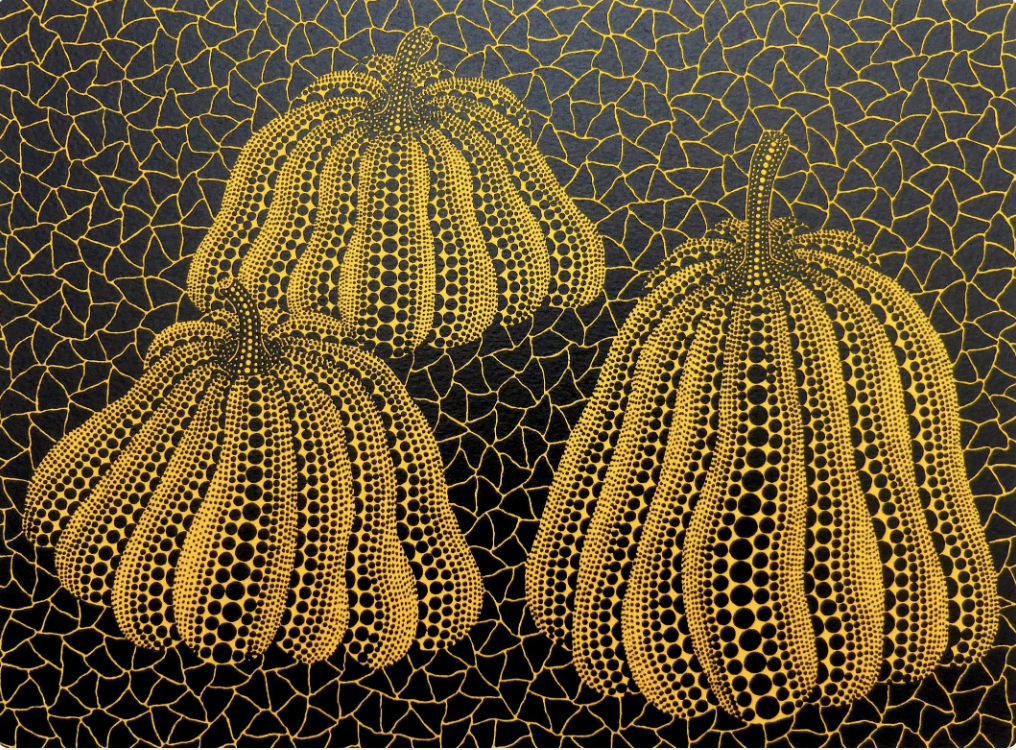
Yayoi Kusama, Three Pumpkins (1993), courtesy of the artist.
From a collector’s perspective, editions offer excellent value and flexibility. Rather than pouring capital into a single painting, buyers can assemble a diversified collection of limited works across different artists. Proper documentation — invoices, certificates of authenticity, edition numbers is essential, and for more valuable editions, the presence of artist proofs or states can act as a valuable premium benchmark.
There are, of course, risks: paper works are delicate, and condition (tears, fading, mounting) can dramatically affect value. Authentication demands rigor, especially in cases where unauthorized editions or reprints exist. But with due diligence, editions are a uniquely attractive asset.
Perhaps most exciting is how editions are connecting with a new generation of buyers. According to Art Basel & UBS, Gen Z and younger collectors are embracing prints at a rate that outpaces traditional blue-chip paintings. These younger collectors are primed for editions, they understand limited drops, series, and collectibility.
In short: editions aren’t just the future of collecting — they’re part of the present. For advisors guiding family offices, emerging collectors, or longtime enthusiasts, multiples offer a way to build a collection that is both culturally rich and economically resilient.
For collectors looking to navigate this landscape with confidence, Artscapy provides specialist advisory support and portfolio tools tailored to editions and multiples. From sourcing and due diligence to documentation and long-term collection management, Artscapy helps collectors integrate prints and editions into a considered strategy that balances passion, provenance and long-term value.
