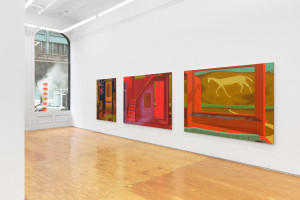
Alfie Caine market analysis. Is now a good moment to sell? (February 2026)
Last updated: 8 February 2026
Alfie Caine has the kind of market that tempts you into thinking it’s straightforward: a handful of public auction results, a recognisable visual language, and a visible climb through serious gallery contexts. The trap is that those elements don’t add up to broad liquidity—they add up to high selectivity.
With Caine, the question isn’t “is the market up or down?” It’s “does my painting sit inside the slice buyers aggressively reward—or just adjacent to it?”
Verdict: Selling Alfie Caine can be rational now if your work is a clearly “signature” interior painting and you control the route to the right buyers.

Alfie Caine, Peace and Quiet Before the Party, 2021. Image: © Phillips
Start with valuation, then choose a route
If you’re considering selling an Alfie Caine work, the cleanest next step is to establish where your piece sits inside the market’s actual demand pattern.
- 👉 Get a price range in about 60 seconds.
- If it looks right, request purchase offers within 48 hours with 0% seller fee (where eligible).
We’ll tell you what the auction record suggests, what it doesn’t prove yet, and which selling route is structurally sensible for your specific Caine.

Alfie Caine, Pots and Wildflowers, 2021. Image: © Phillips
How Caine’s market clears in practice: it’s a “signature image” market, not a broad one
Caine’s work is consistently described—by galleries and critics—as a constructed world of interiors, thresholds, and landscape beyond: windows, doors, terraces, cutlery, tiles, fabrics, and the countryside glimpsed like a memory you can’t quite enter. That isn’t just art writing; it’s the buyer filter. When a Caine painting delivers that “architecture of desire” feeling, it becomes instantly legible to collectors who already follow him, and it performs like a momentum lot. [1][2]
The public auction record in the table reinforces a key behavioural point: buyers aren’t rewarding “a Caine painting.” They’re rewarding “a Caine painting that reads unmistakably as Caine.” That is why you see dramatic separation between the work that becomes a room‑divider in the sale, and the work that becomes merely “a nice emerging painting.”
Implication for you as a seller: your first job is not to pick a date—it’s to identify which side of that signature line your work sits on.
What buyers are actually buying when they buy a “good” Caine
Caine’s galleries repeatedly frame him as an artist who builds space: trained in architecture, then turning that training into imagined rooms and vistas that hover between the familiar and the impossible. In the MASSIMODECARLO material, thresholds (windows/doorways/terraces) are described as the engine of the work—physically between interior and exterior, and emotionally between intimacy and distance. [2]
That “threshold” quality is also explicit in the curatorial language around his earlier solo exhibition at UNION Gallery, which describes doors left ajar, far‑off houses half obscured, and interiors that pull you in while keeping something just out of reach. [3]
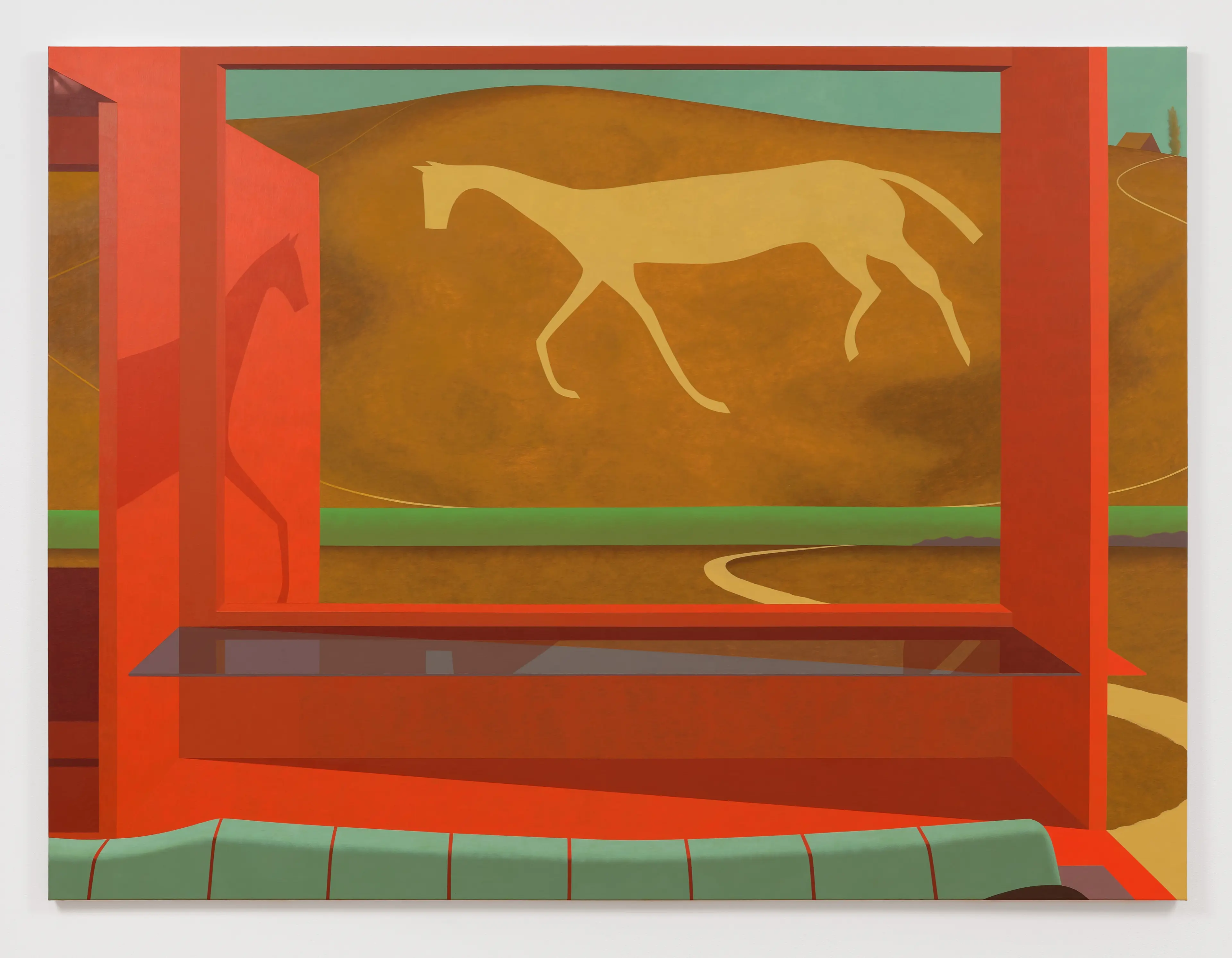
Alfie Caine, Chalk Horse, 2025. Image: © Courtesy of the artist and Margot Samuel, Photo: Matthew Sherman
Here’s what that means in market terms:
- Buyers reward paintings that feel like complete environments. Caine isn’t being bought like a brushy painterly abstraction; he’s being bought like a place you can mentally walk into. [2][3]
- Buyers reward the “portal” motif. When the work hinges on a window/door frame and the landscape beyond, it reads as unmistakably his. [2][4]
- Buyers reward domestic detail without figures. The stillness—objects set out, rooms held in suspense—creates a collectible image that’s easy to live with and easy to recognise. [1][3]
Seller implication: if your work is a fully realised interior with a portal and those “designed details,” you are selling into the part of the market that has shown public urgency.
Where liquidity concentrates and where it evaporates
In the auction results table, Caine’s public secondary market is effectively a Phillips market, with outcomes concentrated in London sale contexts. That concentration matters because Phillips has a defined collector audience for ultra‑contemporary painting, and because their sale curation can amplify recognisability.
The proof that liquidity is not evenly distributed is the “quiet” datapoint: Hastings Old Town is the low outlier in the table, at US$35,560. The work still sells, but it behaves like the market is evaluating the picture, not just bidding the name.
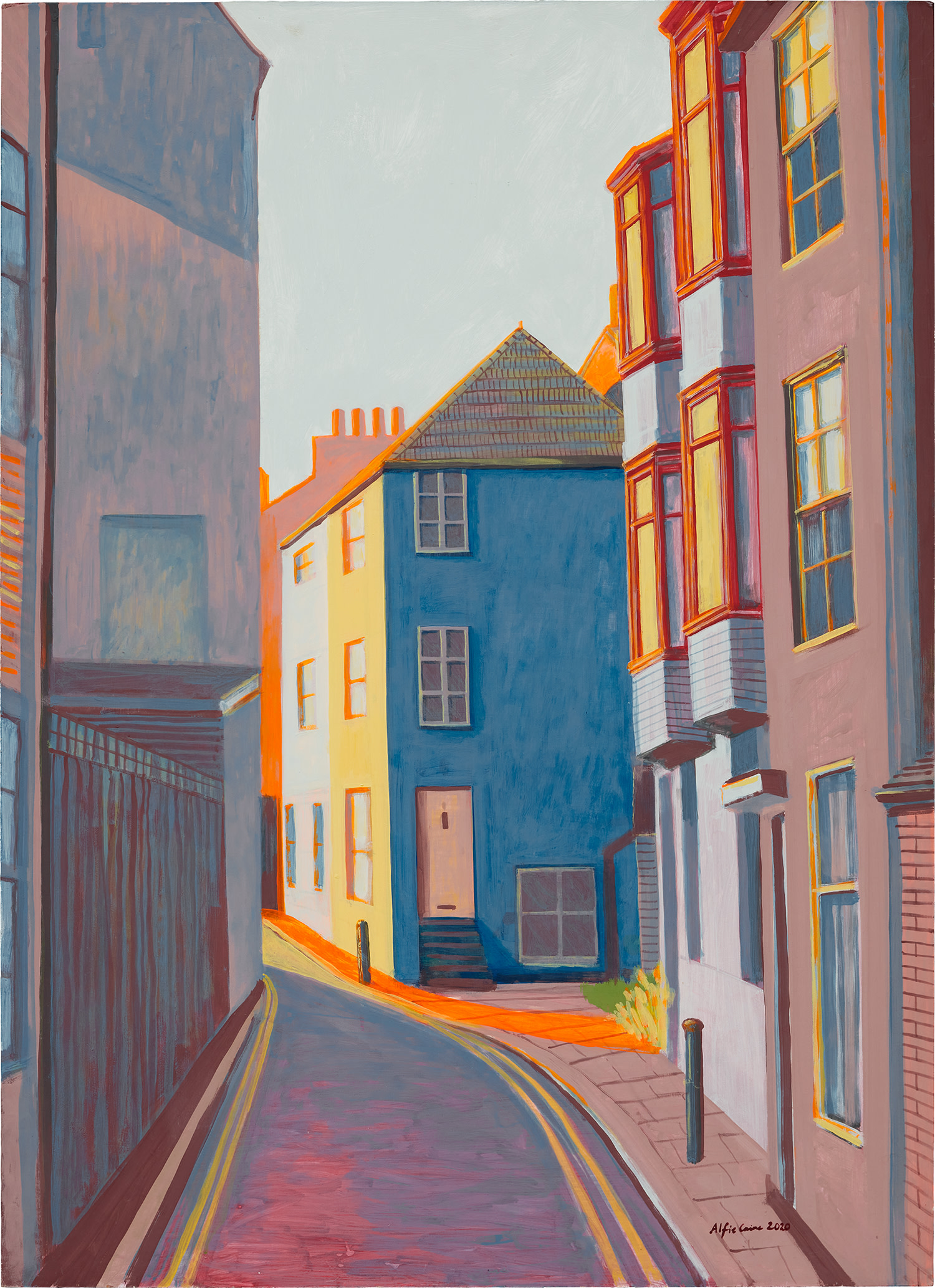
Alfie Caine, Hastings Old Town, 2020. Image: © Phillips
Implication for you: if your Caine is closer to a townscape, exterior view, or “study‑like” work on board/panel, you should not assume it will inherit the auction heat of the best interior paintings—even if it’s the same year and the same artist.
Action: treat those works as candidates for a controlled private placement or a carefully chosen sale context, rather than chasing a headline auction moment.
The uncomfortable truth about estimates in Caine’s market
Emerging‑artist markets often look like they’re “breaking records” because auction estimates lag demand, or because estimates are set conservatively to encourage bidding theatre. Caine’s table suggests exactly that kind of dynamics for the most in‑demand works.
For the highest‑performing lot in the table, the recorded price is over 10× its low estimate. That isn’t normal “healthy demand.” That’s competitive demand, where multiple buyers decide that losing the work costs more than paying up.
Implication: you cannot price your Caine rationally off an auction estimate; you price it off where buyers have actually shown willingness to compete for comparable compositions.
Action: when we value your Caine, we’ll treat estimates as context, but we’ll anchor to realised outcomes for works that match on composition and support.

Alfie Caine, Interior with Sunflowers at Sunset , 2021. Image: © Phillips
The signal that changed behaviour: Phillips + Whitechapel made Caine legible to the auction crowd
Caine’s public auction entry point wasn’t a random consignment; Phillips itself frames his auction debut as coming via the Whitechapel Gallery Art Icon charity auction hosted by Phillips. [5]
Whitechapel’s own press release describes the Art Icon auction as a charity programme supporting the gallery’s education and community work, with artists donating works and Phillips hosting the sale. [6]
Why this matters to sellers is not the charity sale in isolation—it’s what it enabled next:
- It placed Caine inside Phillips’ institutional partnerships narrative (which their collector base reads as legitimacy). [5][6]
- It gave Phillips an early relationship with the artist’s work and story (architecture training, domestic dreamscapes), which later becomes sale‑room framing. [5]
- It helped channel subsequent public price discovery through one auction house, which concentrates liquidity but also concentrates risk.
Implication: when people say “Caine at auction,” they often mean “Caine as Phillips has staged him.” If you sell outside that staging—or with a work that doesn’t fit the staging—results can diverge sharply.

Alfie Caine, Midday Sun, 2020. Image: © Phillips
Gallery momentum is real and it changes what “a good sale” looks like
Over the last couple of years, Caine’s gallery programme has become increasingly structured:
- A US solo exhibition at Margot Samel positioned his work within a New York gallery context and explicitly framed it as his first US solo with the gallery. [4]
- A solo exhibition at MASSIMODECARLO in London was presented as his first solo with the gallery, emphasising his architectural approach to space and the Rye/East Sussex geography that feeds the work. [2]
- Cob presented his work at Independent in New York, explicitly linking his paintings to domestic space and design objects in an art‑fair setting. [7]
This matters because serious gallery programming does two contradictory things at once: it can broaden collector demand, but it can also make the market more picky about what “counts” as core work.
Inference: As Caine’s gallery context strengthens, buyers may become more selective at auction, not less—because they have a clearer picture of what the best work looks like, and because galleries tend to elevate certain formats and motifs over others.
Action: if your work is a core interior‑portal painting, the gallery momentum is supportive context. If your work is peripheral to that image, the same momentum can make pricing harsher.
Is private sale structurally rational for Alfie Caine?
For Caine, private sale is not a consolation prize; it is often the structurally sensible route—because the public auction record is still thin and highly selective.
Here’s the mechanism:
- Caine’s buyers are trained through gallery narratives (thresholds, constructed domestic space, Rye landscapes) and through a small set of highly visible auction moments. [1][2][4]
- A thin public record means each auction result has outsized signalling power—good or bad.
- If your work is not a “headline‑ready” Caine, auction can turn your painting into the datapoint that establishes the wrong floor.
Private placement can be rational because it lets you control three variables that matter disproportionately in Caine’s market: which collectors see it, what comparables the conversation is anchored to, and how the work is positioned relative to his current gallery programme.
Inference: In a market where one weak public result can echo loudly, privacy can be a feature rather than a lack of transparency—especially for works that don’t match the most coveted Caine compositions.
Action: we typically treat private sale as the default option unless your work clearly fits the most aggressively rewarded “signature” lane and the auction context is demonstrably right.
Acting now vs waiting: what you’re really choosing with Caine
With Alfie Caine, “timing” is less about macro cycles and more about whether you want to sell into a market that is hot but narrow.
Reasons acting now can be rational
Caine has visible, recent gallery signalling—US exposure via Margot Samel and a major London presentation via MASSIMODECARLO—and the auction table shows that the best‑fit works can attract serious bidding rather than polite buying. [2][4]
Inference: If your work is a signature interior‑portal painting with strong presentation and clean provenance, the current environment is unlikely to punish you for testing liquidity—provided you choose the right route and avoid being mis‑positioned at auction.
Reasons waiting can be rational
The same auction table also implies a hard boundary: when the work is less signature, outcomes compress quickly. The market is not yet deep enough to “average out” risk across many public comparables.
Inference: If your work is an exterior‑leaning subject, a smaller board/panel piece, or from a later period without public comparables, waiting can be rational—either for more public price discovery, or for a private placement that doesn’t force the market to declare a number in public.
The decision isn’t “sell now or miss out.” The decision is “sell in the lane that the market rewards, or don’t sell publicly at all.”

Alfie Caine, Ocean Retreat, 2020. Acrylic on Panel. Image: © Phillips
What we would need to value your Alfie Caine properly
To value a Caine work in a way that matches how buyers actually behave, we focus on evidence that maps to his signature demand filters:
- Photos that show whether the painting delivers the interior‑portal “threshold” structure associated with his major shows (UNION Gallery, Margot Samel, MASSIMODECARLO). [2][3][4]
- Medium and support details, because the public auction record is dominated by paintings and shows visible separation between supports.
- Provenance and exhibition history—especially if the work ties to a recognisable body of work from a known presentation (for example, UNION Gallery’s What Lies Beyond). [3]
- Condition and any restoration, because emerging‑market buyers can become unexpectedly conservative when a work is meant to be “perfectly staged.”
Data needed. Whether Alfie Caine’s studio or galleries operate a formal authentication process for secondary transfers (for example, certificates issued on resale, or a required gallery notification). What would confirm it: written guidance from the artist’s studio or primary galleries, or a documented past secondary transfer process.
The calm next step
If you’re holding an Alfie Caine and you’re even slightly unsure whether your work sits in the “signature” lane, start with valuation. We’ll show you the pricing logic that matches buyer behaviour, not just headline outcomes.
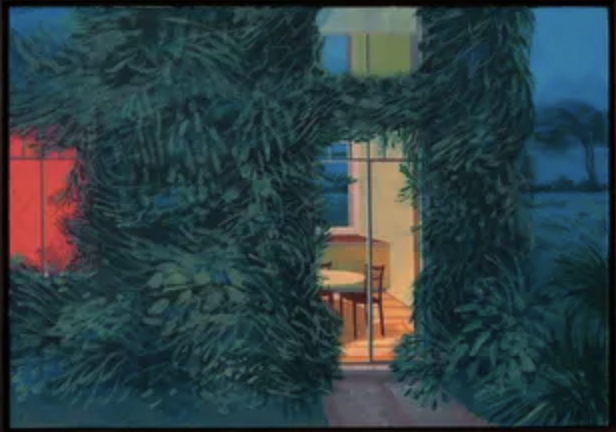
Alfie Caine, Night Kitchen, 2021. Image: © UNION Gallery
Get a price range in about 60 seconds.
Then, if the range and strategy feel right, request purchase offers within 48 hours with 0% seller fee (where eligible).
No pressure, no theatre—just a clear read on how your Caine fits the market that actually exists.
References
[1] Artsy Editorial — “In Alfie Caine’s Paintings, Dreamy Interiors Meet Surreal Landscapes” (published 3 March 2025).
[2] MASSIMODECARLO — Rivers and Rooftops press release (London, 20 November 2025–10 January 2026).
[3] UNION Gallery — What Lies Beyond: Alfie Caine press release text (13 November–18 December 2021).
[4] Margot Samel — The Chalk Carver’s House exhibition page and statement (14 February–15 March 2025).
[5] Phillips Editorial — “Seven Artists on a Hot Streak” (mentions Caine’s auction debut framing and background).
[6] Whitechapel Gallery — Press release: “Whitechapel Gallery Art Icon Auction 2023” (Art Icon programme + Phillips hosting).
[7] Cob Gallery — Independent Art Fair New York presentation page (Alfie Caine & James Shaw).