
The risk of burning an artwork or a collection
In the art market, few concepts are as poorly understood, and as financially damaging, as the idea of a work being “burned”. Collectors often encounter the term only after the damage has been done: a sale attempt fails, interest evaporates, and suddenly an artwork that once felt liquid becomes difficult to place at almost any price. Burning an artwork is not about quality. It is about exposure, timing, and structure. Understanding this risk is essential for anyone considering selling or deaccessioning art.
What does it mean to “burn” an artwork?
An artwork is considered “burned” when it is publicly offered to the market and fails to sell at the expected price. This usually happens through a high-visibility channel such as an auction or widely marketed public sale. When the work does not find a buyer, the outcome becomes part of the artwork’s market history. In a market driven as much by perception as by fundamentals, that failure rarely disappears. Buyers remember. So do advisors, dealers, and auction specialists.
Why failed exposure is so damaging
Art markets do not reset after each attempt. Once a work has been publicly offered, it creates a reference point. If the market rejects that reference, future negotiations begin from a position of weakness.
Buyers anchor to the failure. They assume there is a problem, price, quality, condition, or liquidity pressure, even when none exists. As a result, several consequences tend to follow in a predictable sequence.
Price expectations are revised downward, not only by potential buyers but also by advisors and intermediaries, who begin to frame the work as having missed its moment or failed to meet market expectations. Negotiating power shifts decisively away from the seller, as buyers feel justified in pushing for discounts, extended terms, or additional concessions, assuming the seller has limited alternatives. Time to liquidity increases dramatically, turning what may have been a straightforward transaction into a prolonged process measured in months or even years rather than weeks. In some cases, the damage can persist for years.
How collections get burned, not just individual works
The risk is not limited to single artworks. When multiple works from the same collection are offered unsuccessfully, the issue compounds. The market begins to associate the entire collection, or even the collector, with distress or overexposure.
This can affect future sale outcomes across the collection, the willingness of top-tier buyers to engage, and perceived urgency, even when none exists. What began as a rational attempt to sell can quickly become a reputational problem. This is why HNWIs, large collectors, and estates have started working and consigning with Artscapy.
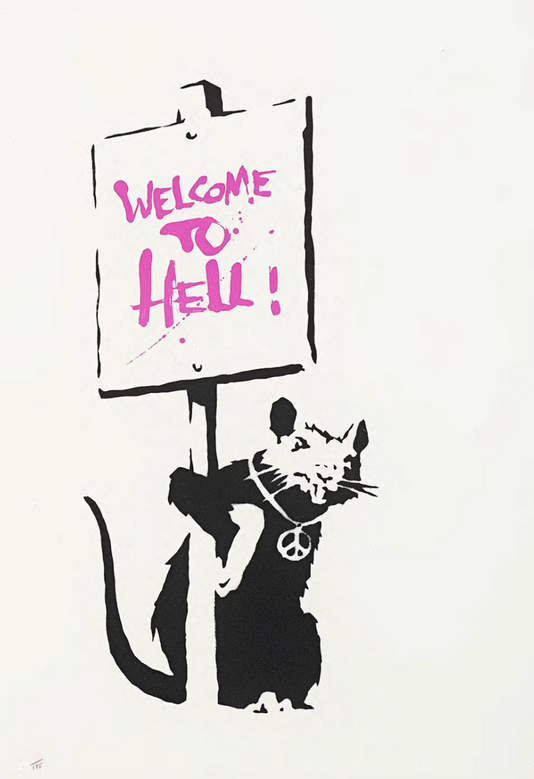
Banksy, Welcome To Hell (Pink) 2004
Common paths to burning art
Most burned works are not the result of poor judgement, but of structural missteps. Typical scenarios include pricing based on headline auction results rather than net seller outcomes; selecting a public channel by default rather than by strategy; accepting optimistic guidance unsupported by data; or exposing a work too quickly without testing private demand.
In each case, the underlying issue is the same: exposure happens before alignment.
Why auctions amplify the risk
Auctions are powerful tools, but unforgiving ones. They offer visibility, not flexibility. Once a catalogue is printed and estimates are published, the outcome becomes public record.
If bidding falls short, the failure is immediate and widely visible. Even if the work is later placed privately, the market remembers the unsuccessful attempt. For high-value works and private collections, this visibility can be particularly costly.
How to reduce the risk
Avoiding the risk of burning an artwork requires discipline. It means resisting urgency, questioning optimistic narratives, and insisting on data before exposure. Critically, it means separating pricing analysis from sales execution.
A credible market estimate should come first. Only then should timing and channel be chosen.
A controlled alternative
At Artscapy, preventing burn risk is a core principle of the sales process. Each artwork is assessed using AI-powered market estimates grounded in real transaction data. This establishes a realistic price range before any market exposure.
From there, the optimal strategy is defined. In many cases, artworks are placed privately into other collections, avoiding public failure altogether. When auctions are used, they are selected selectively, with timing, estimates, and terms carefully aligned to market conditions.
No work is exposed without a clear rationale, and no exposure happens by default.
Protecting long-term value
Art is a long-term asset, even when liquidity is required. Selling should not compromise future value simply to achieve speed.
By approaching deaccessioning as a structured process rather than a single event, collectors can protect both price and reputation. Because in the art market, the greatest risk is not waiting, it is being seen to fail.